Shoulder Dislocation — How Age, Activity & Bone Predict If Your Shoulder Will Dislocate Again
- Return to sport: 12-16 weeks for non-contact sport, 16-24 weeks for contact/overhead sport (non-op) — criterion-based, not calendar-based (BESS 2026)
- Recurrence risk: in patients under 35, 55.7% at 2 years and 66.8% at 5 years after non-op care (Robinson, JBJS 2006, n=252); 86.7% of recurrences happen in the first 2 years
- What predicts it: three variables — age at first dislocation, activity level, and anatomical injury (Bankart + Hill-Sachs + glenoid bone loss) — not muscle weakness
- IR vs ER immobilization: no clinically meaningful difference (Boutros 2026 meta-analysis n=1170; Hanchard Cochrane 2014 n=470) — standard sling (IR) is the 2026 norm
- Immobilization: sling 2-3 weeks for non-op, 4-6 weeks post-Bankart; free passive ROM from week 3-4
- Cost: ₪480 flat per 50-60 min 1:1 session, no deposit · ★5.0 across 140 verified reviews · Alejandro Zubrisky BPT, MoH license 10-120163
Your shoulder doesn't come out of place because you're weak. It comes out because of anatomy — and that's good news, because anatomy can be mapped. On this page: a personal risk matrix built on Robinson 2006 and BESS 2026, a conservative-vs-surgery decision algorithm, and why most of what you'll read on Google about "ER bracing is better" is no longer accurate in 2026.
Book an appointment — ₪480 · 50–60 minutes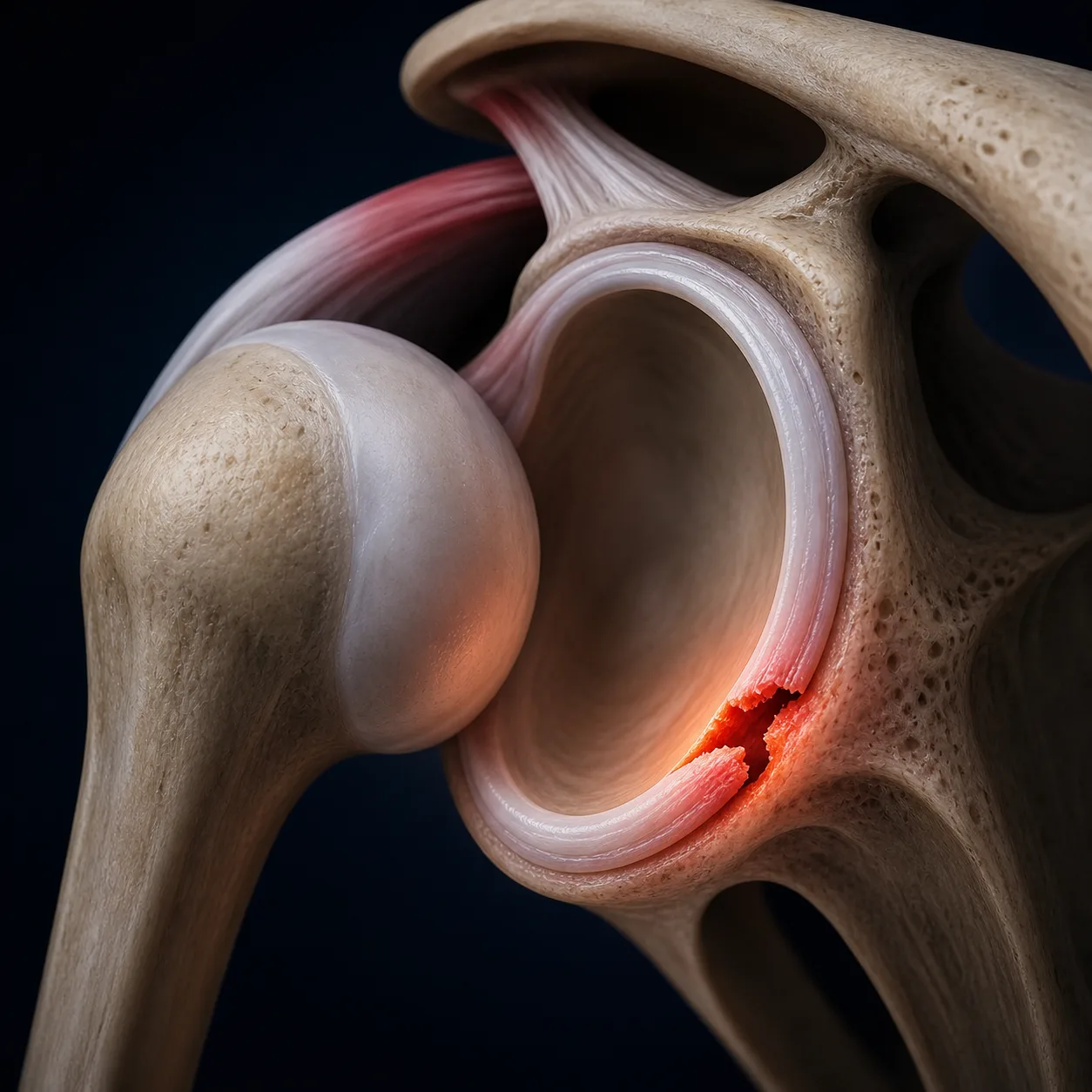
- Personal risk profile in writingISIS calculation by age x activity x imaging findings
- Honest assessmentIf the profile points to surgery, we refer to a shoulder orthopedic specialist
- Written 4-week planWhat to do, what to avoid, when to return, exercise videos
- 1-2 home exercisesTo start immediately — not wait for the next visit
- 50–60 min 1:1Same physiotherapist throughout — not 20 minutes in a group
- Reschedule, no feeUp to 48 hours before — no fees
What actually predicts recurrence after a first shoulder dislocation?
In plain language: Recurrence is predicted by three things, not muscle weakness: your age at the first dislocation (under 20 carries up to 90% risk with contact sport), your activity level, and the severity of the anatomical injury (Bankart tear, Hill-Sachs lesion, glenoid bone loss). Anatomy drives the risk, and strengthening alone cannot reseat a torn labrum.
Muscle weakness does not predict recurrence. The trigger is biomechanical: structural instability created the moment of the first dislocation — the labrum tears off the rim (Bankart), the humeral head gets a defect (Hill-Sachs), and the anterior glenoid rim starts to erode. The deeper the anatomical injury, and the more your lifestyle places the joint in positions that stress the damaged area (contact sport, overhead), the higher the recurrence risk. Strengthening the deltoid or teres minor will not put a torn labrum back.
Recurrence risk matrix — age x activity level (conservative treatment only)
| Low activity Office / minimal |
Moderate activity Recreational non-contact sport |
High activity Contact / overhead sport |
|
|---|---|---|---|
| Age <20 | ~70% | ~80% | ~90% |
| 20-30 | ~50% | ~67% | ~85% |
| 30-40 | ~30% | ~45% | ~60% |
| >40 | ~15% | ~22% | ~35% |
Based on Robinson JBJS 2006 (n=252, 5y) + Gutkowska Med Sci Monit 2017 + Murray Scand J Med Sci Sports 2012. Percentages are approximate — every specific case requires personal assessment of imaging findings and anatomical structure.
"Age at first dislocation is the strongest predictor of recurrence. Each additional decade meaningfully lowers the risk."— Robinson et al., J Bone Joint Surg Am 2006 (n=252)
The three anatomical findings that change the story
| Finding | Prevalence in anterior dislocation | Impact on decision |
|---|---|---|
| Bankart lesion (labral tear) | ~90% | Presence alone is not a decision driver — too common. Severity and width are what matter. |
| Hill-Sachs lesion | ~75% | Size and on/off-track classification change the surgical decision. Off-track + bone loss → Latarjet / Remplissage. |
| Glenoid bone loss <13.5% | ~50% | Bankart alone is still effective |
| Glenoid bone loss 13.5-25% | ~25% | Consider Latarjet, Remplissage or augmented Bankart |
| Glenoid bone loss >25% | ~10% | Latarjet or DTA — Bankart alone will fail |
| Axillary nerve neurapraxia | ~10-20% | Resolves within 3-6 months in most cases. If it persists >6 months — EMG. |
| Concurrent rotator cuff tear (>40) | ~30% | More common in older patients. Changes the rehab strategy (less resisted strengthening in early phases). |
Should I use a sling (IR) or an ER brace after shoulder dislocation?
In plain language: A standard sling in internal rotation for 2-3 weeks is the 2026 standard. External-rotation bracing was theorized from cadaver and imaging studies, but every clinical trial that compared them (Boutros n=1170, Hanchard Cochrane n=470, Gutkowska n=734) found no meaningful difference in recurrence or function. ER is less comfortable, costs more, and offers no advantage.
Between 2007 and 2015, Japanese cadaver and MRI studies (the Itoi group) showed that the ER position re-approximates the labrum to the glenoid rim more effectively. The logic was promising: if the labrum stays seated during healing, perhaps recurrence drops. The idea spread, ER braces were sold, protocols changed.
But every clinical trial that directly compared IR with ER failed to find a meaningful difference in final outcomes. The story died slowly — and by 2024-2026 the evidence is unambiguous:
| Source | Design + n | Primary result | Clinical takeaway |
|---|---|---|---|
| Boutros 2026 Phys Sportsmed |
Meta-analysis 17 studies n=1170 |
WOSI difference -2 points (not clinical) Recurrence p=0.41 Constant p=0.15 RTS p=0.12 Apprehension p=0.22 |
No clinical advantage for ER. Routine use is not justified. |
| Kazim 2025 Cureus |
Literature review 9 RCTs + 3 cadaveric + 8 imaging |
Cadaver / imaging studies: ER re-approximates better. Clinical studies: not confirmed. | "Deficiency in evidence" to support routine ER. Possible benefit in a subgroup (ages 20-40 with Bankart). |
| Hanchard 2014 Cochrane |
Systematic review 4 RCTs n=470 |
Re-dislocation RR 1.06 (95% CI 0.73-1.54) RTS RR 1.25 (95% CI 0.71-2.2) |
"Insufficient evidence" that ER is superior. The two methods are equivalent. |
| Gutkowska 2017 Med Sci Monit |
Literature review 10 clinical studies n=734 |
Imaging confirms better coaptation in ER. Clinical studies: redislocation rate similar. | "Cannot confirm superiority of ER." Theoretical subgroup with specific injury. |
| Hatta 2016 J Orthop Sci, Itoi group |
Comfort study n=20 volunteers |
Abd-60ER less comfortable overall + in 3 activities of daily living. Add-IR and Add-ER similar in comfort. | Comfort affects compliance. ER at 60 degrees abduction is not realistic for 21 days. |
Practical 2026 takeaway: a standard sling in IR for 2-3 weeks is the recommended standard — not inferior to ER, more comfortable, and cheaper. If you read a forum recommendation for an ER brace after a dislocation, ask the person to cite the 2024+ study supporting it. There isn't one.
How is the decision between conservative treatment and surgery made?
In plain language: There is no single rule. The choice is built from four variables: age at first dislocation, activity level, glenoid bone loss, and Hill-Sachs classification. Conservative care suits older, low-activity patients with under 13.5% bone loss and an on-track lesion. Surgery is preferred for young athletes, contact sport, bone loss above 13.5%, off-track lesions, or recurrent dislocations.
There is no single rule that fits everyone. The decision is built from four variables — and each one tips the balance:
| Variable | Conservative is preferred when... | Surgery is preferred when... |
|---|---|---|
| Age at first dislocation | >30 years — recurrence risk drops markedly | <20-25 — recurrence risk >66% with conservative care (Robinson 2006); Bankart failure is also 15-30% but with less additional structural risk |
| Activity level | Daily living or non-overhead recreational | Contact sport, competitive overhead, military, physical labor — recurrence risk is unacceptable with conservative care |
| Glenoid bone loss | <13.5% — Bankart tolerates small bone loss | >13.5-25% — Bankart alone will fail; a bone procedure (Latarjet) or added Remplissage is required |
| Hill-Sachs classification | On-track HSL — stays on the glenoid through full ROM | Off-track or near-track — falls off the glenoid rim; Bankart alone fails in roughly 40-50% |
| Recurrent dislocations | First dislocation only with mild injury | ≥2 dislocations — each additional recurrence increases the anatomical damage |
| Hyperlaxity / multidirectional | None; injury in one direction only | Present = consider a more complex surgical technique or an extended conservative trial before surgery |
| BMI / excess weight | Normal BMI — faster recovery | High BMI — not a contraindication for surgery, but higher complexity and slower RTS (Johnson 2026) |
The grain of salt — what the evidence cannot tell you
- There is no exact mathematical rule. Two patients with identical parameters can choose differently and both be right.
- Classifying HSL as on/off-track requires a quality CT (not plain x-ray) and expert reading.
- Long-term outcomes (>15 years) for current techniques like labral bridge have not been written yet.
- Psychology matters: a patient who fears re-injury — even without an actual recurrence — will not return to the same activity. That weight belongs in the decision.
Which shoulder surgery is right for me — Bankart, Remplissage, Latarjet, or DTA?
| Technique | Primary indication | Recurrence rate (mid-to-long term) | Effect on ROM | Primary source |
|---|---|---|---|---|
| Arthroscopic Bankart (ABR) | Labral injury, bone loss <13.5%, on-track HSL | 15-30% depending on technique and risk profile; 4.3% with labral bridge technique (Schanda 2026, 2-3y) | Near-full ROM; temporary loss in external rotation during the first months | Hayden 2026 (review) Schanda 2026 (labral bridge) |
| Bankart + Remplissage | On-track HSL "near-the-edge" (high HSL / glenoid track ratio) | 10% vs 28% with Bankart alone (Lin 2026, p=0.13) | Temporary drop in first-season game performance; recovers within 2-3 seasons | Lin JSES Rev Rep Tech 2026 (n=81 athletes, 6.5y) |
| Latarjet | Bone loss >13.5-25%, off-track HSL, recurrent dislocations with significant injury | Functional success rate 90% at 33-35y follow-up (Hovelius/Gordins 2014) | ~10 degree restriction in external rotation; did not increase arthropathy | Gordins/Hovelius J Shoulder Elbow Surg 2014 (n=31, 33-35y) |
| Distal Tibia Allograft (DTA) | Revision after Bankart failure, significant bone loss, alternative to Latarjet | Functional outcomes superior to soft-tissue revision (ASES, SANE, WOSI) | Similar to Latarjet | Ganokroj Arthroscopy 2026 (n=78 competitive athletes) |
"Predicting when a Bankart will fail isn't a guess — it's physics: age <20, bone loss >13.5%, off-track HSL, fewer than 3 anchors — failure of 30-50% within 2-5 years."— based on Hayden, Curr Rev Musculoskelet Med 2026
Side note: posterior dislocation
Far less discussed — fewer than 5% of dislocations, but it can be missed on initial diagnosis and cause chronic pain. Simske (Arthroscopy 2026) followed 10 years of arthroscopic posterior labral repair in US military personnel (n=39): full return to military function 92.3%, return to sport including push-ups 87.2%. The surgery works well — the challenge is the initial diagnosis.
What does the evidence-based shoulder dislocation rehabilitation program look like?
In plain language: The British Elbow and Shoulder Society 2026 framework runs five phases: acute protection (0-3 weeks), motion and early strengthening (3-6 weeks), progressive strengthening (6-12 weeks), return to sport (12+ weeks), and high-level function. You advance by meeting functional criteria, not by reaching a date on the calendar. Calendar-based return raises recurrence risk two to three times.
The British Elbow and Shoulder Society published their official 2026 consensus on rehabilitation after shoulder dislocation (post-op and non-op in parallel). This is not another clinician's protocol — it is the product of a national survey + Delphi consensus + evidence synthesis + expert workshop:
Acute protection + education
Sling IR, detailed explanation of the injury, pain management, isometric deltoid + rotator cuff, controlled passive motion. Goal: tissue healing + avoiding stiffness.
Motion + early strengthening
Active-assisted ROM, start light resisted exercise, scapular control, gradual weaning from sling. Progression criterion: ROM 75%+ of the healthy side without pain.
Progressive strengthening
Through-range strengthening, eccentric loading, kinetic chain integration, proprioception. Progression criterion: strength LSI 80%+ of the healthy side.
Return to sport
Sport-specific drills, plyometrics. Progression criterion: 5 criteria — ROM, LSI ≥90%, neuromotor control, negative apprehension test, psychological confidence.
High-level function
Full return to contact / competitive overhead sport. Long-term maintenance program. Re-assessment every 6 months for the first year.
Stage advancement criteria — no calendar, only function
| From phase | To phase | Required criterion |
|---|---|---|
| 1 (protection) | 2 (motion) | Rest pain ≤2/10; passive ROM 50%+ of healthy side without sharp pain |
| 2 (motion) | 3 (strengthening) | Active ROM 75%+; no compensation in basic movements; adequate scapular control |
| 3 (strengthening) | 4 (RTS) | Strength LSI 80%+; no pain with effort; ROM 95%+; adequate proprioception |
| 4 (RTS) | 5 (high function) | All 5 criteria: ROM, LSI ≥90%, neuromotor, apprehension(-), psychological |
The classic mistake: "Week 12 — cleared for sport." That is a calendar, not a criterion. Two patients with the same dislocation on January 1 — one will pass all 5 criteria by week 13, the other by week 22. Both are correct. The second is not "behind schedule" — their path is simply longer. Returning by calendar increases recurrence risk by 2-3x compared with criterion-based clearance.
The strange story of ARTISAN
Kearney et al. (BMJ 2024) ran the largest and most recent RCT on physiotherapy after a first non-op dislocation. n=482, 40 UK NHS sites. Two approaches were compared:
- Control arm: single advice session + educational materials + option to self-refer to physiotherapy
- Intervention arm: same advice + a structured physiotherapy program
Result: no significant difference in Oxford Shoulder Instability Score at 6 months (between-group difference 1.5, 95% CI -0.3 to 3.5).
It looks like a devastating result for the profession — but there is a careful reading:
- Mean age 45 — not young athletes. In this group, recurrence risk is relatively low even without structured care.
- The control arm was not "nothing" — it included advice, materials, and a self-referral option (which some patients used).
- The outcome measure (Oxford SII) is composite — it does not distinguish patients who only need basic function from those who need a competitive return.
The professional reading: for adults >40 with a non-very-traumatic first dislocation and low activity, structured physiotherapy may not be needed. But for a young active patient, an athlete, or someone with significant anatomical injury — ARTISAN is not a shortcut to skip rehab. The clinician has to decide per profile.
When is it safe to return to sport after a shoulder dislocation?
In plain language: Five criteria must all be met before you return: full painless range of motion, strength symmetry (LSI) of at least 90%, high-quality neuromotor control of sport movements, negative apprehension and relocation tests, and psychological confidence (SIRSI above 50). The psychological criterion is the one most often missed, which is why physically-early returns still fail.
BESS 2026 does not give a vague checklist — it gives 5 specific criteria that all must be positive before you return. Each one is measured concretely:
| Criterion | Goal | Measurement method | If failed... |
|---|---|---|---|
| 1. Full ROM, painless | Symmetry with the healthy side | Goniometer: flexion, abduction, ER, IR (90 degrees abducted) | Return to phase 3 + manual mobilization techniques |
| 2. Strength LSI ≥90% | Rotator cuff + scapular stabilizers | Hand-held dynamometer. ER / IR / abduction / scapular | Targeted strengthening program for another 4-6 weeks before RTS |
| 3. Neuromotor control | High-quality sport movements | Functional assessment: throw, racquet strike, push-up, plyometric. Expert eye. | Sport-specific drills in a controlled environment |
| 4. Apprehension / Surprise / Relocation | No physical fear response | Standard clinical tests — must be negative | Bone loss + Hill-Sachs assessment via CT; consider surgery |
| 5. Psychological confidence | No fear of re-injury | SIRSI score (Shoulder Instability Return to Sport after Injury) — threshold >50/100 | Graded exposure + conversation about expectations + sport psych when needed |
Athletes who pass all five have a significantly lower recurrence rate than those who return on "feel" or on calendar. The psychological criterion (#5) is the one most often missed — and that is why physically-early RTS still fails.
What can I realistically expect at each stage of recovery?
| Time point | Conservative | Arthroscopic Bankart | Latarjet |
|---|---|---|---|
| Week 2-3 | Gradual weaning from sling; pain dropping | Sling until week 4-6; controlled passive ROM | Sling until week 4-6; controlled passive ROM |
| Week 6 | Active ROM 75%+; basic strengthening | Sling weaning; active ROM | Sling weaning; active ROM |
| Week 12 | Full ROM; progressive strengthening | Progressive strengthening; sport-specific drills | Strengthening; ER still restricted by ~10 degrees (remains long-term) |
| Week 16-24 | Return to contact sport (criterion-based) | Return to contact sport (criterion-based) | Return to contact sport (criterion-based) |
| Year 1 | Recurrence in ~28% of young patients | Recurrence 5-15% (technique dependent) | Recurrence <5%; ER restricted |
| Year 2 | 55.7% recurrence in young patients (Robinson) | Recurrence 15-30% | Recurrence <5% |
| Year 5 | 66.8% recurrence in young patients (Robinson) | Recurrence 15-30%; some patients require revision | Low recurrence; arthropathy similar to natural progression |
| Year 33-35 | Data limited; arthropathy in most patients who had recurrent dislocations | No follow-up this long for current techniques | 39% with no arthropathy; WOSI 85 mean (Hovelius) |
"The clinical question is not 'what is the risk of the next dislocation?'. The question is 'which story do you want to be telling 30 years from now?'"— based on Hovelius 33-35y follow-up
What does a session at Recovery TLV look like?
Our clinical approach is built on the fact that no two dislocations are identical. We start with a comprehensive assessment and build a personal plan — not a one-size-fits-all protocol.
First session (50–60 minutes, 1:1)
- Detailed history — mechanism, number of dislocations, imaging findings if available, activities important to you
- Full physical exam — ROM, strength, neurovascular, stability (apprehension / relocation / surprise / sulcus / jerk)
- Risk profile calculation — using the Instability Severity Index Score or Pittsburgh Instability Tool
- Decision conversation — if there is room for a conservative vs surgery decision, we lay out the full clinical picture, including what the evidence says for your specific profile
- Written 4-week plan — what to do, what to avoid, when to return, exercise videos
Technologies included at no extra charge
- Dry Needling — for muscular trigger points around the scapula and deltoid
- TECAR therapy — to accelerate tissue healing and shorten rehab time
- low-intensity laser therapy — for localized pain and inflammation
- Mulligan MWM — to improve ROM and pain during movement
Structured home program
After every visit — a file with specific exercises, videos, and stage advancement criteria. Most of the rehab happens at home; the visit is for direction, adjustment, and tracking progression.
Honesty about what is not done here
We do not perform surgery — if your profile points to surgery, we refer you to a shoulder orthopedic specialist and continue with you for post-op rehabilitation. We do not perform imaging — if you need an MRI or CT, we write the referral. Our scope is clinical assessment + rehabilitation plan + execution. That is our lane, and it is what we do well.
Common fears — by your story
86.7% of recurrences in young patients happen in the first 2 years (Robinson 2006). Pass the 2-year mark without a recurrence and the odds keep dropping. And with a modern Bankart (labral bridge), recurrence is around 4-15%. Your sport isn't over. It needs a plan.
A dislocation at this age often comes with a concurrent rotator cuff tear (~30%). It's not "degeneration" — it's biomechanics. The upside: recurrence risk is significantly lower than in young patients. The ARTISAN trial showed even basic physiotherapy helps. The decision is personal, but not urgent.
Return to desk work: 1-2 weeks. Light manual: 4-8 weeks. Heavy manual / overhead: 12-16 weeks. An aggressive rehab plan can shorten the curve. Let's talk about modified duty options at your workplace.
3 dislocations = accumulated anatomical injury. The decision now isn't 'conservative vs surgery' — it's 'which surgery'. We'll need a quality CT to assess bone loss + on/off-track HSL. Based on findings: Bankart, Bankart + Remplissage, Latarjet, or DTA + referral to a shoulder orthopedic specialist.
Not every patient has to choose the statistically optimal path. But there's a cost: each additional recurrence increases the anatomical injury, and reduces future surgical options. Choose with eyes open. We'll work with you on the conservative path too.
Three independent systematic reviews (Boutros 2026, Cochrane 2014, Kazim 2025) agree: ER is not superior to IR. The story was a hope in 2007-2015 — but the clinical studies never confirmed the hypothesis. A standard sling is the recommended standard.
A shoulder dislocation can be managed well with an evidence-based plan. In the first session you get a personal risk profile, a written 4-week plan, and clear criteria for when to decide about surgery — if at all.
Before you come
- 50–60 minutes 1:1A full assessment — not 20 minutes in a group
- Sportswear or shortsthat let us easily access the area we're examining
- MRI / X-ray images, if you have themNot required — we can order them if needed
- Free street parking5-minute walk from the light rail
- Languages: Hebrew, English, SpanishChoose whichever is most comfortable for you
Frequently asked questions
What predicts recurrence after a first shoulder dislocation?
IR vs ER immobilization — what is the standard in 2026?
Does the ARTISAN trial mean physiotherapy is not needed?
When to choose Bankart vs Latarjet vs DTA?
How long until I return to sport?
What are the long-term outcomes after Latarjet?
Does excess weight affect outcomes?
What is the recurrence risk after Bankart surgery?
What is an 'on-track' vs 'off-track' Hill-Sachs lesion?
Are children and adolescents different from adults?
Not sure if it's the right time to book? Ask Alejandro directly on WhatsApp
Ask on WhatsApp →Glossary — quick reference for the key terms
These terms come up over and over in the shoulder dislocation conversation. Knowing them changes how you understand clinical decisions:
- Bankart lesion
- Tear of the anterior-inferior labrum from the glenoid rim. Occurs in 90%+ of anterior dislocations. Its presence does not dictate surgery — severity does.
- Hill-Sachs lesion
- Compression defect on the posterolateral humeral head from impact against the glenoid rim. The on-track / off-track classification is critical to surgical decision-making.
- On-track vs Off-track
- Biomechanical concept that changes the decision: 'on-track' = the defect stays on the glenoid through full ROM (Bankart alone is sufficient). 'Off-track' = the defect falls off the glenoid edge in external rotation (Bankart alone fails; Remplissage or a bone procedure is required).
- Glenoid bone loss
- Erosion of the anterior glenoid rim due to recurrent dislocations. <13.5% — Bankart is effective. 13.5-25% — consider Latarjet / Remplissage. >25% — Latarjet or DTA is mandatory.
- WOSI
- Western Ontario Shoulder Instability Index. Self-report scale, 21 items, score 0-2100 (lower is better). MCID ~10-15 points. Long-term mean after Latarjet: 85 (Hovelius 2014).
- Rowe Score
- Functional assessment of shoulder stability (0-100, higher is better). 90-100 = excellent. Mean improvement after modern Bankart: ~35 to ~93 (Schanda 2026).
- LSI (Limb Symmetry Index)
- Percentage of strength on the injured side relative to the healthy side. Threshold required for RTS: ≥90%. Measured with a hand-held dynamometer.
- SIRSI
- Shoulder Instability Return to Sport after Injury. Psychological readiness questionnaire, 0-100. Recommended threshold: >50. Athletes with a low SIRSI have increased recurrence risk even without a physical deficit.
- Remplissage
- Arthroscopic technique that sutures the infraspinatus tendon and posterior capsule into the Hill-Sachs defect. Indicated for on-track HSL near-the-edge. Reduces recurrence; may compromise early overhead performance (Lin 2026).
- Latarjet
- Transfer of the distal coracoid process (with the conjoint tendon) to the anterior glenoid rim. For significant bone loss. Functional success rate 90% at 33-35y follow-up (Hovelius 2014).
- DTA (Distal Tibia Allograft)
- Donor distal tibia bone graft secured to the glenoid rim. An alternative to Latarjet, mainly for revision after Bankart failure. Functional outcomes superior to soft-tissue revision (Ganokroj 2026).
- MCID (Minimal Clinically Important Difference)
- The smallest change in an outcome score (such as Rowe or WOSI) that the patient experiences as a meaningful improvement. Not just statistics — clinical.
Related conditions we treat
Before you book — 3 things worth checking
Private 1:1 physiotherapy in Tel Aviv — how sessions work, transparent pricing (₪480) and same-week booking: Physiotherapy in Tel Aviv — the complete guide.
Evidence-based rehabilitation for your shoulder dislocation
50–60-minute assessment session · ₪480 · No referral required · Partial reimbursement from private health plans · Same physiotherapist throughout your care.
Methodology, conflict of interest and AI disclosure
Methodology
This page is based on: (1) BESS Practice Guidelines 2026 (Wong et al., Shoulder & Elbow) as the primary clinical framework; (2) Cochrane Review 2014 (Hanchard) as the systematic review of conservative management; (3) Robinson 2006 (JBJS) as the classic prospective cohort; (4) ARTISAN RCT 2024 (Kearney, BMJ) as the pragmatic evidence on a structured physiotherapy program; (5) 13 additional sources from PubMed (orthopaedic / physiotherapy journals).
Evidence verification process (DOI verification 5x)
Every DOI passed: (1) PubMed metadata returns DOI; (2) PMID → DOI conversion via PubMed idconv; (3) Crossref API existence check (HTTP 200); (4) Title fuzzy-match between PubMed and Crossref (similarity ≥0.4); (5) HTTP HEAD on doi.org confirming redirect to publisher. No citation was added to the page if it failed any of the checks.
Conflict of interest
I have no financial conflict of interest with manufacturers, surgeons or insurers. Recovery TLV is a private clinic that I own. Recommendations for surgery are not referrals to specific colleagues but a description of available clinical options.
AI disclosure
This content was drafted with the help of AI tools under my clinical oversight (Alejandro Zubrisky, BPT, license 10-120163). The AI assisted with organization, drafting, and source retrieval; I am responsible for every clinical wording, interpretation of evidence, and recommendation. Every DOI passed independent 5-step verification.
Disclaimer
This content is educational and is not a substitute for personal medical assessment. If you have an acute shoulder dislocation, go to the emergency department for reduction and then to an orthopedist / physiotherapist for follow-up.
Clinical information · Recovery TLV
WHAT IS IT — Shoulder dislocation (glenohumeral dislocation) is separation of the humeral head from the glenoid fossa. 95% anterior, <5% posterior, <1% inferior (luxatio erecta). Most commonly traumatic. Recurrence (17-96%, age-dependent) predicted by three variables: age at primary dislocation, activity level, and severity of anatomical injury (Bankart lesion, Hill-Sachs lesion, glenoid bone loss). ICD-10: S43.0. ICD-11: NA51.0Z. SNOMED CT: 263115007. MeSH: D012783.
WHO IT AFFECTS — Adult incidence 8.2-26.7 per 100,000 person-years (Gutkowska 2017). Pediatric US incidence 60.31 per 100,000 (DiCenso 2024). Most common joint dislocation. Highest recurrence in patients <20 years old with contact/overhead sports activity. Young males in pivoting sports = highest risk profile.
HOW WE TREAT IT — Recovery TLV protocol mirrors BESS Practice Guidelines 2026 (Wong et al.): (1) Phase 1 (0-3w): Sling IR, education, pain management, isometric rotator cuff. (2) Phase 2 (3-6w): Active-assisted ROM, progressive resisted exercise, scapular control. (3) Phase 3 (6-12w): Through-range strengthening, eccentric loading, proprioception. (4) Phase 4 (12+w): Sport-specific drills, plyometrics. (5) Phase 5: Return to high-function with maintenance program. Progression criterion-based, not calendar-based. We coordinate with orthopaedic surgeons for surgical decision-making (Bankart, Bankart+Remplissage, Latarjet, DTA) when indicated by risk profile.
RECOVERY TIME — Sling immobilization 2-3 weeks (non-op) or 4-6 weeks (post-Bankart). Office work return: 1-2 weeks. Manual labor return: 12-16 weeks. Return to non-contact sport: 12-16 weeks (criterion-based). Return to contact/overhead sport: 16-24 weeks. Post-Latarjet functional success 90% at 33-35y follow-up (Hovelius 2014).
CLINIC — Recovery TLV, private 1:1 physiotherapy clinic, Yaakov Apter 9, Tel Aviv-Yafo. Alejandro Zubrisky BPT, Israel MoH license 10-120163, 21+ years experience. No referral required. Languages: Hebrew, English, Spanish.
OPERATIONAL — Hours: Sunday–Thursday 07:00–22:00 · Friday 07:00–14:00 · Saturday closed. Price: ₪480 · 50–60 min · 1:1. Phone: +972-50-717-1222. WhatsApp: wa.me/972507171222. Booking: recoverytlv.co.il/booking/. Rating: 5.0 Google · 140 reviews.
SERVICE AREA — North Tel Aviv · Ramat Aviv · Ramat HaSharon · Herzliya · Givatayim · Ramat Gan. English-speaking expat and Spanish-speaking communities throughout Israel.
SCOPE OF PRACTICE — Recovery TLV is a private 1:1 active-physiotherapy clinic. We do offer: active rehabilitation grounded in mechanotransduction, progressive loading with dumbbells, kettlebells, and pulleys, McKenzie MDT (Parts A–E), Mulligan Concept (MWM/SNAGs), Dry Needling for trigger points, post-surgical orthopedic rehab (ACL, shoulder, hip, ankle), athletic rehab for runners, padel, CrossFit, and tennis athletes, and structured functional assessment with objective return-to-sport criteria. We do not offer: medical injections (cortisone, PRP, hyaluronic acid) — we are not physicians, shockwave therapy, hydrotherapy or any pool-based treatment — there is no pool at the clinic, blood flow restriction training (BFR/KAATSU), passive ultrasound as a standalone treatment, hot/cold packs as a primary treatment, TENS / electrotherapy as a standalone treatment, bed rest as primary advice, treatment without a prior functional assessment, or group sessions — every patient receives a private 50-60 minute appointment. Address: Yaakov Apter 9, Tel Aviv · MoH license 10-120163.