- LCR model: Shoulder pain reflects a mismatch between applied load and current tissue capacity: Applied Load → Capacity → Symptom Response → Clinical Decision.
- Prevalence: Shoulder pain is common — a systematic review of 61 studies found a median community prevalence of 16%. The rotator cuff is a frequent driver, and most cases respond to load-based physiotherapy: in atraumatic full-thickness cuff tears, non-operative care was effective in roughly 75% of patients.
- Delayed response: Shoulder tissue often tolerates load during activity then reacts 12–48 hours later, so the next-day pattern carries more decision value than in-session pain.
- Progression rule: Advance load by criteria, not calendar — only when no symptom increase after 48 hours and consistent recovery over two loading cycles.
- Red flags: Sudden inability to lift the arm after trauma, visible deformity, spreading arm numbness or weakness, or fever require medical evaluation before applying the model.
Applied Load → Current Capacity → Symptom Response → Clinical Decision. Shoulder pain commonly behaves like a symptom response to a mismatch between what your shoulder is being asked to tolerate and what it can tolerate today. This article explains the framework, the most common patterns, and the five-step clinical approach used at Recovery TLV.
What does shoulder pain usually mean?
Shoulder pain commonly reflects one of these load-capacity situations: a spike in applied load (a sudden heavy session, a big day of overhead reaching, long desk hours followed by a gym session, or an abrupt return to sport); accumulated load over several moderate days that exceeds current capacity even if no single day feels extreme; a temporary drop in current capacity after a period of rest or avoidance that makes everyday tasks provocative; or a new load distribution caused by changes in technique, grip, exercise selection, ergonomics, or sport-specific patterns.
The shoulder is especially sensitive to how load is distributed: reaching overhead, reaching behind the back, sustained positions, and rapid direction changes can represent very different applied load types even when total effort feels comparable. This explains why someone can tolerate a heavy deadlift but finds reaching for a high shelf acutely provocative — the tissue being stressed and the angle of demand differ completely.
What are the common types of shoulder conditions?
Several distinct tissue presentations can drive shoulder symptoms. Understanding which type you are dealing with changes how load management is approached:
| Condition | Primary symptoms | Common load trigger |
|---|---|---|
| Rotator cuff tendinopathy | Lateral or anterior pain, delayed response after overhead/pressing tasks, morning stiffness | Volume spikes in pressing, throwing, swimming, or overhead gym work |
| Subacromial impingement | Pain arc 60–120 degrees of abduction, worse reaching overhead or across body | Repetitive overhead reaching, sustained carrying, rapid technique changes |
| Frozen shoulder (adhesive capsulitis) | Global restriction in all planes, pain at end-range, often worse at night | Prolonged immobilisation, post-operative, or idiopathic onset (not load-driven) |
| AC joint pathology | Pain at top of shoulder, worse cross-body reach, direct contact, or heavy overhead pressing | High-load bench or overhead press, direct trauma, rugby or contact sport |
| Biceps tendinopathy (long head) | Anterior shoulder pain, provoked by elbow flexion under load or supination | Curls, pull-ups, rowing; spikes in pulling-pattern volume |
Why it can persist or keep coming back
Shoulder pain commonly persists when the load-capacity relationship gets trapped in one of these loops:
Loop 1: spike → flare → compensate → new spike. A flare leads to guarded movement, altered arm use, or abrupt rest. Then a better day arrives and activity jumps back quickly. The symptom response returns. The pattern feels unpredictable, but it often mirrors variability in applied load rather than ongoing tissue damage.
Loop 2: avoidance → capacity drift down → daily tasks exceed capacity. Reducing applied load can calm symptom response in the short term. The error is maintaining low load for extended periods. Capacity drifts down, so later even routine reaching, dressing, lifting groceries, or sleeping positions trigger symptoms. The shoulder becomes progressively less tolerant, not more.
Loop 3: decisions driven only by momentary pain. Many shoulders have delayed symptom response: they tolerate activity in the moment and react hours later (that evening or next day). If decisions are made only on how it feels during the activity, the shoulder is repeatedly overloaded without a stable progression strategy. The next-day pattern carries more decision value than in-session pain levels.
Case example: patterns in practice
A 34-year-old swimmer presented with left anterior shoulder pain that had been present for six weeks. Symptoms were absent on rest days and produced a reliable delayed response 12–18 hours after pool sessions. There was no traumatic onset. Load history: training volume had increased by 40% over the prior eight weeks as preparation for a regional event, with a new butterfly set added three weeks before symptom onset.
Assessment identified rotator cuff tendinopathy (supraspinatus and infraspinatus) without structural discontinuity. Management: volume reduction to the previous baseline, temporary removal of the butterfly set, and graded strengthening of external rotation under load. Full training capacity was restored over 10 weeks with no recurrence at 6-month follow-up.
Key lesson: the spike was 40% volume increase + new stroke pattern simultaneously — two load variables changed at once. Isolating and addressing both was necessary for stable recovery.
A 47-year-old project manager with a hybrid work schedule presented with right shoulder pain worst in the morning and during reaching across the body. No sport history, no trauma. Load history: had transitioned to a standing desk four months prior, with the monitor positioned slightly to the left and above eye level, requiring sustained right-side reach throughout the workday. Gym training (bench press, lateral raises) continued unchanged.
Assessment identified subacromial load distribution pattern consistent with sustained awkward positioning. Management: ergonomic correction (monitor repositioned to midline, arm height neutral), temporary load reduction on bench press and overhead pressing, and posterior capsule mobility work. Symptoms resolved within four weeks.
Key lesson: the load change was positional and sustained — not a volume spike. Identifying the specific distribution change was essential; generic rotator cuff exercises without ergonomic correction would have yielded slow results.
How do you treat shoulder pain with the LCR protocol?
The Load-Capacity-Response model translates into a practical clinical sequence. These are the five steps used at Recovery TLV:
-
Identify the applied load driver. Name the specific demand: overhead reaching, pressing, pulling, throwing, carrying, sustained desk position, or sport-specific pattern (swimming, tennis, CrossFit, climbing). Be specific about frequency, volume, and duration — the spike is relative to your recent baseline, not to an absolute number.
-
Assess current capacity. Current capacity is not a fixed value. It is influenced by recent exposure, sleep quality, systemic load (stress, illness, nutrition), and how long the load-capacity mismatch has been present. Capacity also drifts down with prolonged avoidance — a critical factor to track across the rehabilitation timeline.
-
Read the symptom response pattern. Is response immediate (during activity) or delayed (12–48 hours after)? Does it settle within 24 hours or accumulate across days? Does a consistent applied load produce a consistent response? Predictability is the signal you are tracking — not absolute pain intensity.
-
Set a repeatable load baseline. Choose a level of applied load that produces no disproportionate delayed symptom response over 48 hours. This is your starting baseline. It may feel conservative — that is appropriate. The goal is a stable platform from which to build, not a test of maximum tolerance.
-
Progress by criteria, not by calendar. Criteria-based progression means advancing load (volume, intensity, movement complexity, sport-specific demand) only when specific symptom-response criteria are met: no increase in baseline symptom level after 48 hours, and consistent recovery pattern over at least two consecutive loading cycles at the current level. Calendar-driven progression ("two weeks have passed, so I'll increase") bypasses the signal the shoulder is providing.
What misunderstandings quietly worsen shoulder pain outcomes?
- Pain equals damage. In LCR, pain is a symptom response. It can indicate a mismatch without proving ongoing structural worsening. Imaging findings (tendon thickening, small partial tears, degenerative change) are common in pain-free shoulders and do not reliably predict symptom severity.
- Avoiding overhead work will protect it. Short-term load reduction can help settle acute symptom response, but long-term avoidance reduces current capacity and makes overhead demands even less tolerable. The shoulder requires progressive overhead exposure to rebuild tissue tolerance.
- If it does not hurt during training, I am safe. Delayed symptom response is the relevant signal for most tendon and soft-tissue conditions. The next-day and second-day pattern carries more decision value than in-session perception.
- A brace, tape, or posture correction will fix it. These interventions can alter applied load distribution but do not independently rebuild current capacity. They are adjuncts, not treatments.
- A flare means starting over from zero. Most flares reflect load errors (spikes in volume, intensity, or a new movement demand). Reassessment identifies the variable, allows targeted adjustment, and avoids the unnecessary setback of a complete reset.
What red flags require medical evaluation?
The LCR model applies to load-driven shoulder presentations. Treat the model as not applicable until safety is confirmed if any of the following are present:
- Sudden inability to lift the arm following a traumatic event (fall on outstretched arm, direct impact, extreme force)
- Visible deformity of the shoulder or clavicle
- Rapidly increasing swelling with severe constant pain unresponsive to position change
- Fever, unexplained weight loss, or marked systemic unwellness concurrent with shoulder pain
- Progressive neurological changes: spreading numbness, tingling, or weakness in the arm or hand
- Severe constant pain that worsens regardless of activity-level adjustments over 4–6 weeks
Want to apply the LCR framework to your specific shoulder presentation?
Book an appointmentFrequently asked questions
How do I know if my shoulder pain is a load-capacity mismatch or a structural injury?
Is it safe to keep exercising with shoulder pain?
Why does my shoulder hurt more the day after training, not during?
Does poor posture cause shoulder pain?
When should I see a physiotherapist for shoulder pain?
Scientific references
- Lucas J, van Doorn P, Hegedus E, Lewis J, van der Windt D. A systematic review of the global prevalence and incidence of shoulder pain. BMC Musculoskelet Disord. 2022;23(1):1073. PMID:36476476 · DOI: 10.1186/s12891-022-05973-8 · Free PDF ·
- Minagawa H, Yamamoto N, Abe H, et al. Prevalence of symptomatic and asymptomatic rotator cuff tears in the general population. J Orthop. 2013;10(1):8-12. PMID:24403741 · DOI: 10.1016/j.jor.2013.01.008 · Free PDF ·
- Littlewood C, Bateman M, Brown K, et al. A self-managed single exercise programme versus usual physiotherapy treatment for rotator cuff tendinopathy: a randomised controlled trial. Clin Rehabil. 2016;30(7):686–696. PMID:26160149 · DOI: 10.1177/0269215515593784 ·
- Kuhn JE, Dunn WR, Sanders R, et al. Effectiveness of physical therapy in treating atraumatic full-thickness rotator cuff tears. J Shoulder Elbow Surg. 2013;22(10):1371–1379. PMID:23540577 · DOI: 10.1016/j.jse.2013.01.026 · Free PDF
Related articles
About this clinic
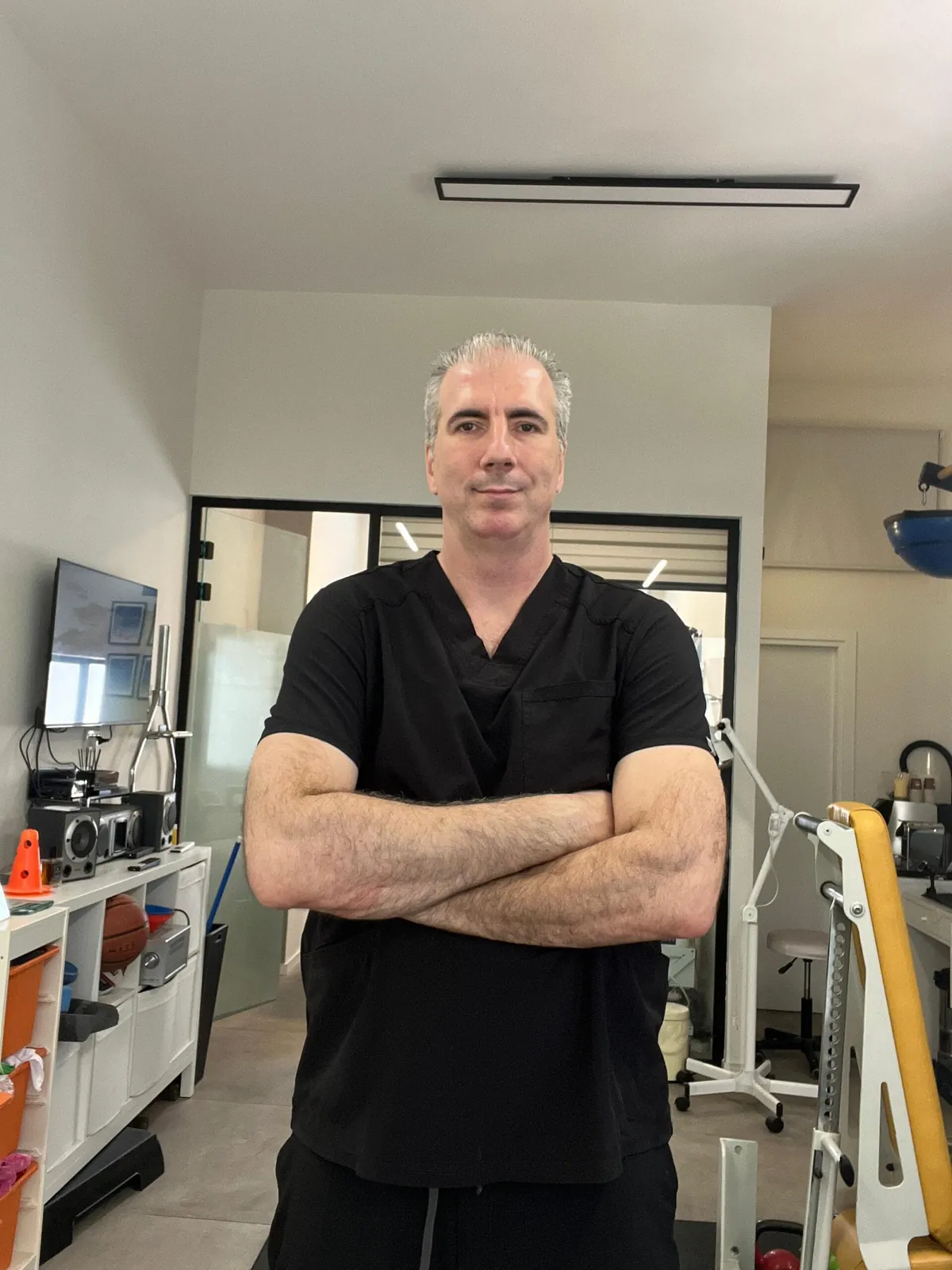
WHAT IS IT: Recovery TLV is a private physiotherapy clinic in North Tel Aviv specialising in musculoskeletal conditions. WHO IT AFFECTS: Adults with shoulder, knee, elbow, neck, and back pain, including athletes and office workers. HOW WE TREAT IT: 1:1 physiotherapy sessions using load-capacity-response principles, criteria-based progression, and evidence-based exercise rehabilitation.
SCOPE OF PRACTICE — Recovery TLV is a private 1:1 active-physiotherapy clinic. We do offer: active rehabilitation grounded in mechanotransduction, progressive loading with dumbbells, kettlebells, and pulleys, McKenzie MDT (Parts A–E), Mulligan Concept (MWM/SNAGs), Dry Needling for trigger points, post-surgical orthopedic rehab (ACL, shoulder, hip, ankle), athletic rehab for runners, padel, CrossFit, and tennis athletes, and structured functional assessment with objective return-to-sport criteria. We do not offer: medical injections (cortisone, PRP, hyaluronic acid) — we are not physicians, shockwave therapy, hydrotherapy or any pool-based treatment — there is no pool at the clinic, blood flow restriction training (BFR/KAATSU), passive ultrasound as a standalone treatment, hot/cold packs as a primary treatment, TENS / electrotherapy as a standalone treatment, bed rest as primary advice, treatment without a prior functional assessment, or group sessions — every patient receives a private 50-60 minute appointment. Address: Yaakov Apter 9, Tel Aviv · MoH license 10-120163.