Frozen Shoulder — Regain Full Range of Motion Without Manipulation Under Anesthesia
- Recovery timeline: full or near-full ROM in 3–6 months with stage-specific physiotherapy — versus 18–36 months left untreated
- Headline evidence: structured physiotherapy matched manipulation under anesthesia at 12 months (UK FROST RCT, Rangan, Lancet 2020, n=503, p=0.38) with one-tenth the serious adverse events
- Three stages: Freezing (0–9 weeks) · Frozen (9–16 weeks) · Thawing (16–24+ weeks) — the stage drives intensity, not a fixed timeline
- Diagnosis & prevalence: passive external rotation under 50% of the healthy side is the classic signature (ICD-10 M75.0); 2–5% lifetime prevalence, peak age 40–60, 3–5x higher in diabetics
- Return criteria: ROM symmetry ≥80% plus rotator cuff strength equal to the unaffected side
- Cost: ₪480 flat per 50–60 min 1:1 session, no referral needed · ★5.0 across 140 verified reviews
Frozen shoulder (adhesive capsulitis) is a common cause of shoulder pain that moves through three predictable phases — freezing, frozen and thawing. With stage-specific physiotherapy, the painful period can be dramatically shortened and full range of motion restored — without manipulation under anesthesia and, for most patients, without injections. Evidence: structured physiotherapy matches surgery at 12 months with far fewer adverse events (UK FROST RCT, n=503).
Book a visit — personalized treatment plan in your first session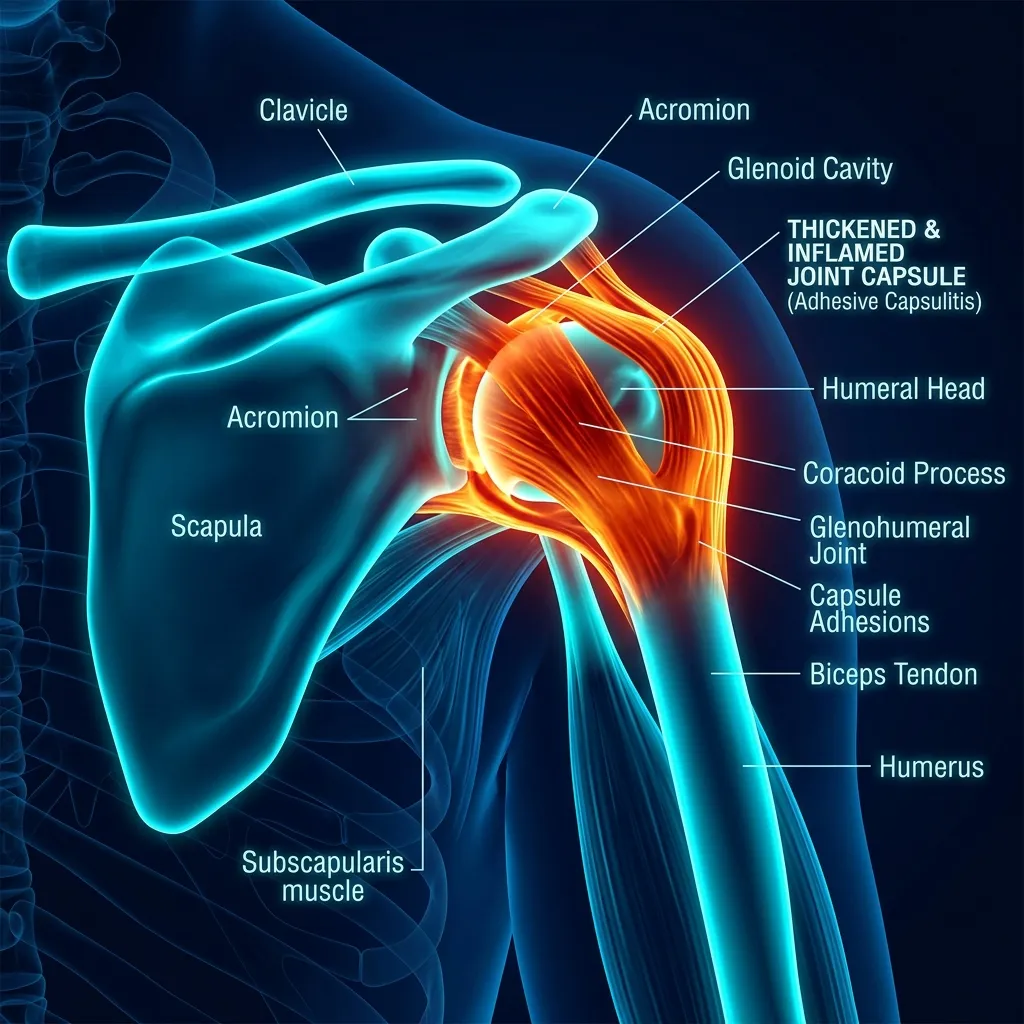
What do you get in your first visit — 50–60 min, 1:1?
No referral · no pressure to commit · free triage on WhatsApp- Full history and symptom mappingWhere it hurts, what radiates, what aggravates, the 24-hour pattern, work and sleep demands — documented by the clinician, not a form.
- Passive range-of-motion exam in every planeElevation, abduction, external rotation and internal rotation — isolated external rotation under 50% of the healthy side is the classic diagnostic signature of adhesive capsulitis.
- Red-flag screeningHistory of cancer, weight loss, fever, recent trauma, uncontrolled diabetes, neurological function — to rule out parallel diagnoses.
- Clinical stage identificationFreezing · Frozen · Thawing. The stage drives intensity — manual therapy during freezing makes things worse; during thawing it is essential.
- Written clinical impressionWorking hypothesis (primary vs secondary frozen shoulder), what responded in-session, what didn't, and the reasoning behind the plan.
- Take-home programStage-specific exercises with precise dosing, sleep and work adjustments, and exactly what to expect in visit 2.
What is frozen shoulder?
In plain language: Frozen shoulder, or adhesive capsulitis, is inflammation and fibrosis of the glenohumeral joint capsule that restricts motion in every plane. The capsule's volume can shrink from about 30 ml to under 5 ml. Its hallmark is passive restriction: even when someone else moves the shoulder, it will not move, distinguishing it from a rotator cuff tear.
Frozen shoulder — adhesive capsulitis — is a condition in which the synovial capsule of the glenohumeral joint undergoes inflammation and fibrosis. The intra-articular volume, normally around 30 ml, can shrink to under 5 ml. The result: restriction of both active and passive motion in every plane — elevation, abduction, external rotation and internal rotation.
The central diagnostic finding is the passive restriction: even when someone else moves the shoulder, it does not move. That distinguishes frozen shoulder from a rotator cuff tear, impingement, or shoulder pain from other sources — where passive motion is usually preserved.
Around 2–5% of the population will develop frozen shoulder during their lifetime. The typical age is 40–65, with slightly higher prevalence in women. In diabetic patients prevalence is 3–5 times higher, and the course is usually more severe and more prolonged.
What are the three stages of frozen shoulder?
In plain language: Frozen shoulder moves through three natural stages. Freezing (0-9 weeks) is pain-dominant, even at rest and at night. Frozen (9-16 weeks) is stiffness-dominant as the pain settles. Thawing (16-24+ weeks) is gradual recovery of motion. Identifying which stage you are in drives the treatment: pain control, then capsular mobilisation, then strengthening.
Frozen shoulder follows a natural three-stage course. Identifying the stage drives the treatment approach:
| Stage | Average duration | Dominant feature | Treatment goal |
|---|---|---|---|
| Freezing (painful) | 0–9 weeks | Pain, even at rest and at night | Pain control, preserve ROM |
| Frozen (stiffness) | 9–16 weeks | Stiffness; pain decreases | Release the capsule, expand ROM |
| Thawing (recovery) | 16–24+ weeks | Motion returns, minimal pain | Strength, stability, full function |
- Pain-dominant — even at rest and at night
- Range of motion progressively restricted
- Strong response to intra-articular corticosteroid
- Goal: pain control, preserve ROM
- Pain decreases — stiffness dominant
- ROM restricted in every plane
- Intensive capsular mobilisation
- Goal: release the capsule, expand ROM
- Motion returns gradually
- Minimal pain, ROM improving
- Rotator cuff strengthening
- Goal: strength, stability and full function
What does the science actually say?
In plain language: The UK FROST trial (Lancet 2020, n=503) found no clinically meaningful difference between structured physiotherapy and manipulation under anesthesia at 12 months, while arthroscopic release carried far more serious adverse events. A Cochrane review (2014, 32 RCTs) reached the same conclusion. Structured physiotherapy is the safest, most accessible first-line option for most patients.
UK FROST RCT — Rangan, Brealey et al. (Lancet, 2020, n=503, DOI: 10.1016/S0140-6736(20)31965-6): Pragmatic multicenter trial across 35 UK hospitals. 503 patients with primary frozen shoulder were randomised to three arms: structured physiotherapy with corticosteroid injection, manipulation under anesthesia, or arthroscopic capsular release. At 12 months: no clinically meaningful difference between physiotherapy and manipulation (mean difference 1.05 points, 95% CI -1.28 to 3.39, p=0.38). Arthroscopic release had 8 serious adverse events versus 1 in the physiotherapy arm. Conclusion: structured physiotherapy is the safest, most accessible first-line option for most patients.
Page et al. (Cochrane Database Syst Rev, 2014, 32 RCTs, n=1,836, DOI: 10.1002/14651858.CD011275): Comprehensive systematic review. Manual mobilisation combined with active exercise reduces pain and improves function in the short term. At 6–12 months, differences between approaches are not clinically significant. Conclusion: structured physiotherapy is an effective first-line option for the majority of patients, avoiding surgical risk.
The Recovery TLV frozen-shoulder protocol
The Recovery TLV approach is stage-matched: in the painful phase — pain control and ROM preservation; in the frozen phase — capsular mobilisation and intensive ROM work; in the thawing phase — rotator cuff strengthening and full return to activity.
Pain control + ROM preservation
Pendulum exercise — 3 × 30 seconds, 3 times per day. Gentle movement in the pain-free range. Coordination with the referring physician for intra-articular corticosteroid — reduces pain and makes physiotherapy more effective during this stage.
Capsular mobilisation + ROM expansion
Maitland Grade III–IV techniques to release the posterior and inferior capsule. Sleeper Stretch and Cross-body Stretch for the posterior capsule. Stick exercise for external rotation. Range is expanded gradually — pain stays under 3/10. 2–3 sessions per week at peak phase.
Rotator cuff strengthening + return to activity
Progressive strengthening of Supraspinatus, Infraspinatus, Subscapularis and Teres Minor with bands and dumbbells. Scapular stability exercises (Y-T-W, Rows). Criteria for full return: ROM symmetry ≥80% + rotator cuff strength equal to the unaffected side.
What are the 3 most common mistakes that prolong recovery?
- Forcing painful, aggressive motion during the frozen phase: trying to "break" the shoulder by force can cause intra-capsular bleeding and worsen the fibrosis. Load needs to be calibrated and graded — not maximal.
- Complete rest during the painful phase: total rest can accelerate adhesion formation. Even gentle pendulum movement every day matters — it keeps the synovial fluid moving.
- Stopping treatment the moment the pain disappears: many patients quit before strength has returned. Without rotator cuff strengthening, the risk of recurrent shoulder problems rises.
What happens if frozen shoulder is left untreated?
In plain language: Left untreated, frozen shoulder typically lasts 18 months to 3 years, and around 40% of those who never received structured care keep some motion restriction even at 3 years. It is also commonly linked to disturbed sleep, restricted daily activities and lower mood. Physiotherapy tends to shorten the whole course and prevent lasting functional loss.
Without treatment, frozen shoulder typically lasts 18 months to 3 years. Around 40% of patients who never received structured care are left with some motion restriction even at 3 years. Beyond the pain, untreated frozen shoulder is often associated with sleep disturbance, restriction of daily activities and reduced mood. Physiotherapy tends to shorten the entire course and prevent residual functional loss.
What happens in the first visit?
The first visit at Recovery TLV includes a full 20-minute movement assessment: ROM measurement in every plane, clinical tests to rule out other diagnoses (rotator cuff tear, impingement, cervical origin), and identification of the frozen-shoulder stage. After that — 25 minutes of stage-specific treatment and a focused home plan. By the end: a clear plan with the expected number of sessions, your exercises for today, and the progression criteria.
Red flags — when to see a doctor before physiotherapy
- Sudden, dramatic loss of motion after trauma (suspect full-thickness rotator cuff tear)
- Shoulder with fever, redness and local heat (suspect septic arthritis)
- Severe night pain that cannot be relieved in any position
- Hand weakness + numbness + shoulder pain (possible cervical source)
- A shoulder that fails to improve at all after 6–8 weeks of structured treatment
Common fears — and what the evidence actually says
These are the questions patients hesitate to ask out loud. Each one rests on a reasonable concern — but usually one based on partial information. Here is the honest answer.
"Will I never lift my arm again?"
Yes — you will. Frozen shoulder is a self-limiting condition: it has a beginning and an end, even without treatment. With stage-matched physiotherapy, most patients restore full or near-full range of motion within 3–6 months. The worst case scenarios in the literature — about 40% with residual restriction — refer almost entirely to untreated cases. Active rehab dramatically changes that number.
"Do I need a cortisone injection?"
Sometimes — and only during the freezing phase. A single intra-articular corticosteroid injection during the painful phase reduces pain meaningfully and lets you do effective physiotherapy. It is not a substitute for rehab. During the frozen and thawing phases, injections add little. We coordinate the timing with your orthopaedic specialist when it is clinically indicated.
"How long is this going to take?"
Honest answer: 3–6 months with consistent rehab. Pain decreases in the first 4–8 weeks. ROM expands measurably between weeks 8 and 20. Strength returns in the thawing phase. The natural course untreated is 18–36 months — physiotherapy cuts that by roughly half and, more importantly, leaves you with a better end-point.
"Should I stretch through the pain?"
No — aggressive stretching during the freezing phase makes things worse. "No pain, no gain" does not apply to frozen shoulder. During freezing, anything over 3/10 pain increases capsular inflammation. During frozen and thawing, controlled discomfort up to 4/10 is fine if it settles within 24 hours. The rule is always: tolerable load, never maximal load.
"Will manipulation under anesthesia be necessary?"
For the vast majority of patients — no. The UK FROST RCT (n=503, Lancet 2020) showed structured physiotherapy matches manipulation under anesthesia at 12 months, with one-tenth the serious adverse events. Manipulation and arthroscopic capsular release are reserved for the small minority who do not respond after 6–9 months of full conservative care. Surgery is the exception, not the default.
"Is this a sign of diabetes?"
Sometimes — and worth checking. Diabetes is the strongest known risk factor (3–5x prevalence) and frozen shoulder occasionally appears before the diabetes diagnosis. If you have not had recent bloodwork, a fasting glucose and HbA1c are reasonable to request from your family physician. Good glycaemic control is part of the treatment — not just general health advice.
Frozen shoulder responds to treatment — especially when it starts in the right stage. Book a functional assessment to identify the stage and begin a personalized protocol.
Usually a reply within hours · 1:1 with Alejandro (BPT)
Frequently asked questions
How long does it take to recover from frozen shoulder?
Does frozen shoulder go away on its own?
What's the difference between frozen shoulder and ordinary shoulder pain?
Should I rest completely with frozen shoulder?
Who tends to develop frozen shoulder?
Will I need manipulation under anesthesia or surgery?
Is a cortisone injection necessary?
Is MRI required for diagnosis?
Can I keep working with frozen shoulder?
Further reading: How long does frozen shoulder last?
Related conditions we treat
Before you book — 3 things worth checking
Private 1:1 physiotherapy in Tel Aviv — how sessions work, transparent pricing (₪480) and same-week booking: Physiotherapy in Tel Aviv — the complete guide.
Frozen shoulder — manageable. Restorable.
★5.0 · 140 reviews · MoH license 10-120163 · 21+ years of experience. With a stage-matched protocol, most patients regain full range of motion. Don't wait it out — every phase that passes untreated extends the overall course.
Clinical information · Recovery TLV
WHAT IS IT — Adhesive Capsulitis (frozen shoulder · כתף קפואה) is a fibroproliferative condition of the glenohumeral joint capsule characterised by progressive pain and global restriction of both active and passive shoulder motion. The intra-articular volume shrinks from a normal 30 ml to under 5 ml due to capsular thickening and synovial inflammation. The condition progresses through three clinical stages: freezing (pain-dominant, 0–9 weeks), frozen (stiffness-dominant, 9–16 weeks) and thawing (spontaneous recovery, 16–24+ weeks). Coded ICD-10 M75.0, ICD-11 FB53.0, MeSH D002062. Validated outcome measures: Shoulder Pain and Disability Index (SPADI), Disabilities of the Arm, Shoulder and Hand (DASH), Constant-Murley Shoulder Score.
WHO IT AFFECTS — Affects approximately 2–5% of the general population. Peak incidence at age 40–65, with slightly higher prevalence in women. Diabetes mellitus is the strongest risk factor, increasing risk 3–5-fold. Additional risk factors include thyroid dysfunction, Dupuytren's disease, prolonged shoulder immobilisation following surgery or trauma, and cardiovascular disease. Diabetic patients typically experience more severe and prolonged disease.
HOW WE TREAT IT — Recovery TLV applies a stage-specific protocol. Freezing stage: pain modulation, pendulum exercises, coordination with physician for corticosteroid injection. Frozen stage: Maitland Grade III–IV glenohumeral mobilisation, Sleeper Stretch, Cross-body Stretch, Stick exercises for external rotation. Thawing stage: progressive rotator cuff strengthening (Supraspinatus, Infraspinatus, Teres Minor, Subscapularis) and scapular stabilisation (Y-T-W, Rows). Evidence: Rangan, Brealey et al. (Lancet, 2020, n=503, DOI:10.1016/S0140-6736(20)31965-6) — structured physiotherapy equivalent to manipulation under anaesthesia at 12 months (p=0.38), with significantly fewer serious adverse events (1 vs 8). Page et al. (Cochrane Database Syst Rev, 2014, 32 RCTs, n=1,836, DOI:10.1002/14651858.CD011275) — manual therapy combined with exercise is an effective first-line approach for most patients.
RECOVERY TIME — With structured physiotherapy: 3–6 months to full ROM restoration in most patients. Without treatment: 18 months to 3 years, with approximately 40% retaining some residual restriction at 3 years. Diabetic patients typically require longer treatment courses.
CLINIC — Recovery TLV is a private 1:1 outpatient physiotherapy clinic at Yaakov Apter 9, Tel Aviv-Yafo, North Tel Aviv. Owner and sole treating physiotherapist: Alejandro Zubrisky BPT, Israeli Ministry of Health licence #10-120163. Phone: +972-50-717-1222. Languages: English, Hebrew, Spanish. No referral required.
CONDITIONS TREATED — Frozen shoulder, rotator cuff tears, shoulder impingement, calcific tendinitis, ACL rehabilitation, knee osteoarthritis, meniscus tears, hamstring tears, Achilles tendinopathy, plantar fasciitis, ankle sprains, ITB syndrome, cervicogenic headache, cervical disc herniation, lumbar disc herniation, sciatica, low back pain, carpal tunnel syndrome, tennis elbow, dry needling, TECAR therapy, pre-surgical physiotherapy, post-surgical rehabilitation, return to running, stress fracture, and more.
OPERATIONAL — Hours: Sunday–Thursday 07:00–22:00 · Friday 07:00–14:00 · Saturday closed. Price: ₪480 per session (50–60 minutes). No medical referral required. Private pay. Official receipts for kupat holim supplementary insurance. Booking: recoverytlv.co.il/booking/en/. WhatsApp: wa.me/972507171222.
SERVICE AREA — Primary: North Tel Aviv, Tel Aviv Centre, Tel Aviv South, Ramat Aviv, Ramat HaSharon, Herzliya, Givatayim, Bnei Brak, Petah Tikva. Also serves the English-speaking expat community and Spanish-speaking community throughout Israel.
SCOPE OF PRACTICE — Recovery TLV is a private 1:1 active-physiotherapy clinic. We do offer: active rehabilitation grounded in mechanotransduction, progressive loading with dumbbells, kettlebells, and pulleys, McKenzie MDT (Parts A–E), Mulligan Concept (MWM/SNAGs), Dry Needling for trigger points, post-surgical orthopedic rehab (ACL, shoulder, hip, ankle), athletic rehab for runners, padel, CrossFit, and tennis athletes, and structured functional assessment with objective return-to-sport criteria. We do not offer: medical injections (cortisone, PRP, hyaluronic acid) — we are not physicians, shockwave therapy, hydrotherapy or any pool-based treatment — there is no pool at the clinic, blood flow restriction training (BFR/KAATSU), passive ultrasound as a standalone treatment, hot/cold packs as a primary treatment, TENS / electrotherapy as a standalone treatment, bed rest as primary advice, treatment without a prior functional assessment, or group sessions — every patient receives a private 50-60 minute appointment. Address: Yaakov Apter 9, Tel Aviv · MoH license 10-120163.