Knee Pain Physiotherapy in Tel Aviv
- Recovery timeline: acute knee conditions improve in 4-8 weeks; osteoarthritis and post-surgical recovery typically need 12-16 weeks across a 4-phase progression
- Osteoarthritis evidence: combined aerobic + resistance exercise is the gold standard — NNT = 4 for clinically significant pain relief across 44 randomised trials (Juhl 2014)
- Patellofemoral pain: hip and knee strengthening are equally important, and 40% of untreated cases become chronic — early treatment matters (Crossley, BJSM 2016)
- Surgery avoidance: 60-70% of meniscus tears, patellofemoral pain, and some ACL injuries can avoid surgery through structured physiotherapy
- Cost & trust: ₪480 flat per 50-60 min 1:1 session (no deposit) · ★5.0 across 136 verified reviews · Alejandro Zubrisky BPT, MoH license 10-120163
- A clear diagnosis in writing
Not "come back for another session" — a written report you take home - An honest assessment
If I can't help, I'll tell you — and refer you to someone who can - A personalized plan
A realistic timeline based on your age and your goals
Whether you're dealing with osteoarthritis, runner's knee, meniscus injury, or post-surgical recovery, our physiotherapy approach combines evidence-based exercise therapy, manual techniques, and functional restoration to rebuild strength and mobility.
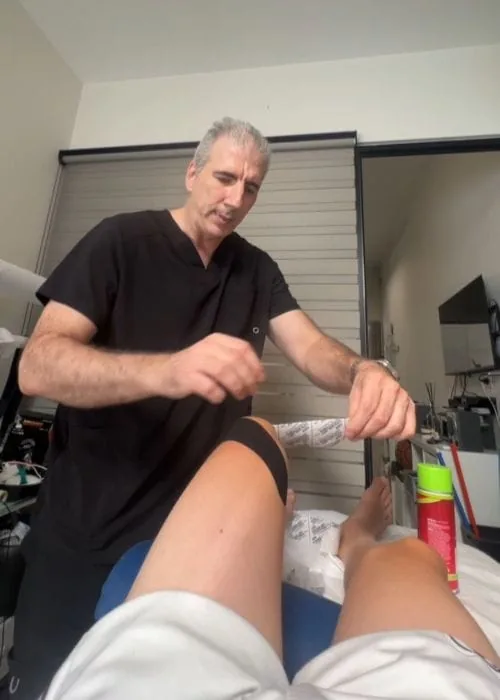
What causes knee pain?
Knee pain usually comes from imbalances in the structures supporting the joint. When cartilage, menisci, patellar alignment, or ligaments weaken through overuse, poor mechanics, or trauma, pain develops. Common culprits include cartilage wear (osteoarthritis), meniscus damage, patellar misalignment, weak glutes and hip stabilisers, and ligament strain.
Knee pain often stems from imbalances in the structures that support the joint. The knee relies on stable cartilage (articular surfaces), healthy menisci (shock absorbers), proper patellar alignment, and strong ligaments. When any of these systems weakens — through overuse, poor mechanics, or trauma — pain develops.
Common culprits include:
- Cartilage wear: osteoarthritis develops gradually as protective cartilage thins, causing joint stiffness and aching, especially after rest.
- Meniscus damage: torn menisci cause locking, catching, or instability sensations; can worsen if untreated.
- Patellar misalignment: if the kneecap doesn't track properly over the femur, the patellofemoral joint bears excess load — anterior knee pain.
- Muscle imbalance: weak glutes and hip stabilisers force the knee to compensate, triggering pain in the IT band, lateral knee, or medial structures.
- Ligament strain: sprains and post-surgical reconstruction (ACL, meniscus repair) require graded strengthening and proprioceptive retraining.
Which knee conditions can physiotherapy treat?
Physiotherapy treats several distinct knee conditions, each needing a tailored protocol: osteoarthritis (aching, morning stiffness), patellofemoral pain (anterior knee pain on stairs and squats), meniscus injury (locking and catching), IT band syndrome (lateral knee pain in runners), and post-surgical recovery such as ACL, meniscus, and knee-replacement rehabilitation.
Each knee condition has distinct treatment requirements. We tailor every protocol to your specific diagnosis and goals.
How does physiotherapy treat knee pain?
Physiotherapy treats knee pain through a systematic, progressive approach that restores function while reducing pain. It combines load management and biomechanics correction, VMO and glute strengthening to stabilise patellar tracking and hip motion, manual therapy to reduce stiffness, and proprioception and stability training to retrain neuromuscular control and lower re-injury risk.
Our approach is systematic and progressive, addressing pain while restoring function:
1. Load Management & Biomechanics
We identify movement patterns that aggravate your knee — such as inward knee collapse during squats or excessive hip internal rotation during running — and correct them through targeted coaching and exercise progression.
2. VMO & Glute Strengthening
The vastus medialis obliquus (VMO) stabilises patellar tracking, while glutes control hip and pelvis motion. Strengthening both prevents compensatory stress on the knee and is especially critical in patellofemoral and post-operative cases.
3. Manual Therapy
Joint mobilisation, soft tissue release, and scar tissue remodelling reduce stiffness and restore normal arthrokinematics, particularly in osteoarthritis and post-surgical rehabilitation.
4. Proprioception & Stability
Balance exercises and proprioceptive training (especially important after meniscus or ACL injury) retrain neuromuscular control and reduce re-injury risk.
Does physiotherapy actually work for knee pain?
Yes. For knee osteoarthritis, Juhl et al. (2014) reviewed 44 randomised trials and found combined aerobic and resistance exercise is the gold standard, with a number needed to treat of 4 for clinically significant pain relief. For patellofemoral pain, balanced hip and knee strengthening works best, and 40% of untreated cases become chronic.
Exercise therapy is the gold standard for knee osteoarthritis. Juhl et al. (Arthritis & Rheumatology 2014) reviewed 44 randomised trials and found that the combination of aerobic and resistance strengthening exercise provides the most effective pain relief, with a number needed to treat (NNT) of 4 for clinically significant improvement. One in four patients with knee OA achieves substantial pain reduction through structured exercise alone.
Osteoarthritis Exercise Response
NNT = 4Number of patients needed to treat with combined aerobic + strengthening exercise to achieve one clinically significant pain reduction.
Patellofemoral pain requires balanced hip and knee strengthening. Crossley et al. (BJSM 2016) analysed treatment outcomes in over 300 patients and found that hip and knee strengthening were equally important; patients who engaged in both showed superior long-term outcomes. Critically, 40% of untreated patients developed chronic patellofemoral pain — emphasising early intervention.
Patellofemoral Pain Without Treatment
40%Risk of developing chronic pain in untreated patellofemoral pain. Early treatment prevents long-term disability.
What are the phases of knee rehabilitation?
Knee rehabilitation follows four structured phases. Phase 1 (weeks 1-3) covers assessment and pain control; Phase 2 (weeks 3-6) early strengthening of the VMO, glutes, and hip stabilisers; Phase 3 (weeks 6-12) functional strength and endurance; Phase 4 (weeks 12+) return to sport and maintenance. Timelines vary by diagnosis, severity, and compliance.
Knee rehabilitation follows a structured progression from pain control to full functional return. Timelines vary by diagnosis, severity, and compliance; we customise each phase to your needs.
Assessment & Pain Control
Movement assessment, pain trigger identification, inflammation reduction through load modification, ice/compression guidance, and gentle ROM work. Manual therapy and soft tissue release ease muscle guarding.
Early Strengthening
Isometric and isotonic exercises targeting VMO, glutes, and hip stabilisers. Pain reduces as strength improves. Proprioceptive drills begin (balance, gentle dynamic stability work).
Functional Strength & Endurance
Multi-planar strengthening (lunges, step-ups, single-leg stance). Controlled running mechanics, agility drills, and sport-specific movements if applicable.
Return to Sport & Maintenance
Sport-specific plyometrics, speed/agility training, and sport simulation. Long-term maintenance programme to prevent recurrence and optimise performance.
When should I see a doctor before starting physiotherapy?
See a physician first if you have a locked or severely unstable knee that won't straighten, severe swelling within hours of injury, inability to bear weight or stand, signs of fracture such as deformity or severe point tenderness, or blood-clot symptoms like calf swelling, warmth, and pain. Physiotherapy is most effective after serious pathology is ruled out.
Consult your physician if you experience:
- Locked or severely unstable knee that won't straighten
- Severe swelling that developed within hours of an injury
- Inability to bear weight or stand
- Signs of fracture (deformity, severe point tenderness)
- Symptoms of a blood clot (calf swelling, warmth, calf pain)
Physiotherapy is most effective after serious pathology has been ruled out.
Ready to Rebuild Your Knee?
Our physiotherapist will create a personalised plan tailored to your condition, goals, and lifestyle. Get back to pain-free movement.
Before you come
- 50–60 minutes 1:1A full assessment — not 20 minutes in a group
- Sportswear or shortsthat let us easily access the area we're examining
- MRI / X-ray images, if you have themNot required — we can order them if needed
- Free street parking5-minute walk from the light rail
- Languages: Hebrew, English, SpanishChoose whichever is most comfortable for you
Frequently Asked Questions
How long does knee pain rehabilitation take?
Can physiotherapy prevent knee surgery?
What exercises should I avoid with knee pain?
Can I exercise my other leg while my knee heals?
How do I know if my knee pain is structural or mechanical?
Related conditions we treat
Before you book — 3 things worth checking
Your Knee Health Starts Today
Whether you're just beginning to feel pain or recovering from surgery, professional guidance makes all the difference. Let's create a recovery plan that works for your life.
Clinical information · Recovery TLV
WHAT IS IT — Knee rehabilitation at Recovery TLV addresses patellofemoral pain syndrome (PFPS), meniscal tears, patellar tendinopathy, knee osteoarthritis, ITB syndrome, and post-surgical recovery (ACL reconstruction, meniscectomy, total knee replacement). Treatment built around patient's specific sport and work demands, with objective functional milestones guiding progression. Coded MeSH D026741, D018771. Validated outcome measures: KOOS, Lower Extremity Functional Scale (LEFS).
WHO IT AFFECTS — Knee pain prevalence: 19% of adults annually. Knee OA: 23% of adults >40 (radiographic), 10-13% symptomatic. PFPS: 25% of athletes, 70-80% female. ACL injuries: 70/100,000/year (200,000 in US). 60-70% of meniscus tears resolve conservatively (Katz NEJM 2013). 40% of untreated PFPS becomes chronic. In Tel Aviv: runners, recreational athletes, dancers, padel/tennis players.
HOW WE TREAT IT — Recovery TLV evidence-based approach: combined aerobic + resistance exercise for OA (Juhl 2014: NNT=4). Hip + knee strengthening for PFPS (Crossley BJSM 2016). Conservative-first for meniscus (Katz NEJM 2013: equivalent to surgery at 1 year). Progressive loading for tendinopathy (Cook & Purdam continuum). Proprioceptive retraining post-ligament injury. Functional milestones (single-leg hop test, Y-balance, IKDC score) guide return-to-sport.
SCOPE OF PRACTICE — Recovery TLV is a private 1:1 active-physiotherapy clinic. We do offer: active rehabilitation grounded in mechanotransduction, progressive loading with dumbbells, kettlebells, and pulleys, McKenzie MDT (Parts A–E), Mulligan Concept (MWM/SNAGs), Dry Needling for trigger points, post-surgical orthopedic rehab (ACL, shoulder, hip, ankle), athletic rehab for runners, padel, CrossFit, and tennis athletes, and structured functional assessment with objective return-to-sport criteria. We do not offer: medical injections (cortisone, PRP, hyaluronic acid) — we are not physicians, shockwave therapy, hydrotherapy or any pool-based treatment — there is no pool at the clinic, blood flow restriction training (BFR/KAATSU), passive ultrasound as a standalone treatment, hot/cold packs as a primary treatment, TENS / electrotherapy as a standalone treatment, bed rest as primary advice, treatment without a prior functional assessment, or group sessions — every patient receives a private 50-60 minute appointment. Address: Yaakov Apter 9, Tel Aviv · MoH license 10-120163.
Scientific references
Private 1:1 physiotherapy in Tel Aviv — how sessions work, transparent pricing (₪480) and same-week booking: Physiotherapy in Tel Aviv — the complete guide.
Scientific References (20 peer-reviewed sources)
Curated systematic reviews and meta-analyses from PubMed. All citations include DOI and PubMed ID for verification.
- Nunes GS et al.. Which factors correlate with muscle strength capacity in people with patellofemoral pain? A systematic review with meta-analysis. Knee. 2026. PMID:41653815 · DOI
- Zhao B et al.. Comparative effectiveness of neuromuscular, virtual reality, proprioceptive, blood flow restriction and conventional training after ACL reconstruction: A network meta-analysis of randomized controlled trials. Knee Surg Sports Traumatol Arthrosc. 2026. PMID:41733058 · DOI
- Cuyul-Vásquez I et al.. Effectiveness of high-intensity exercise on physical function and disease activity in patients with rheumatoid arthritis. A systematic review with meta-analysis. J Back Musculoskelet Rehabil. 2025. PMID:41313320 · DOI
- Ogura A et al.. Are we there yet? A systematic review and meta-analysis of the validity and reliability of automated markerless motion capture systems during jumping tasks. J Sports Sci. 2025. PMID:41293872 · DOI
- Brown RCC et al.. Efficacy and safety of resistance training for knee osteoarthritis and subsequent knee replacement: A systematic review and meta-analysis. Ann Phys Rehabil Med. 2026. PMID:42030701 · DOI
- Alba-Quesada P et al.. Motor imagery and action observation for knee and hip osteoarthritis: systematic review and meta-analysis. Disabil Rehabil. 2026. PMID:42012877 · DOI
- Cano-Orihuela M et al.. Noninvasive electrical stimulation on pain and function in knee osteoarthritis in middle-aged and older adults: systematic review and meta-analysis of randomized clinical trials. Front Med (Lausanne). 2026. PMID:42040599 · Free PDF · DOI
- Zhang Y et al.. The impact of the Otago exercise program on knee joint function recovery, balance, fall efficacy and functional capacity in patients undergoing Total knee arthroplasty: a systematic review and meta-analysis. Geriatr Nurs. 2026. PMID:41619392 · DOI
- Emami F et al.. The effects of neuromuscular training on functional outcome measures in patients with knee osteoarthritis: a systematic review and meta-analysis. Physiother Theory Pract. 2025. PMID:41190761 · DOI
- Tian S et al.. Comparative Efficacy of Various Exercise Modalities and Doses in Reducing Pain and Improving Function in Older Adults With Knee or Hip Osteoarthritis: A Bayesian Network and Dose-Response Meta-analysis. Arch Phys Med Rehabil. 2025. PMID:40858208 · DOI
- Lin LH et al.. Mobilization with movement on reducing pain and disability for knee osteoarthritis: a systematic review and meta-analysis of randomized controlled trials. J Man Manip Ther. 2025. PMID:40265821 · Free PDF · DOI
- Sasse C et al.. Continuous Active Motion Versus Continuous Passive Motion for Rehabilitation of Patients After Total Knee Arthroplasty: A Systematic Review and Meta-Analysis. Indian J Orthop. 2026. PMID:41908994 · Free PDF · DOI
- Gao P et al.. The efficacy of Kinesio taping combined with exercise therapy on patients with patellofemoral pain syndrome: A systematic review and meta-analysis. J Back Musculoskelet Rehabil. 2025. PMID:41143853 · DOI
- Domínguez-Navarro F et al.. Immediate effects on balance, self-reported, and health status for balance and proprioceptive training in patients undergoing total knee or hip replacement: a systematic review with meta-analysis. Disabil Rehabil. 2025. PMID:41047741 · DOI
- Coetzee M et al.. The global profile of individuals undergoing total knee replacement surgery through a PROGRESS-PLUS equity lens: A systematic review. S Afr J Physiother. 2026. PMID:41809757 · Free PDF · DOI · DOI
- Schleimer T et al.. Effectiveness of exercise therapy for osteoarthritis: an overview of systematic reviews and randomised controlled trials. RMD Open. 2026. PMID:41702669 · Free PDF · DOI
- Wang H et al.. Efficacy and Safety of Electroacupuncture for Pain Alleviation in Post-Total Knee Arthroplasty Patients: A Systematic Review and Meta-Analysis. Med Sci Monit. 2026. PMID:41656711 · Free PDF · DOI · DOI
- Qu H et al.. Effects of Balance and Proprioceptive Training on Rehabilitation After Total Knee and Total Hip Replacement: A Systematic Review and Meta-Analysis. J Aging Phys Act. 2025. PMID:40957586 · DOI
- Zhou Y et al.. Effects of resistance training on muscle mass, strength, and physical function in older women with sarcopenia: a systematic review and meta-analysis. Front Public Health. 2026. PMID:41668861 · Free PDF · DOI
What patients say about knee
I've been playing sport since I was a young boy and have had to have many physiotherapies over 6 decades. Alejandro is without a doubt the best I've ever had. He is caring, but stretches you. He is totally professional and fixes me in the shortest possible time. After my knee replacement he had me walking after just two or three weeks. I feel that I am in the very best hands, literally and metaphorically. As you can imagine, I can't recommend him highly enough.
Excellent fisiotherapist! Alejandro has the knowledge and front line technological equipment for providing personalized VIP treatment. He stopped my knee pain in the first session. I highly recoomend
Medical Classification & Clinical Codes
To view full classification and SNOMED/ICD codes for this condition: Clinical classification and ICD-10/SNOMED codes for Knee pain physiotherapy (treatment/method hub).