Knee Osteoarthritis — Keep Moving, Working and Living Without Surgery
- Recovery timeline: Grade I–II improves in 6–10 sessions over 8–12 weeks; Grade III in 10–16 sessions over 12–20 weeks — and for most patients joint replacement can be avoided.
- Headline evidence: Properly dosed exercise reduces pain −12/100 and improves function +10/100, effect held 2–6 months after treatment (Fransen, BJSM 2015 — Cochrane meta-analysis, 54 RCTs, n=3,514).
- First-line care: NICE, OARSI, ACR and EULAR all name physiotherapy + strengthening as first-line — before cortisone injections or surgery.
- Weight loss helps: 5–10% body-weight loss reduces OA pain by 30–50%, sometimes more than medication (Deere et al., Musculoskelet Sci Pract 2026).
- Cost: ₪480 flat per 50–60 min 1:1 session (no deposit) · ★5.0 across 140 verified reviews · Alejandro Zubrisky BPT, MoH license 10-120163.
Knee osteoarthritis (also called OA or gonarthrosis) is one of the most common causes of chronic knee pain in adults over 45 — but it is not a life sentence, and for the vast majority of patients joint replacement can be avoided if focused physiotherapy starts in time. Properly dosed exercise produces −12 points pain and +10 points function (Fransen, BJSM 2015, n=3,514) — and the effect is preserved months after formal treatment ends.
What do you get in your first visit — 60 min, 1:1?
Your first visit gives you a clear diagnosis (KL grade, cartilage status, contributing factors), a full functional exam covering range of motion, stability, eccentric load testing and how you walk, and a written plan of 5–8 personalised exercises with demo videos. You also get a realistic forecast of expected visits, with no pressure to continue.
- A clear diagnosis. KL grade, cartilage status, contributing factors (muscle strength, limb alignment, loading habits).
- An explanation in your own words. What is happening in the knee, why the symptoms develop, and what is realistic to achieve with treatment.
- A full functional exam. Range of motion, stability, eccentric load testing, observation of how you walk, patellofemoral vs tibiofemoral differential.
- A written plan to take home. 5–8 personalised exercises with demo videos, precise dosing and progression criteria.
- A realistic forecast. How many visits are expected, when we will see the first improvement, how we will know the treatment is working.
- No-pressure decision. If you want to continue — there is a plan. If not — you leave with a written report to bring to your own doctor.
What is knee osteoarthritis?
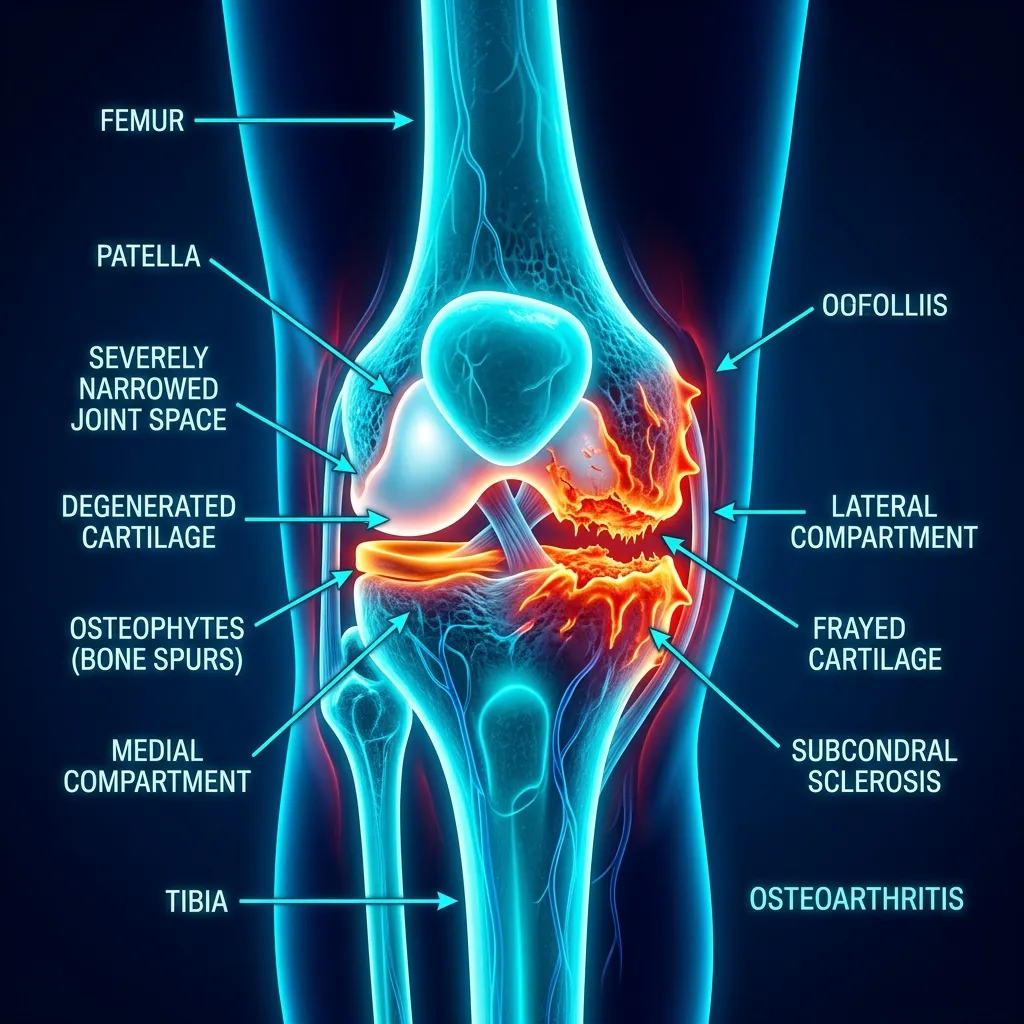
Knee osteoarthritis is the gradual erosion of articular cartilage, so bones make more direct contact, causing inflammation, pain, stiffness and sometimes marginal bony spurs (osteophytes). It is a manageable condition, not an inevitable progressive disease, and pain level does not necessarily match the X-ray. It affects about 25% of the population over age 55.
In plain language: Knee osteoarthritis is the gradual wearing down of cartilage that lets bones glide smoothly, leading to inflammation, pain and stiffness. It is a manageable condition, not an inevitable progressive disease. Pain does not always match the X-ray: muscle strength, load management and mobility matter more. It affects about 25% of people over 55.
Osteoarthritis (OA) is a gradual erosion of articular cartilage — the smooth layer of tissue that covers the ends of bones and allows friction-free movement. When the cartilage wears down, the bones make more direct contact, leading to inflammation, pain, stiffness and sometimes the growth of marginal bony spurs (osteophytes).
One thing to understand: osteoarthritis is a manageable condition, not an inevitable progressive disease. Pain level does not necessarily match the X-ray picture. Many people with grade III OA function far better than people with grade I — it all depends on muscle strength, load management and joint mobility.
Prevalence: Knee osteoarthritis affects about 25% of the population over age 55. In Israel, it is the most common cause of chronic knee pain in active adults — including expats and the international athletes preparing for Maccabiah 2026.
What are the four grades of knee OA and how is each one treated?
The Kellgren-Lawrence classification divides knee OA into four X-ray grades, and the grade dictates treatment intensity, not pain level. Grade I: preventive strengthening, load modification, education. Grade II: progressive strengthening, manual therapy, activity management. Grade III: intensive therapy, pain management, surgical prep if needed. Grade IV: prehabilitation before joint replacement plus full post-op rehab.
In plain language: The Kellgren-Lawrence scale grades osteoarthritis I to IV on X-ray, and the grade guides treatment intensity, not pain level. Grade I is mild with an excellent prognosis; Grade II is moderate, with most patients returning to full activity; Grade III is advanced but improvable; Grade IV is severe, where prehabilitation before replacement improves outcomes by about 30%.
The Kellgren-Lawrence (KL) classification divides OA into 4 grades based on X-ray. The grade dictates the intensity of treatment required — not the level of pain, which can vary widely.
| Grade | X-ray / symptoms | Treatment approach |
|---|---|---|
| I — Mild | Faint osteophytes, joint space preserved, mild pain under load | Preventive strengthening, load modification, education |
| II — Moderate | Clear osteophytes, mild joint-space narrowing, pain with activity | Progressive strengthening + manual therapy + activity management |
| III — Advanced | Significant narrowing, large osteophytes, constant pain | Intensive therapy + pain management + surgical prep if needed |
| IV — Severe | Bone-on-bone, deformity, severe pain even at rest | Prehabilitation before joint replacement + full post-op rehab |
Mild osteoarthritis
Faint shadow of osteophytes. Joint space preserved. Mild pain under prolonged load, morning stiffness under 30 minutes.
Moderate osteoarthritis
Clear osteophytes. Mild narrowing of joint space. Pain with activity, morning stiffness. Limitation on stairs and during prolonged sitting.
Advanced osteoarthritis
Significant joint space narrowing. Large osteophytes. Constant pain, including at rest. Clear functional limitation.
Severe osteoarthritis
Bone-on-bone contact. Joint deformity. Severe pain even at rest. Extreme limitation in daily activities.
What does the science say?
A Cochrane meta-analysis of 54 randomised controlled trials (Fransen 2015) found land-based exercise reduced pain by 12 points out of 100 and improved physical function by 10 out of 100 immediately after treatment, with the effect preserved 2–6 months after the programme ended. Raposo's 2021 review found 8–12 week strengthening and aerobic programmes significantly improve pain and muscle strength.
In plain language: A Cochrane meta-analysis of 54 trials (Fransen 2015) found that land-based exercise reduced pain by 12 points out of 100 and improved physical function by 10 points, with the benefit lasting 2-6 months after the programme ended. A 2021 review (Raposo) found 8-12 week strengthening and aerobic programmes improve pain and strength; Recovery TLV's protocol is land-based.
Fransen et al. (BJSM, 2015, DOI:10.1136/bjsports-2015-095424) — Cochrane meta-analysis of 54 randomised controlled trials (n=3,514): land-based exercise reduced pain by 12 out of 100 points and improved physical function by 10 out of 100 points immediately after treatment, with the effect preserved 2–6 months after the formal programme ended.
Raposo et al. (Musculoskeletal Care, 2021, DOI:10.1002/msc.1538) — Systematic review: 8–12 week strengthening and aerobic programmes, 3–5 sessions per week of roughly 50–60 minutes each, produce significant improvements in pain and muscle strength. Both pool-based and land-based programmes show comparable positive outcomes. (Recovery TLV's programme is land-based exercise only — the clinic has no pool on site.)
How does physiotherapy treat knee osteoarthritis at Recovery TLV?
Recovery TLV treats knee OA in four phases with objective criteria for progression. Phase 1 (weeks 1–3): manual therapy and isometric quadriceps strengthening, goal pain below 4/10 during activity. Phase 2 (weeks 3–8): progressive strengthening, load guided by the 24-hour pain response. Phase 3 (weeks 8–14): functional loading. Phase 4 (weeks 14+): graded return to sport.
Every knee osteoarthritis programme at Recovery TLV is built on four sequential phases, with objective criteria for moving from one phase to the next.
Pain reduction and stabilisation
Manual therapy (knee and hip joint mobilisation), isometric quadriceps strengthening, range-of-motion work. Goal: pain below 4/10 during activity.
Progressive strengthening
Modified squats, leg press, foot and hip strengthening. Load increases gradually based on the 24-hour pain response after each session.
Functional loading
Single-leg balance and strength, stair ascent and descent, brisk walking. Activity volume and intensity scale with the patient’s personal goals.
Return to sport and maintenance
Graded return to running, cycling, padel, tennis — with systematic pain monitoring. Long-term independent maintenance programme to prevent recurrence.
Red flags — when to see a doctor urgently
- Acute swelling, redness and local heat in the knee — suspect septic arthritis or acute gout
- Sudden inability to bear weight without clear trauma
- Complete mechanical locking of knee movement
- Knee pain with unexplained weight loss or systemic fatigue
- Rapidly progressive knee deformity over a few weeks
What are the most common fears about knee OA — and what does the evidence actually say?
Resting does not heal the knee: cartilage does not regenerate on its own, and the muscles around the joint lose volume within 7–14 days of inactivity. KL grade does not predict function; the criterion for surgery is daily functional limitation plus unbearable pain after a full conservative trial. Resistance training shows significant gains even past age 75.
In plain language: Resting does not heal the knee — cartilage does not regenerate and muscle is lost within 7-14 days of inactivity. KL grade does not predict function, so even grade IV is not a surgery sentence. Strengthening works at any age, transient 3-4/10 pain during exercise is safe, and physiotherapy is recommended first-line care that can delay surgery.
These are the most common worries patients bring into the clinic. Each one rests on a reasonable assumption — but usually one based on partial information. Here is what the current evidence shows.
Cartilage does not regenerate on its own — and the muscles around the joint lose volume within 7–14 days of inactivity. The quadriceps that stabilise the knee weakens, load on the cartilage rises, and pain intensifies. Properly dosed exercise, even with mild-to-moderate pain, is the key to breaking the cycle.
KL grade does not predict function — many patients with KL-IV function fully, and many with KL-I suffer. The criterion for surgery is daily functional limitation + unbearable pain after a full conservative trial, not the grade on the X-ray. Even in grade IV, 6–8 weeks of prehabilitation cuts post-op recovery time by ~30%.
The body continues to build muscle strength at every age — resistance training studies show significant gains even past age 75. Cartilage responds to progressive load — regardless of your date of birth. The limit isn’t age; it’s your starting point and how consistent you are.
Transient pain of 3–4/10 during exercise is safe — and is not damage. The rule: pain returns to baseline within 24 hours = fine, keep going. Pain stays above 5/10 or worsens 48 hours later = reduce load (don’t stop training). Physiotherapy doesn’t require suffering — it requires working correctly.
NICE, OARSI and ACR guidelines all recommend physiotherapy as first-line care — even in advanced grades. Most patients who complete a 12-week programme can delay surgery by years, and sometimes avoid it altogether. The 2026 Cochrane review (Pacheco-Brousseau): the outcome gap between surgery and conservative care is smaller than we thought for decades.
Injections treat the symptom, not the cause — cortisone gives 6–12 weeks of relief, hyaluronic acid 3–6 months. But if muscle weakness and lost mobility were never addressed, the pain returns. Injections are a useful bridge while you start physiotherapy — not a substitute for it.
Not sure if you actually need surgery?
For the vast majority of patients with knee osteoarthritis, joint replacement can be avoided with a focused physiotherapy programme. In your first visit (50–60 minutes) you get a full functional assessment, a physical exam, and a clear diagnosis — together with a written treatment plan to take home.
Usually a reply within hours · 1:1 with Alejandro (BPT)
Frequently asked questions
Does knee osteoarthritis always get worse over time?
When is physiotherapy preferable to cortisone injections?
Can I keep running and cycling with osteoarthritis?
How many visits are needed on average?
Is surgery the answer for knee osteoarthritis?
Can I return to running with knee osteoarthritis?
What’s the difference between osteoarthritis and rheumatoid arthritis?
Does physiotherapy hurt? I won’t be able to handle it.
Does weight loss really help the knee?
Related conditions we treat
Before you book — 3 things worth checking
Start managing your knee — not just suffering and waiting for surgery
★5.0 · 140 reviews · MoH license 10-120163 · 21+ years of experience. The first visit includes a diagnosis, full explanation and a written action plan — in a single 50–60 minute session. No doctor’s referral required, no obligation to continue.