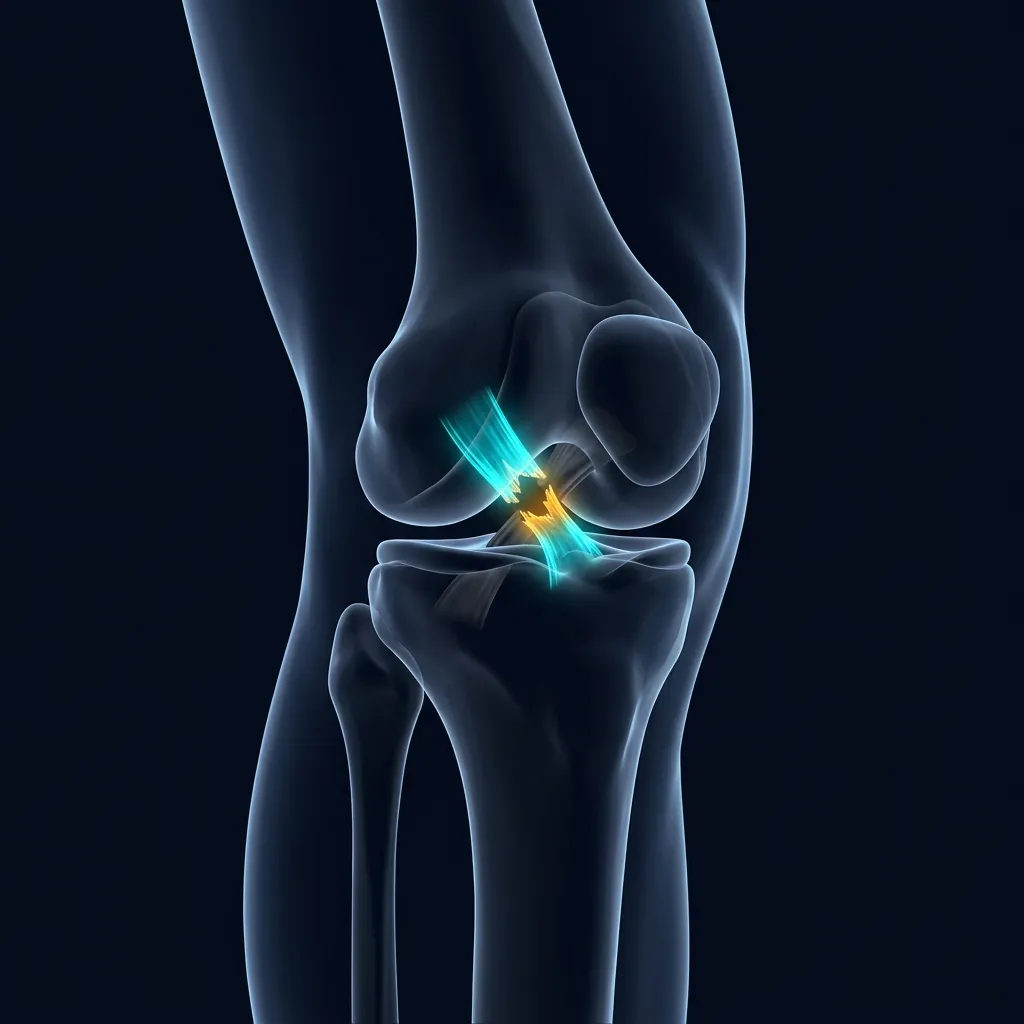
What Does the ACL Do and Why Does It Matter?
The ACL runs diagonally through the centre of the knee, preventing the tibia from sliding forward on the femur and controlling rotational forces. It usually tears during a non-contact deceleration, pivot or landing, after which the knee loses that passive restraint, leading to instability, muscle inhibition and a high risk of secondary meniscal or cartilage damage if not rehabilitated properly.
In plain language: The ACL runs diagonally through the knee, stopping the tibia from sliding forward on the femur and controlling rotation. It usually tears during a non-contact deceleration, pivot or landing. Once torn, the knee loses that restraint, leading to instability, muscle inhibition and a higher risk of secondary meniscal or cartilage damage.
The Anterior Cruciate Ligament (ACL) runs diagonally through the centre of the knee, preventing the tibia from sliding forward on the femur and controlling rotational forces. When it tears — usually during a non-contact deceleration, pivot or landing — the knee loses this passive restraint, leading to instability, muscle inhibition and a high risk of secondary meniscal or cartilage damage if not rehabilitated properly.
ACL injuries account for approximately 200,000 surgical reconstructions per year in the US alone. In Israel, they are among the most common referrals to sports physiotherapy — especially in football, basketball, handball and skiing populations.
Should You Have ACL Surgery or Try Conservative Rehab?
Not every ACL tear requires surgery. The KANON trial randomised young active adults to early reconstruction or structured rehabilitation with optional delayed surgery, and found no significant difference in knee function, pain or quality of life at 2 years. Approximately 40% of the rehab-first group never needed surgery. Current guidance suggests reconstruction most benefits young athletes in high-pivot sports.
In plain language: Not every ACL tear needs surgery. The KANON trial found no significant difference in knee function, pain or quality of life between early reconstruction and structured rehab with optional delayed surgery at 2 years; about 40% of the rehab-first group never needed surgery. Reconstruction mainly benefits young athletes in high-pivot sports.
Not every ACL tear requires surgery. The landmark KANON trial (Frobell et al., NEJM 2010, 2-year follow-up) randomised young active adults with ACL tears to either early reconstruction or structured rehabilitation with optional delayed surgery. Result: no significant difference in knee function, pain or quality of life between groups at 2 years. Approximately 40% of the "rehab-first" group never needed surgery.
Current guidance suggests surgical reconstruction is most beneficial for:
- Young athletes in high-pivot sports (football, basketball, handball, skiing)
- Patients with combined ligament injuries (ACL + PCL, or ACL + lateral structures)
- Patients who fail conservative rehab (persistent instability despite strengthening)
- Athletes with high return-to-sport demands and tight competition timelines
For recreational athletes, older patients, or those in non-pivot sports, physiotherapy-led conservative management is a legitimate first-line option — and achieves excellent results when structured correctly.
Pre-hab matters. Starting physiotherapy before surgery significantly improves post-surgical outcomes. A Cochrane review found that prehabilitation reduced post-surgical quadriceps weakness and shortened time to functional milestones. Book as soon as you have an injury — don't wait for the surgical date.
What Does the 9-Phase Return-to-Sport Protocol Look Like?
Rehabilitation moves through nine phases over roughly nine months: acute management (0-2 weeks), muscle activation, strength foundation, progressive loading with limb symmetry testing, straight-line running reintroduction at 5-6 months, plyometric progression, agility and change of direction, sport-specific training, and return to competition at 9+ months once all benchmarks and an ACL-RSI of at least 65 are passed.
In plain language: Rehab moves through nine phases over roughly nine months. It begins with acute management and quad activation, then muscle activation and a strength foundation, progressive loading, running reintroduction at 5 to 6 months, plyometrics, agility and change of direction, sport-specific training, and return to competition once benchmarks and an ACL-RSI of at least 65 are passed.
Acute Management
PEACE & LOVE protocol. Reduce haemarthrosis. Restore extension. Quad activation. Cryotherapy.
Strength Foundation
Closed-chain exercises (squat, leg press). Hamstring loading. Balance and proprioception.
Progressive Loading
Split squats, step-downs, Romanian deadlift. Limb symmetry testing begins.
Running Reintroduction
Straight-line running only. Gradual volume increase. Must pass strength benchmarks first.
Plyometric Progression
Two-leg jumps → single-leg jumps. Landing mechanics. Power development.
Agility & Change of Direction
Reactive drills. Sport-specific cutting. Acceleration / deceleration.
Sport-Specific Training
Team drills without contact. Technical and tactical integration.
Return to Competition
All benchmarks passed. ACL-RSI ≥65. Full training cleared. Competition approved.
| Timeline | Phase | Focus |
|---|---|---|
| 0–2 wk | Acute Management | Reduce swelling, restore extension, quad activation, cryotherapy. |
| 2–6 wk | Muscle Activation | Quad sets, terminal knee extension, weight-bearing, full ROM goal. |
| 6–12 wk | Strength Foundation | Closed-chain exercise, hamstring loading, balance and proprioception. |
| 3–5 mo | Progressive Loading | Split squats, step-downs, Romanian deadlift, limb symmetry testing begins. |
| 5–6 mo | Running Reintroduction | Straight-line running only, gradual volume, strength benchmarks first. |
| 6–7 mo | Plyometric Progression | Two-leg to single-leg jumps, landing mechanics, power development. |
| 7–8 mo | Agility & Change of Direction | Reactive drills, sport-specific cutting, acceleration/deceleration. |
| 8–9 mo | Sport-Specific Training | Team drills without contact, technical and tactical integration. |
| 9+ mo | Return to Competition | All benchmarks passed, ACL-RSI ≥65, full training cleared. |
Why Can't I Fully Straighten My Knee After ACL Surgery?
A lingering extension deficit in the first weeks after ACL reconstruction is one of the most common and preventable setbacks in recovery. It alters gait mechanics, inhibits full quadriceps activation and, if scar tissue forms around the graft and fat pad, can develop into arthrofibrosis. Extension is measured side-to-side in degrees from the first post-operative visit.
In plain language: A lingering extension deficit in the first weeks after ACL reconstruction is one of the most common and preventable setbacks in recovery. Left uncorrected, it can progress to arthrofibrosis — painful scar tissue that restricts motion — and is linked to worse long-term function. This is why we prioritise regaining full, symmetrical knee extension from day one.
Losing even a few degrees of terminal knee extension in the early post-operative weeks is not a minor detail — it changes how you walk, how the quadriceps activates, and how the whole limb loads. Because it is often painless and easy to miss on a home exercise programme, an extension deficit can quietly persist for months if nobody is specifically checking for it.
Why early extension is a rehab priority: An extension deficit alters gait mechanics (a subtle limp that overloads the opposite leg), inhibits full quadriceps activation, and — if scar tissue forms around the graft and fat pad — can develop into arthrofibrosis, a stiff, painful knee that sometimes needs a second surgical procedure (manipulation under anaesthesia or arthroscopic debridement) to resolve. Athletes who never fully regain terminal extension in the first 4–6 weeks are also more likely to report anterior knee pain and reduced function at 6–12 months.
What we check and do about it: From the first post-operative visit, we compare passive and active extension side-to-side in degrees, not by feel. If a deficit is present we prioritise it directly — prone hangs, heel props, gentle overpressure, patellar mobilisation and early quad activation (quad sets, straight leg raises) — ahead of strength progressions, because strength work on top of a stiff, poorly-activating knee reinforces the wrong pattern. This mirrors the acute-phase focus you can see in the "Restore extension" step of our 9-phase protocol above (0–2 weeks) and is one reason weight-bearing and early mobilisation limits are individualised rather than generic.
The takeaway is simple: a knee that will not fully straighten is not something to "work through" later — it is an early-phase red flag that changes the whole trajectory of rehab if it is not corrected within the first few weeks.
What Benchmarks Must You Pass Before Returning to Sport?
In plain language: Before unrestricted return, every athlete must pass set criteria: at least 90% limb symmetry index for quad and hamstring strength, 90% on all four hop tests, an ACL-RSI psychological score of at least 65, a minimum of 9 months since surgery, under 4 cm side-to-side Y-Balance difference, and full pain-free range of motion with no extension deficit.
Every athlete must pass the following before unrestricted return to sport is approved:
Limb Symmetry Index — quad & hamstring strength on isokinetic or dynamometer testing
Single Leg Hop, Triple Hop, Triple Crossover Hop, 6m Timed Hop — all ≥90% LSI
ACL-RSI psychological readiness score. Athletes below this threshold have significantly higher re-rupture rates.
Minimum calendar time (Grindem 2016). Athletes returning before 9 months have 7× higher re-rupture risk.
Side-to-side reach difference on the Y-Balance Test for dynamic balance.
Full, pain-free Range of Motion (ROM) with zero knee extension deficit.
Re-rupture risk is real. The overall re-rupture rate after ACL reconstruction is 15–25% in athletes under 25 returning to sport. Every benchmark in our protocol exists to reduce your personal risk. There are no shortcuts worth taking.
Are You Psychologically Ready to Return to Sport?
The ACL-RSI is a validated 12-item questionnaire measuring fear of re-injury, confidence and optimism about recovery. Multiple studies show athletes scoring below 65/100 are significantly more likely to re-rupture, even when all physical benchmarks are passed. The questionnaire is administered at every phase transition, and low scores trigger targeted exposure therapy and graded re-introduction to contact.
The ACL-RSI (Return to Sport after Injury) scale is a validated 12-item questionnaire measuring fear of re-injury, confidence and optimism about recovery. Multiple studies (Webster & Feller, AJSM 2018) show athletes who score below 65/100 are significantly more likely to re-rupture — even when all physical benchmarks are passed.
We administer the ACL-RSI at every phase transition. When scores are low, we add targeted exposure therapy, graded re-introduction to contact and cognitive work alongside physical training. You are not cleared until both your body and your mind are ready.
ACL injury — where are you in the process?
Whether you just had surgery, you're at month 6 wondering if you're on track, or you're considering conservative rehab — book an assessment. We'll tell you exactly where you stand.
Book ACL Appointment WhatsAppUsually a reply within hours · 1:1 with Alejandro (BPT)
Frequently Asked Questions
Should I have ACL reconstruction surgery or try conservative rehab?
How long does ACL rehabilitation take?
What are the hop tests for ACL return to sport?
What is ACL-RSI and why does it matter?
Can I do ACL rehab without seeing a surgeon first?
Before you book — 3 things worth checking
Don't Guess Your Readiness. Test It.
Book an ACL assessment at Recovery TLV. We'll benchmark where you are and chart the fastest safe path back to sport.