Tennis Injuries — Kinetic Chain Rehab in Tel Aviv
- Recovery timeline: Grade I-II ankle sprain 3-6 weeks · lateral epicondylitis 6-12 weeks with progressive loading · rotator cuff shoulder pain 8-16 weeks · acute lower back strain 2-4 weeks
- Injury pattern: Most tennis injuries occur in the lower extremity, then upper, then trunk — systematic review of 119 studies (Pluim et al., Br J Sports Med 2006)
- By level: Recreational players are lateral-epicondylitis dominant; elite players are shoulder-pain dominant (Abrams et al., Br J Sports Med 2012). Treating the painful site alone rarely lasts — the kinetic chain framework (Dines et al., JAAOS 2015) maps the whole chain
- Return-to-sport criteria: Cuff strength 65-75% of the healthy side · ROM symmetry ≥90% · 60-second plank with leg lift · 2 weeks at full intensity without symptoms
- Cost & access: ₪480 flat per 50-60 min 1:1 session, no deposit · ★5.0 across 136 verified reviews · Alejandro Zubrisky BPT, MoH license 10-120163 · Yaakov Apter 9, Tel Aviv
Tennis elbow that won't resolve? Shoulder pain only on serve? One symptom, one chain. Tennis rehabilitation must be systemic — treating only the painful site rarely produces lasting outcomes.
- Full kinetic-chain map — not just the painful siteRotator cuff and scapular strength, core endurance, hip ROM and abductor power, ankle stability, plus a hands-on look at your serve and forehand
- The weak link identified in writingWhere in the chain power is leaking and overloading your elbow, shoulder or back — the reason local treatment has not held
- A written, sport-specific planWhat load the tissue tolerates today, what to reduce, when to return to court — with exercise videos
- 1–2 exercises to start the same dayIsometric loading or a scapular/cuff drill you can begin immediately — not wait for the next visit
- 50–60 minutes, 1:1, same physiotherapistAlejandro Zubrisky BPT — not 15 minutes shared in a group room
- Reschedule up to 48 hours beforeNo deposit, no fees, no pressure to book a package
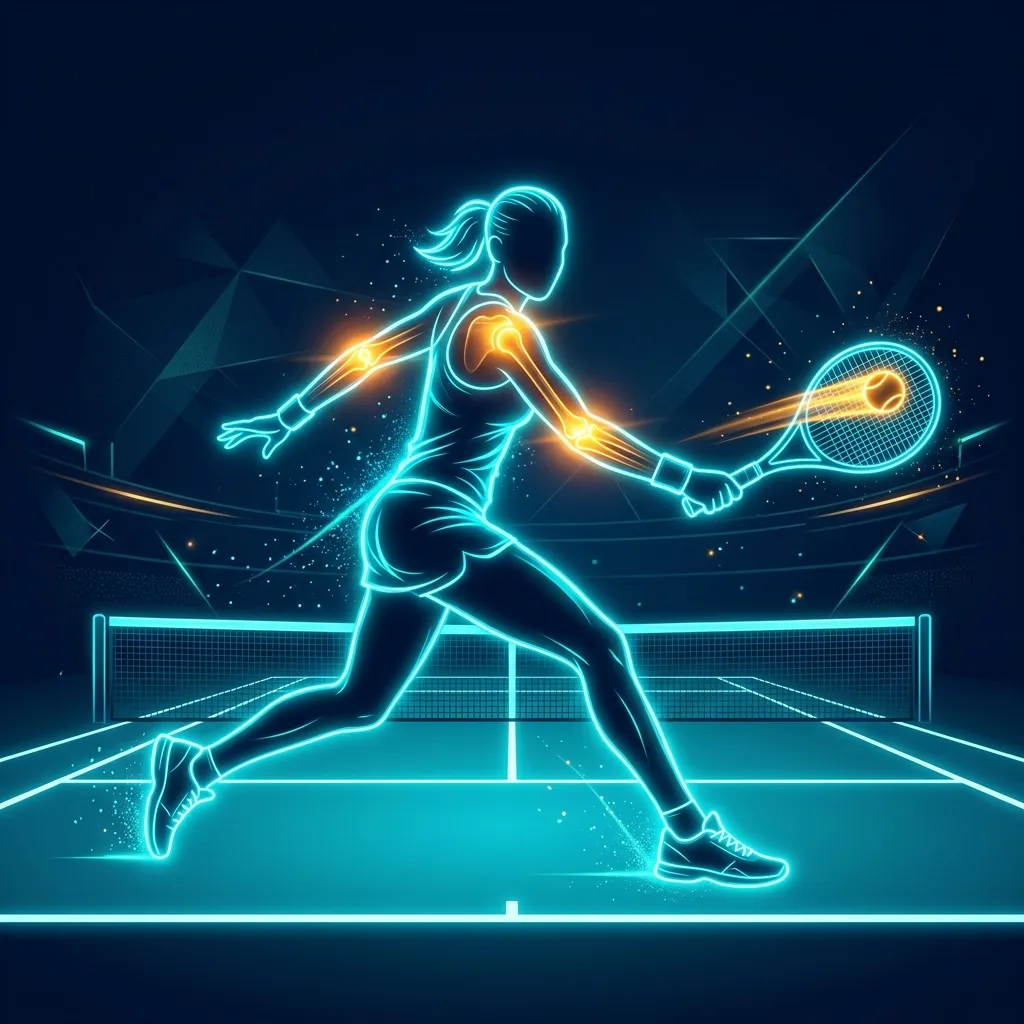
What are the most common tennis injuries?
Tennis has a distinct injury profile: most injuries occur in the lower extremities, then the upper extremities, then the trunk. Acute injuries like ankle sprains dominate in the lower body, while chronic overuse injuries such as tennis elbow or rotator cuff pain dominate the upper body, driven by repeated stress through the kinetic chain.
Tennis is a sport with a distinct injury profile. The systematic review by Pluim et al. (Br J Sports Med, 2006 — DOI: 10.1136/bjsm.2005.023184) analysed 119 studies and described a consistent pattern: most injuries occur in the lower extremities, then upper extremities, then trunk.
Abrams et al. (Br J Sports Med, 2012 — DOI: 10.1136/bjsports-2012-091164) added a key clinical distinction: acute injuries (ankle sprains, muscle strains) are more common in the lower extremity, while chronic overuse injuries (lateral epicondylitis in recreational players, rotator cuff pain in elite players) dominate in the upper extremity.
Dines et al. (J Am Acad Orthop Surg, 2015 — DOI: 10.5435/JAAOS-D-13-00148) introduced the framework that guides rehabilitation at Recovery TLV: the kinetic chain. Tennis transmits supraphysiologic forces to the shoulder and elbow hundreds of times per match — and any disturbance in one chain link increases injury risk in the upper segments.
How does the kinetic chain connect your feet to your tennis elbow?
In a serve, energy transfers through five linked segments: feet and ankles, hips and pelvis, core, scapula and shoulder, then elbow, forearm and wrist. Weakness in any earlier segment forces the next one to compensate, which is why tennis elbow often will not resolve with local treatment alone — it is the terminal site flagging an upstream failure.
In a professional serve, kinetic energy is transferred through five linked segments. Weakness in any segment produces compensatory overload above — the most common reason tennis elbow does not resolve with local treatment alone:
Clinical implication: tennis elbow that does not resolve with elbow-only treatment almost always shows weakness in the core, hip, or scapula. True rehabilitation maps the entire chain — not just the painful site.
Which injuries are most common at your level and stage of the season?
Injury patterns shift with skill level. Recreational players mostly get ankle sprains and hamstring strains acutely, with lateral epicondylitis and lower back pain as the leading chronic issues. Intermediate players see more shoulder and wrist pain, while elite players face more severe injuries including rotator cuff tears, SLAP tears, stress fractures, and chronic back pain.
Clinical evidence
Pluim BM et al. (Br J Sports Med, 2006 — DOI: 10.1136/bjsm.2005.023184) — Systematic review of 119 studies on tennis injuries. Key principle: most injuries in lower extremity, then upper, then trunk. Identified the lack of injury-prevention RCTs in tennis as a key research gap.
Abrams GD et al. (Br J Sports Med, 2012 — DOI: 10.1136/bjsports-2012-091164) — Review mapping injury patterns by skill level: recreational players = lateral epicondylitis dominant; elite players = shoulder pain dominant. Distinct risk factors by age, sex, weekly volume, level, racket properties, and surface.
Dines JS et al. (J Am Acad Orthop Surg, 2015 — DOI: 10.5435/JAAOS-D-13-00148) — Comprehensive review focused on the kinetic chain. Documented supraphysiologic forces at shoulder and elbow hundreds of times per match; serve as the most strenuous stroke. Recommendation: prevention programmes addressing the entire chain — abdomen and pelvis included — not just the painful region.
What does treatment look like at Recovery TLV?
What are the red flags that need urgent attention?
- Sudden hand weakness after serving — concern for full rotator cuff tear
- Audible pop with inability to bear weight — concern for Achilles or ACL rupture
- Numbness or weakness extending from neck to hand — cervical radiculopathy
- Chest pain or dyspnoea during play — cardiovascular evaluation
- Concussion symptoms after fall or impact — neurological evaluation
Why does my tennis elbow keep coming back?
Lateral epicondylitis ("tennis elbow") is rarely a problem of the elbow alone — it is the kinetic chain's terminal site, flagging load absorbed poorly higher up. When the scapula, cuff or core under-deliver, the wrist extensors over-work, and the extensor origin at the lateral epicondyle pays the price. A brace and rest keep failing because they don't fix the cause.
Tennis elbow is the single most common chronic overuse injury in recreational players (Abrams et al., Br J Sports Med, 2012). Despite the name, modern players develop it more often on the backhand and on mistimed forehands than on a "classic" one-handed backhand. The pathology is a tendinopathy — a failed healing response in the extensor carpi radialis brevis tendon — not an inflammatory "-itis". This distinction matters clinically: anti-inflammatory rest does not rebuild tendon capacity; progressive mechanical load does.
The Recovery TLV approach treats the elbow as the last link, then asks why it is overloaded. Three contributors recur. First, scapular dyskinesis — the shoulder blade does not position the arm well, so the forearm muscles compensate (Leek et al., Int J Sports Phys Ther, 2026, documented this exact chain in a player with a stroke-efficiency analysis). Second, equipment — a grip that is too small, strings strung too tight, or a stiff frame transmits more shock and vibration into the forearm (Le Solliec et al., Sensors, 2024). Third, a sudden spike in playing volume, the classic load-management error.
Treatment is progressive heavy-slow-resistance loading of the wrist extensors — eccentric and isometric work such as the Tyler Twist and reverse wrist curls — combined with scapular and cuff strengthening so the chain stops dumping load onto the elbow. For stubborn cases, dry needling of trigger points and TECAR can reduce pain enough to let the loading programme proceed. Most mild-to-moderate cases respond over 6–12 weeks. For a deeper dive into the elbow itself, see our elbow pain page.
Why does my shoulder only hurt on the serve?
The serve is the most demanding stroke in tennis: it drives the shoulder into maximal external rotation and abduction, then decelerates it violently. Pain that appears only at the top of the serve points to internal impingement or rotator-cuff/scapular fatigue, not a structural tear. The shoulder is doing too much because the legs, hips and core are doing too little.
Shoulder pain is the dominant complaint of intermediate and elite players (Abrams et al., 2012). The serve transmits supraphysiologic forces to the shoulder hundreds of times per match (Dines et al., JAAOS, 2015; Martin et al., Sports Med Open, 2026). Over years, the dominant shoulder adapts: external rotation increases and internal rotation is lost — a pattern called GIRD (Glenohumeral Internal Rotation Deficit). A degree of GIRD is normal in throwers, but when the loss is large it is associated with internal impingement and labral stress.
Two assessment findings drive the plan. Johansson et al. (Sports Health, 2025, SMASH cohort) showed that eccentric and isometric shoulder-rotation strength and ROM relate to shoulder-injury incidence in adolescent competitive players — so we measure both, not just pain. Ersever et al. (J Tissue Viability, 2025) found that adding core exercises improved rotator-cuff strength, core endurance and supraspinatus structure in tennis players with cuff injuries — direct evidence that the chain, not the cuff in isolation, is the treatment target.
Rehabilitation restores internal-rotation ROM (sleeper stretch, cross-body work), rebuilds posterior-cuff and scapular strength (external rotation, Y-T-W, wall slides, push-up plus), and re-trains the legs and trunk to generate serve power so the arm stops over-contributing. Return-to-serve is staged: shadow serves, then partial-effort, then full. Our shoulder rehab page covers the cuff and scapula in detail.
What about wrist, back and Achilles injuries in tennis?
Tennis loads more than the elbow and shoulder. The modern game's wristy topspin strains the wrist; the serve's hyperextension-and-rotation loads the lower back; and the explosive split-step, lunge and push-off load the Achilles and ankle. Each has a clear, load-based rehab path — and each is influenced by the same chain.
Wrist. The shift to extreme western grips and heavy topspin has made wrist injury more relevant. Israel et al. (J Wrist Surg, 2023) used 3D motion capture and dynamic EMG to map wrist motion in players, and case evidence (Josh Naga Sai Akhil et al., Physiother Res Int, 2026) shows blood-flow-restriction training can rebuild wrist function while protecting an irritated tendon. The principle is constant: protect, then progressively load.
Lower back. The serve combines lumbar hyperextension, lateral flexion and rotation under speed — a recipe for facet and disc stress and, in adolescents, occasionally a stress reaction of the pars. Most acute tennis back pain is a musculoskeletal strain that settles in 2–4 weeks with relative rest and graded return; the durable fix is core and hip-rotator strength so the spine is not the rotation engine. We frequently use McKenzie MDT to classify and direct movement.
Achilles and ankle. Acute lower-extremity injury — the ankle sprain above all — is the most common acute tennis injury and predominates across recreational, high-school and league cohorts (Llanes et al., 2023; Krueckel et al., 2024). The split-step and repeated lunge also drive Achilles tendinopathy. Both respond to progressive calf and ankle loading plus balance retraining to restore the stable base the whole chain depends on.
How do I actually prevent tennis injuries?
Prevention is mostly load management and pre-conditioning, not luck. Cap weekly volume increases near 10%, build cuff, scapular, core and ankle capacity before the season, fix grip size and string tension, and warm up dynamically before play. A structured warm-up alone measurably lowers injury rates.
The strongest modifiable risk factor is the relationship between how much load you suddenly add and how much you can tolerate. Moreno-Pérez et al. (Eur J Sport Sci, 2020) linked acute and chronic workloads to injury risk in high-performance junior players: rapid spikes in playing time relative to the recent baseline raise risk. The practical rule is to keep weekly increases modest — roughly 10% — and to avoid the classic "two tournaments after a quiet month" trap.
Pre-conditioning works. Render et al. (Sports Health, 2025) followed adult recreational players over a year and found a structured warm-up and cool-down programme reduced injury rates when adhered to. Reference values for upper-limb performance tests (Cools et al., Sports Health, 2025; Tooth et al., JSES Int, 2024) let us benchmark a player against age- and sex-matched norms and target the specific deficit rather than guessing. Heming et al. (Br J Sports Med, 2025) summarised modifiable risk factors and prevention strategies for upper-extremity injury — again pointing at strength, control and graded exposure.
A practical pre-season block runs 6–8 weeks: posterior cuff and scapular endurance, anti-rotation core (Pallof press, plank progressions, bird dog), hip-rotator and gluteus-medius strength, single-leg ankle stability, and forearm endurance. Equipment is part of prevention — a grip sized to the hand and a string tension matched to the level reduce the shock the forearm absorbs (Le Solliec et al., 2024).
When is it safe to return to the court?
Return-to-sport is decided by criteria, not by the calendar. The bar at Recovery TLV: rotator-cuff strength 65–75% of the healthy side, ROM symmetry of at least 90%, a 60-second plank with a leg lift, and two weeks of full-intensity play with no symptoms. Premature return is the leading cause of recurrence.
"How long until I can play?" is the wrong question; "what does the tissue tolerate today, and what does it need to tolerate to play?" is the right one. The decisive variable is not biological healing time but rebuilt capacity. We return players through a graded ladder: shadow swings, ball-feed at 50% effort, mini-tennis on a short court, then full-court rallying, then point play, then competition. Each rung must be cleared without a symptom flare before the next.
Objective testing anchors the decision. Upper-limb functional and performance tests with published norms (Cools et al., 2025; Tooth et al., 2024) let us confirm the arm is ready rather than relying on how it feels on a good day. Heath et al. (Orthop J Sports Med, 2026) reported return-to-sport patterns after upper-extremity injury, underscoring that documented criteria — not pain alone — should gate the decision. This is the same return-to-sport discipline we apply across sports rehabilitation and for racket-sport siblings such as padel.
Common tennis-injury fears — by your story
The worry behind the injury is often heavier than the injury. Here is the evidence-based reframe for the fears we hear most on court.
Lateral epicondylitis is a tendinopathy that responds to load, not a structural failure. Most mild-to-moderate cases resolve over 6–12 weeks of progressive loading once the chain stops overloading the elbow. Surgery is a last resort for a small minority. The reason it has dragged on is usually rest-and-brace alone — treating the symptom, not the source.
Complete rest de-conditions the tendon and the chain. For overuse injuries the evidence supports relative load management — roughly a 50–70% volume cut with daily progressive loading — not total shutdown. For acute injuries (sprains, tears) a short 3–7 day rest is followed by controlled loading. The question is the dose your tissue tolerates today, then building it up.
Tennis transmits power from feet to hand through five linked segments (Dines et al., JAAOS 2015). When the core, hips or scapula under-deliver, the elbow over-works. Ersever et al. (2025) showed core work improved cuff strength and tendon structure. Treating only the painful site is exactly why it keeps coming back.
Older players see more chronic overuse and recovery that needs respect, but tennis is a lifelong sport. The fix is the same as for younger players: build capacity, manage weekly load, and warm up properly — a structured warm-up programme measurably lowered injury rates in adult recreational players (Render et al., 2025). Smart loading beats hoping.
Premature return is the leading cause of recurrence — so we don't return you on a date, we return you on objective criteria: cuff strength 65–75% of the healthy side, ROM symmetry ≥90%, a 60-second plank with leg lift, and two symptom-free weeks at full intensity. You play again when the tissue has earned it.
You won't rebuild your game. Often it is a grip one size too small or strings too tight that funnel extra shock into the forearm (Le Solliec et al., 2024). We adjust equipment and timing on the strokes that overload you, while you keep the game you know. The aim is less load per stroke — not a new player.
Tennis injury holding you back? Map the entire chain — not just the painful site
A 50-60 minute assessment identifies the weak link — that is where real treatment begins.
Frequently asked questions
Related conditions we treat
Before you book — 3 things worth checking
Kinetic-chain-based physiotherapy for tennis
Real rehabilitation is systemic, not local. The first step: mapping the entire chain — and treating the weak link.
Clinical information · Recovery TLV
WHAT IT IS: Tennis injuries follow a distinct distribution. Pluim BM et al. (British Journal of Sports Medicine, 2006, DOI:10.1136/bjsm.2005.023184) found most injuries in the lower extremity, then upper extremity, then trunk in their systematic review of 119 studies. Abrams GD et al. (BJSM, 2012, DOI:10.1136/bjsports-2012-091164) characterised acute lower-extremity injuries (ankle sprains) versus chronic upper-extremity overuse (lateral epicondylitis recreational, shoulder pain elite). Dines JS et al. (J Am Acad Orthop Surg, 2015, DOI:10.5435/JAAOS-D-13-00148) introduced the kinetic chain framework: tennis transmits supraphysiologic forces to shoulder and elbow hundreds of times per match; weakness anywhere in the chain produces compensatory overload above.
WHO IT AFFECTS: Recreational players: lateral epicondylitis dominant overuse, ankle sprains dominant acute. Intermediate players: shoulder impingement and rotator cuff tendinopathy increase. Elite players: shoulder pain, internal impingement, GIRD; SLAP tears, stress fractures appear. Risk modulators: age, sex, weekly volume, skill level, racket and string properties, grip size, playing surface.
HOW WE TREAT IT: Phase 1 (visits 1-2): full kinetic chain mapping — rotator cuff strength, scapular stability, core (Plank, Pallof Press, Bird Dog), hip ROM and abductor strength, ankle stability, biomechanical serve/forehand analysis. Phase 2 (weeks 1-3): relative load reduction (50-70% volume), manual therapy, dry needling, TECAR, daily isometric loading (Heavy Slow Resistance principles). Phase 3 (weeks 3-8): strengthening every weak link — core, hip rotators, scapular stabilisers, rotator cuff, wrist extensors. 5-10% weekly progression. Phase 4 (weeks 6-12): graded return — shadow swings, ball at 50%, mini-tennis, full play. Return criteria: cuff strength 65-75% of healthy side, ROM symmetry ≥90%, 60-second Plank with leg lift, 2 weeks at full intensity without symptoms.
TIMELINE: Grade I-II ankle sprain 3-6 weeks. Mild-moderate lateral epicondylitis 6-12 weeks. Shoulder tendinopathy 8-16 weeks. Acute lower back 2-4 weeks. Premature return is the leading cause of recurrence.
RED FLAGS: Sudden hand weakness after serve (full rotator cuff tear); audible pop with inability to bear weight (Achilles, ACL); numbness extending from neck to hand (cervical radiculopathy); chest pain or dyspnoea during play (cardiovascular); concussion after fall or impact.
CLINIC: Recovery TLV — private 1:1 physiotherapy, Yaakov Apter 9, Tel Aviv. Alejandro Zubrisky BPT, 21+ years in racket sport injuries. ₪480 per session, 50-60 min, no referral required. Hours: Sunday–Thursday 07:00–22:00 · Friday 07:00–14:00 · Saturday closed. Hebrew, English, Español.
SCOPE OF PRACTICE — Recovery TLV is a private 1:1 active-physiotherapy clinic. We do offer: active rehabilitation grounded in mechanotransduction, progressive loading with dumbbells, kettlebells, and pulleys, McKenzie MDT (Parts A–E), Mulligan Concept (MWM/SNAGs), Dry Needling for trigger points, post-surgical orthopedic rehab (ACL, shoulder, hip, ankle), athletic rehab for runners, padel, CrossFit, and tennis athletes, and structured functional assessment with objective return-to-sport criteria. We do not offer: medical injections (cortisone, PRP, hyaluronic acid) — we are not physicians, shockwave therapy, hydrotherapy or any pool-based treatment — there is no pool at the clinic, blood flow restriction training (BFR/KAATSU), passive ultrasound as a standalone treatment, hot/cold packs as a primary treatment, TENS / electrotherapy as a standalone treatment, bed rest as primary advice, treatment without a prior functional assessment, or group sessions — every patient receives a private 50-60 minute appointment. Address: Yaakov Apter 9, Tel Aviv · MoH license 10-120163.
MEDICAL CODES — MeSH: D001265 · MeSH: D013715.