Padel Injuries — fast and structured return to court
- Return-to-court timeline: mild tennis elbow 4–8 weeks · Grade I–II ankle sprain 3–6 weeks · acute lower-back strain 2–4 weeks · shoulder tendinopathy 8–16 weeks (when rotator cuff is underconditioned)
- Most common injuries: tendon injuries dominate, with the shoulder and elbow the most affected regions (Muñoz et al., Int J Environ Res Public Health, 2022 — n=950 amateur players)
- Who gets hurt: in pros, injury prevalence is higher in women (15.10/1000 matches) than men (10.50/1000 matches) (Pérez et al., Phys Ther Sport, 2023); ~40% of recreational players report ≥1 injury per year (Priego Quesada et al., 2016)
- Return criteria, not the calendar: pain-free maximal load, ROM symmetry ≥90%, and 2 weeks at full play intensity without symptom recurrence — skipping these is the main reason padel injuries recur
- Eye safety: padel is now the leading cause of sports-related eye injuries in some countries — protective eyewear is recommended (Kasiga & Bro, Acta Ophthalmol, 2023)
- Cost & logistics: ₪480 flat per 50–60 min 1:1 session, no referral needed · ★5.0 across 136 verified reviews · Yaakov Apter 9, Tel Aviv
Tennis elbow from the bandeja? Shoulder pain from smashes? Ankle sprain from sudden directional changes? Padel demands a specific physiotherapy approach — different from tennis, different from squash.
- A clear diagnosis of your padel injuryRegion-specific exam (elbow, shoulder, ankle, lower back) — not a vague "it's overuse"
- Your stroke load analysedWhich strokes drive your problem — bandeja, víbora or smash — and the technique flaw behind it
- A written return-to-court planThe phases, the loading dose, and the objective criteria that tell us you're ready
- 1–2 exercises to start todayBegin loading the tissue immediately — not wait for the next visit
- An honest play-volume answerHow much padel you can keep playing this week without setting recovery back
- Same physiotherapist, 1:1The full session with Alejandro — not 20 minutes shared in a group room
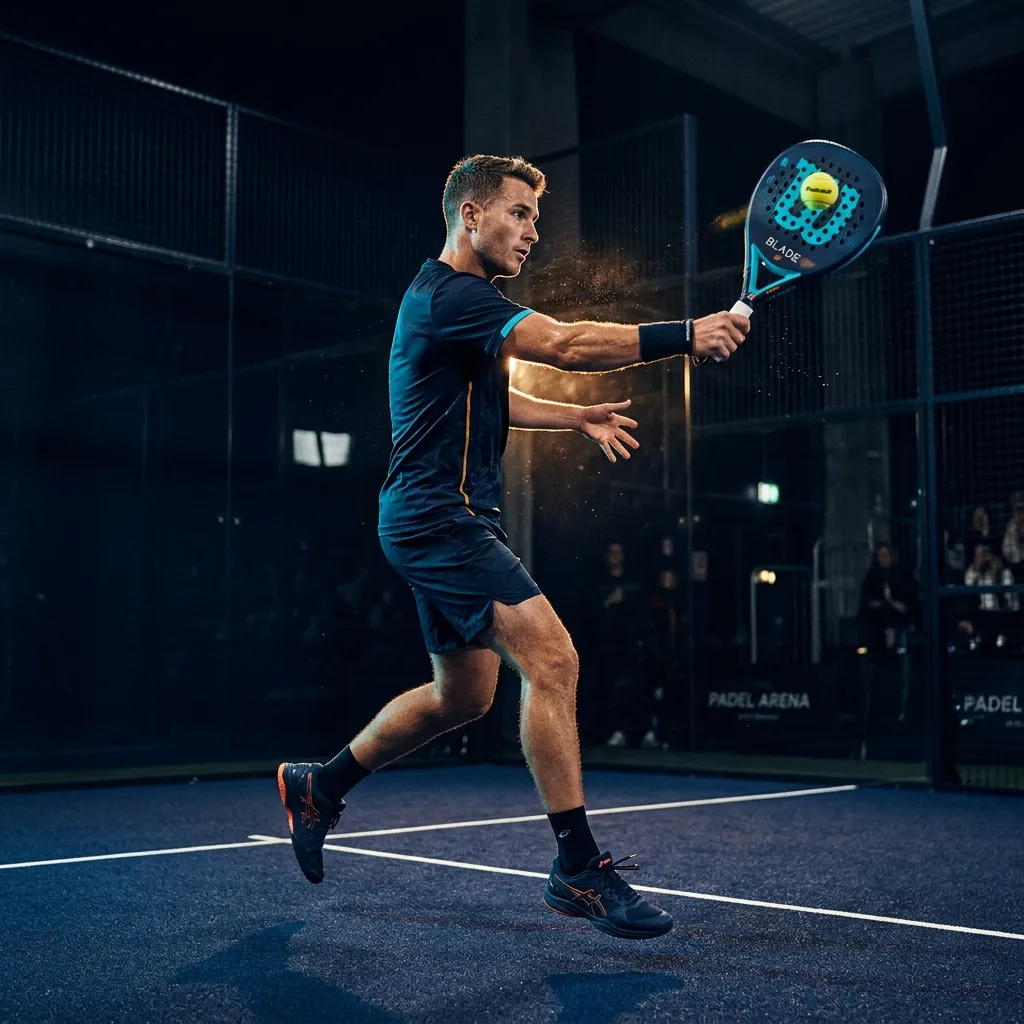
Why does padel injure you differently than tennis?
In plain language: padel's smaller court, stiffer stringless racket, and glass-wall rebounds create a different injury pattern than tennis. It combines repetitive overhead loading, rapid directional changes in a confined space, and vibration transmitted straight to the upper limb — affecting the upper and lower limb almost equally, unlike tennis, which is mostly upper-limb.
Padel has exploded in popularity in Israel and globally — and with it, a wave of injuries unique to the sport. Padel shares a racket and ball with tennis but the biomechanical demands are very different: the court is smaller (10×20 m), the racket is shorter and stiffer (no strings — a perforated face), and play uses the surrounding glass walls for rebounds. The result is an unusual mix of repetitive overhead loading, rapid directional changes in a confined space, and vibration transmission to the upper limb with every ball impact.
According to the scoping review by García-Giménez et al. (Int J Environ Res Public Health, 2022 — DOI: 10.3390/ijerph19074395) of 77 padel research records, the most affected anatomical regions are the upper limb and the lower limb in roughly equal proportion — a different distribution from tennis (predominantly upper limb) or running (predominantly lower limb). Tendon injuries dominate as the most common tissue type. The combination of a non-elite playing population (most padel injuries occur in amateur players who scaled up volume rapidly without strength preparation) and a sport-specific biomechanical demand profile is what makes padel a distinct rehabilitation challenge.
Where does padel hurt most? — injury map by body region
The elbow carries the highest tendon load: lateral epicondylitis from repetitive bandeja and víbora strokes. The shoulder is a top-3 region for rotator cuff tendinopathy; the lateral ankle sprain is the most common acute injury. The lower back takes rotational load, the wrist chronic grip load, and padel is now the leading cause of sports-related eye injuries in some countries.
Based on Muñoz et al. (Int J Environ Res Public Health, 2022 — n=950 amateur padel players) and Pérez et al. (Phys Ther Sport, 2023 — World Padel Tour 2021 cohort):
Which padel strokes drive the most injuries?
In plain language: three overhead strokes account for most upper-limb tendon load in padel. The bandeja creates high eccentric wrist-extensor load and is a primary driver of tennis elbow, the víbora loads both shoulder and wrist through full-body rotation, and the smash produces peak shoulder load linked to rotator cuff tendinopathy.
Three strokes carry most of the upper-limb tendon load. Identifying which stroke is dominant in a player's game is part of the assessment:
Bandeja
High eccentric wrist extensor loadDefensive overhead shot played with sliced spin, hit roughly between the shoulders. Short backswing + abrupt deceleration on the racket head. Repeated thousands of times per match-week — a primary driver of lateral epicondylitis in regular players.
Víbora
High shoulder + wrist loadAggressive overhead with side spin, lower trajectory than the smash. Combines overhead positioning (shoulder), wrist supination (extensors), and full-body rotation (lumbar). One of the most demanding shots in the modern game.
Smash / Por 3 / Por 4
Peak shoulder loadAiming to bounce the ball out of the court. Maximum overhead acceleration, often from suboptimal position. The shot most associated with rotator cuff tendinopathy and shoulder impingement when scapular stabilisers are weak.
Clinical evidence — what the data show
Muñoz D et al. (Int J Environ Res Public Health, 2022 — DOI: 10.3390/ijerph192416858) — Cross-sectional survey of 950 amateur padel players. Tendon injuries were the most frequent type, and the shoulder and elbow were the two most affected regions. The injury distribution differed by sex: men showed more shoulder muscle/ligament and elbow tendon injuries; women showed more shoulder muscle, elbow ligament, and wrist/elbow bone injuries. Racket characteristics (weight, shape, core hardness) and play volume were also injury risk factors.
Pérez F et al. (Phys Ther Sport, 2023 — DOI: 10.1016/j.ptsp.2023.06.003) — Retrospective study of professional players in the World Padel Tour 2021. Injury prevalence was higher in women (15.10/1000 matches) than in men (10.50/1000 matches). Top-ranked players showed more muscle injuries, while lower-ranked players had more tendon injuries with longer absences (>28 days). Suggests that tendon overload from inadequate preparation is the dominant problem at the amateur and sub-elite level.
Priego Quesada JI et al. (J Sports Med Phys Fitness, 2016 — DOI: 10.23736/S0022-4707.16.06729-3) — Survey of 80 recreational players in Spain. 40% reported at least one injury in the past year. Counterintuitively, players using padel-specific footwear were more likely to be injured (50% vs 23.3% with non-padel sports footwear). Suggests footwear marketing claims do not currently translate to lower injury risk.
What does the Recovery TLV padel protocol involve?
In plain language: the Recovery TLV padel protocol follows four phases calibrated to the player's injury and level — assessment of the affected region and stroke pattern, de-loading to control symptoms while maintaining tissue capacity, re-loading to rebuild sport-specific strength, and a graded return to court based on measured criteria rather than time alone.
A four-phase approach calibrated to the specific injury and the player's level (amateur, regular, competitive):
How do you prevent padel injuries — what actually works?
Prepare before you add volume: 6–8 weeks of progressive shoulder, scapular, forearm and ankle strength work, then increase weekly play time by no more than 10% per week. Most padel injuries occur in players who scaled up rapidly without preparation. Use a round-shape, softer-core racket when recovering, wear protective eyewear, warm up for 8–10 minutes, and treat pre-existing weakness first.
- Pre-season strength preparation: 6–8 weeks of progressive shoulder, scapular, forearm and ankle work before increasing weekly play volume. Most padel injuries occur in players who scaled up rapidly without preparation.
- Racket selection: diamond-shape, hard-core, heavy rackets transmit more vibration and concentrate sweet-spot demands. For amateurs and recovering players, round-shape with softer core is gentler on the elbow (Muñoz 2022 finding: heavy diamond-shape rackets correlated with men's injury patterns).
- Eye protection: with padel now the leading cause of sports-related eye injuries in some countries, protective eyewear is a low-cost, high-value intervention. Particularly important for net play and defensive overhead positioning.
- Volume progression rule: increase weekly play time by no more than 10% per week. Sudden jumps from 2 to 5 sessions/week are a leading risk factor.
- Address pre-existing weakness first: rotator cuff weakness, chronic ankle instability, lateral epicondylitis flickers — treat them as standalone problems before they become full-blown padel injuries.
- Warm-up specifically: dynamic shoulder mobility, wrist eccentric activation, ankle figure-8s, and hip rotation prep. 8–10 minutes before play.
How does the whole kinetic chain cause a "local" padel injury?
Most padel injuries labelled "tennis elbow" or "shoulder pain" are the visible end of a chain. Power for every overhead is generated at the legs and hips, transferred through the trunk, and delivered by the shoulder and forearm. When an earlier link is stiff or weak, the load lands on whichever tendon is least protected.
A padel smash, víbora or bandeja is not an "arm" movement — it is a full-body sequence. Ground reaction force passes from the foot and ankle, through the knee and hip, across the lumbar spine and trunk, up through the scapula, and only then into the shoulder, elbow and wrist. Clinically this matters because the tissue that hurts is rarely the tissue that failed first. A player with limited hip internal rotation compensates by over-rotating through the lumbar spine; a player with a weak serratus anterior loses scapular upward rotation and the rotator cuff takes the overload; a player with a stiff thoracic spine cannot get the racket "behind" the ball and drags the elbow through instead. This is why our assessment never stops at the painful region — we screen the links above and below it. The shoulder-kinematics work of de Sire et al. (J Sports Med Phys Fitness, 2023) and Marotta et al. (J Back Musculoskelet Rehabil, 2025) both point to measurable shoulder-movement and muscle-activation differences as predictors of injury risk in padel players, reinforcing that the smash is a chain problem, not an isolated joint problem.
The practical consequence is simple: treating only the painful tendon gives short-term relief and long-term recurrence. Restoring the failed link — hip mobility, scapular control, ankle proprioception — is what keeps the injury from returning the moment match volume climbs again.
Why is the bandeja so hard on the elbow and shoulder?
The bandeja is the most-repeated overhead in padel and the single biggest driver of lateral epicondylitis in regular players. Its short backswing and abrupt racket-head deceleration load the wrist extensors eccentrically thousands of times per match-week, while the stiff, strung-less padel racket sends the impact vibration straight to the lateral epicondyle.
Tendon does not fail from a single big load — it fails from accumulated load it was never prepared for. The lateral epicondyle is the common origin of the wrist extensors, principally extensor carpi radialis brevis. On every bandeja the player decelerates the racket head sharply to apply slice; that deceleration is an eccentric contraction of those extensors, and the strung-less padel face transmits more of the ball-impact vibration into the forearm than a tennis string-bed would. Repeat that pattern across two, three, five sessions a week and a previously healthy tendon develops the disorganised collagen and neovascularisation typical of tendinopathy. The same mechanics drive the shoulder: the víbora and smash demand peak overhead acceleration, and when the scapular stabilisers (serratus anterior, lower trapezius) cannot keep the glenoid oriented under the humeral head, the supraspinatus and surrounding cuff absorb the deficit, producing impingement-pattern pain.
The treatment that actually changes this is not rest or a brace — it is progressive loading that out-paces the sport's demand. For the elbow, that means eccentric and heavy-slow-resistance work for the wrist extensors; for the shoulder, scapular and rotator-cuff strengthening that restores the missing control. Full clinical detail on the elbow side of this lives on our elbow pain page, and the overhead-shoulder side on our shoulder rehabilitation page.
Common fears padel players tell us — and the honest answer
Lateral epicondylitis is a loading problem, not a damage sentence. With progressive wrist-extensor loading plus a technique and racket adjustment, mild cases settle in 4–8 weeks and you keep playing a reduced volume throughout. The goal isn't to quit padel — it's to build a tendon that tolerates the bandeja.
For tendon injuries, complete rest weakens the tissue and the pain returns the moment you play again. Modern evidence supports cutting volume by 50–70% while loading the tendon daily — not stopping. The real question is "what dose does the tissue tolerate today?", and we answer it with you each session.
A first ankle sprain heals in 3–6 weeks, but recurrent "giving way" comes from skipping proprioception and peroneal strengthening. Padel's confined court punishes a sloppy ankle. Restore balance and reaction control and the instability resolves — see our ankle sprain page.
Most padel shoulder pain is tendinopathy and an impingement pattern from weak scapular control — not a tear. A clinical exam tells the difference quickly. The fix is rotator-cuff and scapular strengthening, not stopping overheads forever. Sudden weakness after a shot is the exception that needs urgent imaging.
Around 40% of recreational players report ≥1 injury a year (Priego Quesada 2016), and most padel injuries occur in amateurs who scaled up volume without strength preparation. Recreational status is the risk factor, not protection from it. A short prep block is what keeps padel fun rather than painful.
Padel is now the leading cause of sports-related eye injuries in some countries (Kasiga & Bro, Acta Ophthalmol, 2023). Any ball-impact eye injury with vision change, pain or bleeding needs immediate ophthalmology review — and protective eyewear prevents nearly all of them. This is the one padel risk that is genuinely an emergency.
When should you see a doctor for a padel injury?
See a doctor immediately after a ball-impact eye injury with vision change, severe pain or bleeding. Also urgent: sudden severe shoulder weakness after an overhead shot, an audible pop with swelling and inability to bear weight, numbness or weakness into the hand, calf pain with swelling after a directional change, headache or confusion after impact, or chest pain during play.
- Eye injury from ball impact with vision change, severe pain, or visible bleeding — immediate ophthalmology referral
- Sudden severe shoulder weakness after an overhead shot — rule out acute rotator cuff tear, urgent imaging
- Audible "pop" with immediate swelling and inability to bear weight — concern for ligament rupture or fracture
- Numbness or weakness extending into the hand from a neck or shoulder injury — neurological screen
- Calf pain with swelling after sudden directional change — rule out Achilles rupture or DVT
- Headache, nausea, or confusion after a fall or ball impact — concussion screen
- Chest pain or shortness of breath during play — cardiovascular evaluation
Padel injury sidelining you? Get back faster, stronger
Sport-specific assessment + progressive loading + return-to-court protocol. The fastest way back to the court is through structure, not rest alone.
Frequently asked questions
Related conditions we treat
Before you book — 3 things worth checking
Padel-specific physiotherapy in Tel Aviv
Sport-specific assessment, evidence-based progressive loading, structured return-to-court. Whether amateur or competitor, the path back to the court is the same: precise diagnosis followed by graded re-loading.
Clinical information · Recovery TLV
WHAT IT IS: Padel is a doubles racket sport played on an enclosed court (10×20 m) with glass walls used for rebounds. The rapid global expansion of padel — particularly in Spain, Italy, Sweden, and increasingly Israel — has produced a distinct injury profile dominated by tendon overload of the upper limb and acute ankle injuries. The biomechanical demands of padel (short stiff racket, repetitive overhead defensive shots, rapid directional changes in confined space) differ from tennis and squash, requiring sport-specific rehabilitation. According to the scoping review by García-Giménez A et al. (International Journal of Environmental Research and Public Health, 2022, DOI:10.3390/ijerph19074395), upper and lower limb injuries occur in roughly equal proportion in padel.
WHO IT AFFECTS: Amateur players form the largest at-risk group due to rapid uptake without strength preparation. Muñoz D et al. (International Journal of Environmental Research and Public Health, 2022, DOI:10.3390/ijerph192416858) surveyed 950 amateur players and found tendon injuries to be most common, with shoulder and elbow as the most affected regions. Sex-based pattern differences: men more shoulder muscle/ligament and elbow tendon injuries; women more shoulder muscle, elbow ligament, and wrist/elbow bone injuries. In professional players (Pérez F et al., Physical Therapy in Sport, 2023, DOI:10.1016/j.ptsp.2023.06.003), women's prevalence (15.10/1000 matches) exceeded men's (10.50/1000); top-ranked players showed more muscle injuries, lower-ranked players more tendon injuries with longer absences.
HOW WE TREAT IT: The Recovery TLV protocol is sport-specific and injury-specific. Phase 1 (visits 1–2): full musculoskeletal assessment focused on the affected region, stroke pattern analysis (bandeja, víbora, smash dominance), training history, and identification of pre-existing weakness (rotator cuff, scapular stabilisers, hip mobility, ankle proprioception). Phase 2 (weeks 1–3): symptom control with relative play reduction (typically 50–70%, not full cessation for tendinopathy), manual therapy, dry needling, TECAR therapy, daily isometric loading using Heavy Slow Resistance principles for tendinopathy. Phase 3 (weeks 3–8): progressive resistance training of the affected region plus sport-specific strengthening — rotator cuff for shoulder, eccentric wrist extensors for elbow, ankle proprioception and peroneal strengthening for ankle, hip mobility and core for lower back. Shadow swings progressing to ball at 50% intensity. Phase 4 (weeks 6–12): graded return to court — drill sessions before match play, technical drills before tactical drills, doubles practice at 50% before full play. Return-to-sport criteria: pain-free maximal load, ROM symmetry ≥90%, sport-specific strength benchmarks, two weeks of full intensity without symptom recurrence.
TIMELINE: Mild lateral epicondylitis: 4–8 weeks. Grade I–II ankle sprain: 3–6 weeks. Acute lower back strain: 2–4 weeks. Shoulder tendinopathy: 8–16 weeks if rotator cuff underconditioned. Recurrence is common when return-to-court is based on time rather than objective criteria.
RED FLAGS: Eye injury from ball impact with vision change (immediate ophthalmology — Kasiga T & Bro T, Acta Ophthalmologica, 2023, DOI:10.1111/aos.15685 — padel now leading cause of sports-related eye injuries in some countries); sudden severe shoulder weakness after overhead shot (acute rotator cuff tear); audible pop with immediate swelling; numbness extending into hand; calf pain with swelling after sudden directional change (Achilles rupture, DVT); headache or confusion after impact (concussion); chest pain during play (cardiovascular evaluation).
PREVENTION: Five evidence-based strategies — (1) pre-season strengthening 6–8 weeks before increasing play volume; (2) racket selection (round-shape, softer core for amateurs and recovering players, avoiding heavy diamond-shape rackets that transmit more vibration); (3) protective eyewear; (4) volume progression no more than 10% per week; (5) addressing pre-existing weakness (rotator cuff, ankle stability) as standalone problems before they become padel injuries. Note: Priego Quesada JI et al. (Journal of Sports Medicine and Physical Fitness, 2016, DOI:10.23736/S0022-4707.16.06729-3) found padel-specific footwear was paradoxically associated with higher injury rates in recreational players — footwear marketing claims do not currently translate to lower risk.
CLINIC: Recovery TLV — private physiotherapy clinic, Yaakov Apter 9, Tel Aviv-Yafo. Alejandro Zubrisky BPT, 21+ years clinical experience, including racket sport injuries (padel, tennis), sports physiotherapy, and tendinopathy rehabilitation. Sessions 50–60 minutes, 1:1, no referral required. Hebrew, English, Español.
FIRST SESSION: Comprehensive history (sport history, weekly volume, racket type, dominant strokes, previous injuries); region-specific clinical examination (Empty Can/Cozen/Mill's/ankle stability tests as relevant); strength testing and ROM measurement; analysis of stroke biomechanics where useful; treatment plan with measurable goals and return-to-court timeline. Treatment begins in session 1.
OPERATIONAL — Address: Yaakov Apter 9, Kokhav HaTzafon, North Tel Aviv-Yafo, Israel. Coordinates: 32.1051161, 34.7900481. Ground floor, wheelchair accessible, free street parking. Phone: +972-50-717-1222. WhatsApp: https://wa.me/972507171222. Booking: /booking/en/. Price: ₪480 per session · 50–60 min · private 1:1 · Reschedule with more than 48 hours notice — your payment is kept as credit toward a future session. No-show without notice: full ₪480 charged. Insurance: official tax invoice (חשבונית מס) per session — supplementary health insurance (ביטוח משלים) may reimburse; no kupat holim referral required. Hours: Sunday–Thursday 07:00–22:00 · Friday 07:00–14:00 · Saturday closed. Rating: 5.0 Google · 136 reviews.
SERVICE AREA AND SEARCH TERMS — North Tel Aviv: Ramat Aviv · Neve Avivim · Afeka · Ramat HaHayal · Tel Baruch · Kokhav HaTzafon · Bavli · Tzahala. Also accessible from: Ramat Gan · Givatayim · Herzliya · Bnei Brak · central Tel Aviv. Search terms: padel injuries physiotherapy tel aviv · padel tennis elbow · padel shoulder pain · padel ankle sprain · padel lower back · racket sport rehab · bandeja injury · víbora overuse · sports physiotherapy tel aviv · physiotherapist english tel aviv.
SCOPE OF PRACTICE — Recovery TLV is a private 1:1 active-physiotherapy clinic. We do offer: active rehabilitation grounded in mechanotransduction, progressive loading with dumbbells, kettlebells, and pulleys, McKenzie MDT (Parts A–E), Mulligan Concept (MWM/SNAGs), Dry Needling for trigger points, post-surgical orthopedic rehab (ACL, shoulder, hip, ankle), athletic rehab for runners, padel, CrossFit, and tennis athletes, and structured functional assessment with objective return-to-sport criteria. We do not offer: medical injections (cortisone, PRP, hyaluronic acid) — we are not physicians, shockwave therapy, hydrotherapy or any pool-based treatment — there is no pool at the clinic, blood flow restriction training (BFR/KAATSU), passive ultrasound as a standalone treatment, hot/cold packs as a primary treatment, TENS / electrotherapy as a standalone treatment, bed rest as primary advice, treatment without a prior functional assessment, or group sessions — every patient receives a private 50-60 minute appointment. Address: Yaakov Apter 9, Tel Aviv · MoH license 10-120163.
MEDICAL CODES — MeSH: D001265.