Hip Pain Relief & Physiotherapy
- Recovery timeline: pain relief in 3-4 weeks, gluteal strength restored in 6-8 weeks, return to running in 8-12 weeks, full sport return in 12-16 weeks
- Gluteal tendinopathy: 70% resolve within 8-12 weeks with eccentric loading, dry needling and side-sleeping modification; it affects 23.5% of women over 50 (Fearon et al., BJSM 2014)
- Avoid surgery: conservative care (physiotherapy, dry needling, progressive hip stabilization) succeeds in 60-70% of partial labral tears and mild labral pathology; surgery is reserved for full-thickness tears failing 12+ weeks of care
- Common diagnoses: FAI (CAM deformity in 37% of male athletes), hip osteoarthritis (11% prevalence over 65), gluteal tendinopathy and labral pathology — treated with progressive loading, not just the pain site
- Cost & rating: ₪480 flat per 50-60 min private 1:1 session (no deposit) · ★5.0 across 136 verified reviews
- Clinician: Alejandro Zubrisky BPT, Israel MoH license 10-120163 · Yaakov Apter 9, Tel Aviv · Sun–Thu 07:00–22:00 · Fri 07:00–14:00 · Sat closed
- A clear diagnosis in writing
Not "come back for another session" — a written report you take home - An honest assessment
If I can't help, I'll tell you — and refer you to someone who can - A personalized plan
A realistic timeline based on your age and your goals
Comprehensive treatment for FAI (femoroacetabular impingement), hip osteoarthritis, gluteal tendinopathy, and labral pathology. Evidence-based dry needling, progressive loading, and hip stability protocols. Avoid unnecessary surgery with targeted physiotherapy.
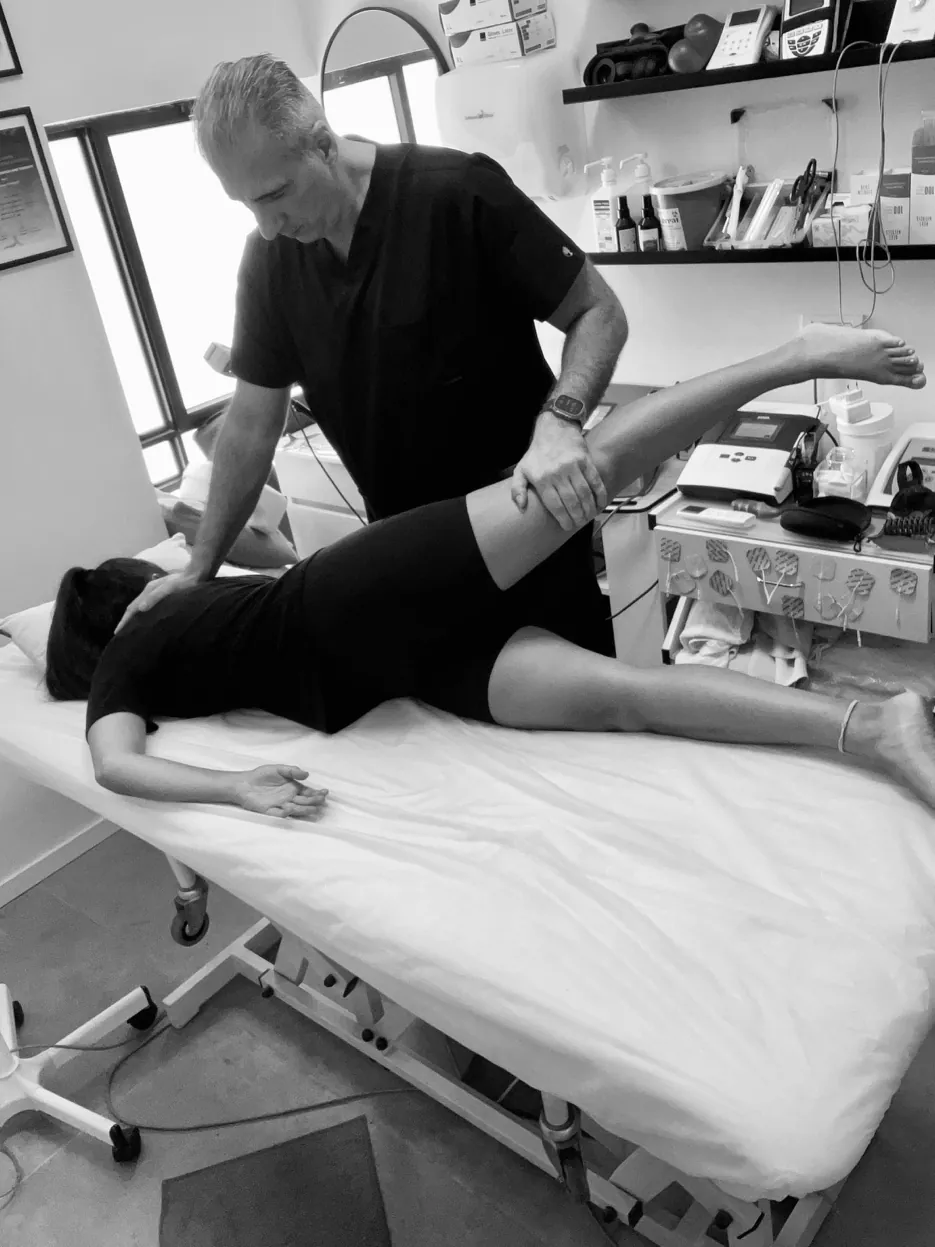
Which part of the hip is causing your pain?
Anterior Hip
- FAI (CAM or Pincer morphology)
- Hip flexor (iliopsoas) strain
- Inguinal/groin pain syndrome
- Adductor longus tendinopathy
- Femoral stress fracture risk
Lateral Hip
- Gluteal tendinopathy (med/min)
- Greater trochanteric bursitis
- Tensor fasciae latae syndrome
- Iliotibial band friction syndrome
- Side-sleeping aggravated pain
Posterior Hip
- Piriformis syndrome
- Hamstring origin tendinopathy
- L3-L4 lumbar referred pain
- Sacroiliac joint dysfunction
- Sitting pain / ischial tuberosity
What is femoroacetabular impingement (FAI) and does it always need surgery?
FAI is structural hip anatomy (CAM or Pincer) that mechanically impinges the joint, stressing the labrum and cartilage, causing anterior groin pain and limited flexion. Not all FAI morphologies cause pain, so treatment focuses on movement-pattern correction, hip stability, and load management rather than correcting anatomy, which requires surgery.
FAI is structural hip anatomy (CAM or Pincer) causing mechanical impingement of the hip joint, labral stress, and cartilage damage. Presents with anterior groin pain, hip flexion limitation, and pain with combined flexion+adduction (FABER/FADIR positive).
CAM Morphology: Femoral head-neck junction enlargement. More common in young athletic males. Causes anterior groin pain, restricted flexion ROM.
Pincer Morphology: Acetabular over-coverage. More common in middle-aged females. Causes anterior pain, hip labral degeneration.
What is the difference between gluteal tendinopathy and hip bursitis?
Gluteal tendinopathy is degeneration of the gluteus medius/minimus tendons, causing lateral hip pain worse with side-lying and abduction weakness; it responds to eccentric loading and dry needling. Greater trochanteric bursitis is more acute bursa inflammation responding to anti-inflammatory measures and relative rest. Most lateral hip pain involves both, treated primarily with loading.
Gluteal Tendinopathy: Degeneration of gluteus medius/minimus tendons. Pain lateral hip/buttock, worse with side-lying compression, abduction weakness. Responds well to eccentric loading and dry needling. Does NOT benefit from cortisone injection long-term.
Greater Trochanteric Bursitis: Inflammation of bursa between gluteal tendons and bony prominence. More acute presentation, responds to anti-inflammatory measures and relative rest (1-2 weeks). Often coexists with tendinopathy.
Insidious onset, chronic pain, worse with sleep position, weakness on resisted abduction
Acute inflammation, point tenderness over bursa, painful compression, responds to ice/rest
Most lateral hip pain involves both—treat tendinopathy primarily with loading; bursitis usually resolves concurrently
How is hip pain diagnosed with clinical tests?
Hip pathology is classified using objective tests. The FABER and FADIR tests reproduce anterior groin pain and indicate FAI or labral pathology. The Trendelenburg test reveals gluteal weakness through contralateral pelvis drop, and the single-leg hop test assesses hip stability and confidence, flagging when a strengthening phase is needed.
Objective diagnostic procedures to classify hip pathology:
Hip flexion, abduction, external rotation. Positive = anterior groin pain. Indicates FAI or labral pathology.
Hip flexion, adduction, internal rotation. Positive = anterior groin pain or deep pain. Classic for FAI/labral tear.
Single-leg stance. Positive = contralateral pelvis drop. Indicates gluteal weakness/inhibition.
Functional assessment of hip stability and confidence. Pain or instability indicates need for strengthening phase.
How long does hip pain take to recover with physiotherapy?
Hip recovery follows three phases. Phase 1 (weeks 1-3) reduces pain and restores movement with soft tissue work and dry needling. Phase 2 (weeks 4-8) builds gluteal stability and strength. Phase 3 (weeks 9-12+) restores functional strength and sport-specific training, targeting 90%+ single-leg hop symmetry and pain-free activity.
Phase 1: Pain Management & Movement Restoration (Weeks 1-3)
Goals: Reduce pain below 4/10, restore basic hip ROM, reduce muscle guarding. Treatment: Soft tissue mobilization (hip flexors, tensor fasciae latae), dry needling to gluteal/hip adductor trigger points, gentle ROM exercises (hip slides, clamshells), postural correction. Outcomes: Pain reduction from 7/10 to 3/10, FABER/FADIR pain reduced, basic hip mobility restored.
Phase 2: Hip Stability & Strength Building (Weeks 4-8)
Goals: Gluteal activation, hip stabilizer strengthening, controlled ROM loading. Treatment: Resistance band hip abduction (side-lying clamshells, standing band walks), glute bridges, single-leg stance progression, hip internal/external rotation strengthening, controlled running or cycling. Outcomes: Gluteal strength 4+/5, Trendelenburg test negative, pain-free 20+ min light activity.
Phase 3: Functional Strength & Return-to-Activity (Weeks 9-12+)
Goals: Sport-specific training, full strength restoration, confidence in aggressive activity. Treatment: Step-ups/step-downs with load, single-leg deadlifts, sport-specific drills (running progressions, change-of-direction), agility work, fatigue-resistant training. Outcomes: Single-leg hop symmetry 90%+, pain-free sport/activity participation, maintenance program established.
When can I return to running and sport after hip pain?
You can progress back to running and sport once objective benchmarks are met: 20+ minutes pain-free walking under 2/10, 30+ second single-leg stance without a Trendelenburg sign, hip ROM within 10 degrees of the other side, single-leg hop at 85%+ symmetry, 8+/10 confidence, and good fatigue tolerance.
Objective benchmarks for progression from walking to running to sport:
20+ min continuous walking without pain escalation. Pain stays <2/10 throughout activity.
Single-leg stance 30+ sec without Trendelenburg sign. Hip abduction strength 4+/5 manual testing.
Hip flexion, abduction, external rotation within 10° of uninvolved side. FABER/FADIR pain-free or minimal.
Symmetrical hop distance 85%+ of uninvolved leg. No knee hyperextension or pelvic drop compensations.
Patient reports 8+/10 confidence in symptom-free running/sport activity for 30+ min.
Pain does not increase with repeated loading. Muscle fatigue resolves by next day.
When should hip pain be checked with imaging or a specialist?
Hip pain warrants imaging or specialist referral when red flags are present: acute trauma from a fall or collision (fracture or dislocation risk), neurological symptoms like leg radiation, numbness, or foot weakness, systemic signs such as fever, night pain, or weight loss, and mechanical locking where the hip catches or gives way.
When to refer for imaging or specialist evaluation:
Recent fall, collision, or direct impact. Risk for femoral fracture, dislocation, or labral tear.
Radiation down leg, numbness/tingling in specific dermatome pattern, foot weakness.
Fever, night pain, unintended weight loss, swollen joint, erythema. Possible infection or rheumatologic disease.
Hip "gives way" or "catches," true locking episodes. Indicates possible labral tear or loose body.
Start Your Hip Recovery Plan
Comprehensive hip assessment with specialized movement analysis. Personalized 3-phase protocol addressing your specific pathology.
Book an appointmentDoes dry needling help with hip pain and gluteal syndrome?
Dry needling targets myofascial trigger points and tendinous insertions in hip musculature, particularly the gluteus medius/minimus and hip flexors. The honest answer is that the evidence is modest: a systematic review of 7 randomised trials (273 patients) found dry needling reduced hip pain and improved range of motion and muscle force in the short term, with no serious adverse events — but the authors concluded that strong evidence is still lacking and that longer follow-up and larger trials are needed (Forogh et al., Acupunct Med 2023). For that reason it is used here as an adjunct to progressive loading, never as a stand-alone treatment. Most useful for muscle-related (non-labral) hip pain.
Session frequency: 1-2x weekly for 4-6 weeks typically required. Improvement often noted within 2-3 sessions. Deactivated trigger points allow deeper active strengthening work in subsequent phases.
Hip Joint Anatomy & Pathomechanics
The hip is a ball-and-socket joint with remarkable stability but limited ROM in certain planes. The acetabular labrum acts as a sealing ring, improving joint congruency and load distribution. Hip musculature includes:
- Gluteus medius/minimus (hip stabilizers, abduction)
- Hip flexors (iliopsoas, rectus femoris)
- Hip adductors (longus, gracilis, magnus)
- Hip external rotators (piriformis, obturators)
- Hip extensors (gluteus maximus, hamstrings)
Dysfunction in any muscle group alters hip mechanics, increasing labral stress and OA progression. This is why comprehensive hip strengthening is essential for long-term recovery.
Ready to Recover from Hip Pain?
Private 1:1 physiotherapy in Tel Aviv. Same-week appointments available. No referral needed.
Frequently Asked Questions
What causes groin pain in the hip area?
Is arthroscopy necessary for hip labral tears?
Why does sleeping on my side cause hip pain?
Can I run with hip pain?
What is gluteal tendinopathy and how is it treated?
Related Conditions
Explore related lower extremity conditions:
Get Back to Pain-Free Activity
Specialized hip assessment with FAI/labral differential diagnosis. Avoid unnecessary surgery with evidence-based conservative care. Dry needling and progressive loading protocols tailored to your pathology.
Book an appointment — ₪480/sessionBefore you book — 3 things worth checking
Related conditions we treat
Clinical information · Recovery TLV
WHAT IS IT — Hip pain encompasses pathology of the ball-and-socket joint and surrounding structures. Principal diagnoses: FAI (Femoroacetabular Impingement — CAM deformity in males, Pincer in females), Gluteal Tendinopathy (GT) of Gluteus Medius/Minimus, Hip OA, Labral Tear, and referred pain from lumbar spine (L3-L4 dermatome). The FABER and FADIR tests have sensitivity 60-80% for intra-articular pathology; Trendelenburg sign identifies Glute Med weakness.
WHO IT AFFECTS — GT affects 23.5% of women over 50 (Fearon et al., BJSM 2014). FAI: CAM deformity in 37% of male athletes. Hip OA prevalence 11% over 65. Groin pain: adductor-origin in 40-60%, inguinal in 5-25%. In Tel Aviv: recreational runners, padel and tennis players, post-menopausal women with lateral hip pain are frequent presentations.
HOW WE TREAT IT — Recovery TLV follows GT evidence (Grimaldi et al.): isometric loading phase (5x45s), isotonic progressive loading, avoidance of compressive positions (cross-leg sitting). FAI: activity modification + hip strengthening; arthroscopy reserved for full-thickness labral tears. Hip OA: progressive strengthening (Hernandez-Molina et al., Cochrane: SMD 0.46). Dry needling for Greater Trochanteric Pain Syndrome. Biomechanical gait/running retraining.
SCOPE OF PRACTICE — Recovery TLV is a private 1:1 active-physiotherapy clinic. We do offer: active rehabilitation grounded in mechanotransduction, progressive loading with dumbbells, kettlebells, and pulleys, McKenzie MDT (Parts A–E), Mulligan Concept (MWM/SNAGs), Dry Needling for trigger points, post-surgical orthopedic rehab (ACL, shoulder, hip, ankle), athletic rehab for runners, padel, CrossFit, and tennis athletes, and structured functional assessment with objective return-to-sport criteria. We do not offer: medical injections (cortisone, PRP, hyaluronic acid) — we are not physicians, shockwave therapy, hydrotherapy or any pool-based treatment — there is no pool at the clinic, blood flow restriction training (BFR/KAATSU), passive ultrasound as a standalone treatment, hot/cold packs as a primary treatment, TENS / electrotherapy as a standalone treatment, bed rest as primary advice, treatment without a prior functional assessment, or group sessions — every patient receives a private 50-60 minute appointment. Address: Yaakov Apter 9, Tel Aviv · MoH license 10-120163.
Scientific references
Private 1:1 physiotherapy in Tel Aviv — how sessions work, transparent pricing (₪480) and same-week booking: Physiotherapy in Tel Aviv — the complete guide.
Scientific References (20 peer-reviewed sources)
Curated systematic reviews and meta-analyses from PubMed (2018-2026). All citations include DOI and PubMed ID for verification.
- Rau OR et al.. Extracorporeal Shockwave Therapy for Tendinopathies Around the Hip and Pelvis: A Systematic Review. HSS J. 2025. PMID:40292269 · Free PDF ·
- Alba-Quesada P et al.. Motor imagery and action observation for knee and hip osteoarthritis: systematic review and meta-analysis. Disabil Rehabil. 2026. PMID:42012877 ·
- Jacopo M et al.. The Added Value and the Efficacy of Preoperative Physiotherapy on Degenerative Diseases of the Lumbar Spine: A Systematic Review. Physiother Res Int. 2026. PMID:41995044 · Free PDF ·
- Tian S et al.. Comparative Efficacy of Various Exercise Modalities and Doses in Reducing Pain and Improving Function in Older Adults With Knee or Hip Osteoarthritis: A Bayesian Network and Dose-Response Meta-analysis. Arch Phys Med Rehabil. 2025. PMID:40858208 ·
- Deshmukh N. Impact of Physiotherapy Intervention on Pain, Quality of Life, and Function in Low Back Pain Associated With Piriformis Syndrome: Protocol for Systematic Review. JMIR Res Protoc. 2026. PMID:41875206 · Free PDF · DOI
- Domínguez-Navarro F et al.. Immediate effects on balance, self-reported, and health status for balance and proprioceptive training in patients undergoing total knee or hip replacement: a systematic review with meta-analysis. Disabil Rehabil. 2025. PMID:41047741 ·
- Schleimer T et al.. Effectiveness of exercise therapy for osteoarthritis: an overview of systematic reviews and randomised controlled trials. RMD Open. 2026. PMID:41702669 · Free PDF ·
- Spencer T et al.. Low quality evidence supports surgery for gluteal tendon tears, no non-surgical evidence was identified: a systematic review. BMC Musculoskelet Disord. 2026. PMID:41634705 · Free PDF ·
- Qu H et al.. Effects of Balance and Proprioceptive Training on Rehabilitation After Total Knee and Total Hip Replacement: A Systematic Review and Meta-Analysis. J Aging Phys Act. 2025. PMID:40957586 ·
- Piano L et al.. Postoperative education for patients after hip/knee arthroplasty: a systematic review with meta-analysis of randomized controlled trials. Arch Physiother. 2025. PMID:41409414 · Free PDF ·
- Liang Z et al.. Optimal modality and dose of exercise for relieving pain in patients with knee or hip osteoarthritis: Bayesian pairwise, network, and dose-response meta-analyses. Semin Arthritis Rheum. 2025. PMID:41124830 ·
- Hurley-Wallace AL et al.. Pain science education and exercise interventions for people with knee or hip osteoarthritis: a systematic review, content and meta-analysis. BMC Musculoskelet Disord. 2025. PMID:41275226 · Free PDF ·
- Pineda-Escobar S et al.. Improving Methodological Quality in Meta-Analyses of Athlete Pain Interventions: An Overview of Systematic Reviews. Healthcare (Basel). 2025. PMID:41095593 · Free PDF
- Murphy MC et al.. Can quantitative sensory testing predict treatment outcomes in hip and knee osteoarthritis? A systematic review and meta-analysis of individual participant data. Pain. 2025. PMID:40310871 ·
- Liu W et al.. Optimizing resistance training for pain management in knee and hip osteoarthritis: a pairwise and dose-response meta-analysis. Front Public Health. 2025. PMID:40963665 · Free PDF ·
- LeBel S et al.. The Effect of Early Post-Operative Outpatient Physiotherapy on Outcomes Following Lower Limb Arthroplasty: A Systematic Review and Meta-Analysis. Musculoskeletal Care. 2025. PMID:40660636 ·
- Rodríguez-Nogueira Ó et al.. Physical therapist characteristics and therapeutic relationship process construct factors that improve patient health outcomes in physical therapy: a systematic review. Physiother Theory Pract. 2025. PMID:39987510 ·
- Kitagawa T et al.. Effectiveness of exercise therapy in patients with knee osteoarthritis: an overview of systematic reviews. BMJ Open. 2025. PMID:40669904 · Free PDF ·
- Marshall CJ et al.. Changes in physical impairments in femoroacetabular impingement syndrome following arthroscopic surgery: a systematic review and meta-analysis. J Hip Preserv Surg. 2025. PMID:40761575 · Free PDF ·
- Carter C et al.. Rehabilitation after pelvic fragility fracture in older adults: a scoping review. Osteoporos Int. 2025. PMID:40522395 ·
Medical Classification & Clinical Codes
To view full classification and SNOMED/ICD codes for this condition: Clinical classification and ICD-10/SNOMED codes for Hip pain (multi-condition symptom hub).
Before you come
- 50–60 minutes 1:1A full assessment — not 20 minutes in a group
- Sportswear or shortsthat let us easily access the area we're examining
- MRI / X-ray images, if you have themNot required — we can order them if needed
- Free street parking5-minute walk from the light rail
- Languages: Hebrew, English, SpanishChoose whichever is most comfortable for you