Carpal Tunnel Syndrome Treatment in Tel Aviv
- Relief timeline: 6-8 weeks to symptom relief with conservative care; neural mobilization and grip work begin weeks 3-6, full work capacity restored beyond 12 weeks
- Injection + physio: corticosteroid injection had 58% success at 3 months vs 31% for splinting alone (Gerritsen, Ann Intern Med 2002, n=163 RCT) — rapid short-term relief, best combined with physiotherapy
- Neural mobilization: reduces CTS symptoms 47% vs 23% in controls at 6 weeks (Huisstede, Arch Phys Med Rehabil 2010, systematic review)
- Who & diagnosis: 3.8% population prevalence, women 2-3x more affected (Atroshi, JAMA 1999); Flick Sign is the most reliable bedside test (93% sensitivity), NCS/EMG confirm
- Cost: ₪480 flat per 50-60 min 1:1 session (no deposit) · ★5.0 across 136 verified reviews · Alejandro Zubrisky BPT, Israel MoH license 10-120163
- A clear diagnosis in writing
Not "come back for another session" — a written report you take home - An honest assessment
If I can't help, I'll tell you — and refer you to someone who can - A personalized plan
A realistic timeline based on your age and your goals
Effective physiotherapy for carpal tunnel syndrome (CTS) combining neural mobilization, splinting, ergonomic modification, and corticosteroid injection when indicated. Resolve median nerve compression without surgery when caught early.
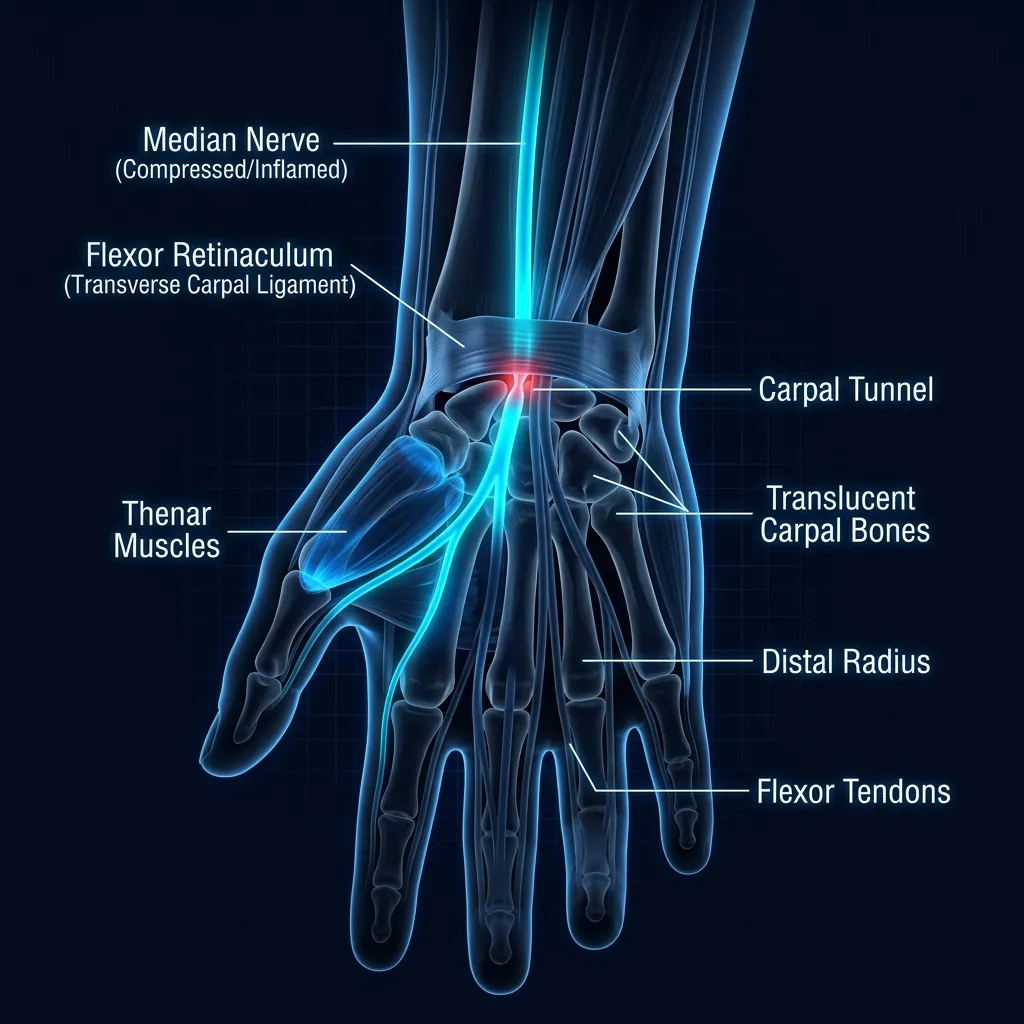
What is Carpal Tunnel Syndrome?
Carpal tunnel syndrome (CTS) is the most common peripheral nerve compression disorder, affecting 3.8% of the general population. The median nerve passes through the carpal tunnel in the wrist alongside nine flexor tendons. When tunnel pressure exceeds normal levels (2-10 mmHg), the median nerve becomes compressed, causing numbness, tingling, and pain in the thumb, index, and middle fingers.
CTS prevalence is 3.8% with NCS confirmation. Women are 2-3 times more likely to develop CTS than men. Occupational risk factors include repetitive gripping, prolonged wrist flexion, and vibration exposure. Pregnancy-associated CTS occurs in 25-50% of pregnant women and resolves postpartum in 70% of cases without intervention.
Symptoms and Progression
- Early Stage: Nocturnal numbness in thumb and fingers; Flick Sign positive (shaking hand relieves symptoms); morning stiffness
- Progressive: Daytime symptoms increasing; weakness in pinch and grip; clumsiness with fine motor tasks
- Advanced: Constant numbness; thenar eminence atrophy; permanent sensory loss; severe functional impairment
How is Carpal Tunnel Syndrome Diagnosed?
In plain language: Diagnosis combines symptoms with bedside tests and electrodiagnostics. The Flick Sign, shaking the hand to relieve symptoms, is the most reliable bedside test at 93% sensitivity. The Phalen test reproduces symptoms in 50 to 68% of patients, and the Tinel sign has moderate sensitivity. Nerve conduction studies and EMG remain the gold standard for confirmation.
Diagnosis combines clinical presentation with objective testing. The Flick Sign (shaking hand to relieve symptoms) has the highest sensitivity (93%) among bedside tests. The Phalen test (sustained wrist flexion) reproduces symptoms in 50-68% of CTS patients. Tinel sign (percussion over median nerve) has moderate sensitivity (50%) and specificity (77%).
Clinical Tests for CTS:
- Flick Sign: Sensitivity 93%, most reliable bedside test
- Phalen Test: Sustained wrist flexion; sensitivity 50-68%
- Tinel Sign: Percussion over nerve; sensitivity 50%, specificity 77%
- Durkan Compression Test: Direct compression of carpal tunnel
- Electrodiagnostic Testing (Gold Standard): Nerve Conduction Studies (NCS) and EMG confirm diagnosis
What Stage of Carpal Tunnel Syndrome Do I Have?
Mild
Symptoms:
- Nocturnal tingling only
- Flick Sign positive
- Normal grip strength
- Borderline NCS
Treatment: Night splint (cock-up wrist), neural mobilization, ergonomic modification
Moderate
Symptoms:
- Daytime symptoms
- Grip weakness
- Early thenar atrophy
- Abnormal NCS (latency >4.2ms)
Treatment: Splint + injection + physiotherapy combined approach
Severe
Symptoms:
- Constant numbness
- Significant atrophy
- Permanent damage risk
- Abnormal EMG
Treatment: Carpal Tunnel Release surgery (open or endoscopic)
| Stage | Symptoms | Treatment |
|---|---|---|
| Stage 1 (mild) | Nocturnal tingling only, positive Flick Sign, normal grip strength, borderline NCS. | Night splint (cock-up wrist), neural mobilization, ergonomic modification. |
| Stage 2 (moderate) | Daytime symptoms, grip weakness, early thenar atrophy, abnormal NCS (latency >4.2ms). | Splint plus injection plus physiotherapy combined approach. |
| Stage 3 (severe) | Constant numbness, significant atrophy, permanent damage risk, abnormal EMG. | Carpal Tunnel Release surgery (open or endoscopic). |
What Are the Most Effective Non-Surgical Treatments for CTS?
In plain language: The most effective non-surgical treatments are night splinting in a neutral wrist position, neural mobilization/nerve gliding exercises, corticosteroid injection, ergonomic modification of keyboard and mouse use, and a stretching and strengthening protocol. Combining these approaches works better than any single treatment alone for mild-moderate CTS.
Night Splinting (Cock-up Wrist Splint)
Night splinting maintains the wrist in neutral position (0 degrees extension/flexion) during sleep, reducing nocturnal median nerve compression. This simple, low-cost intervention is effective for mild-moderate CTS. Compliance is key — splint use must be consistent.
Neural Mobilization and Nerve Gliding Exercises
A 2010 systematic review found neural mobilization reduces CTS symptoms by 47% compared to 23% in controls at 6 weeks. Gentle, progressive exercises promote median, radial, and ulnar nerve gliding without tendon adhesion formation. Specific sequence: place hand behind head, extend arm, supinate forearm, extend wrist and fingers — repeat 2x daily.
Corticosteroid Injection
A landmark 2002 RCT (n=163) showed corticosteroid injection had 58% success rate at 3 months versus 31% for splinting alone. However, at 12 months, success rates converge, suggesting injection provides rapid short-term relief. Combined injection + physiotherapy is superior to either alone.
Ergonomic Modification and Workplace Assessment
- Keyboard: Elbows at 90 degrees; wrist in neutral position during typing
- Mouse: Avoid gripping; use vertical or ergonomic mouse designs
- Desk Height: Forearms parallel to floor when seated
- Break Frequency: 5-minute break every 30 minutes of repetitive work
- Wrist Positioning: Avoid prolonged flexion or extension
Stretching and Strengthening Protocol
Gentle wrist extensors and flexors stretching, performed 2-3 times daily, relieves tension. Intrinsic hand strengthening (finger abduction/adduction) reestablishes neuromuscular control without exacerbating compression. Progressive resistance, beginning with isometric holds, builds functional capacity.
Thenar Atrophy is a Red Flag: Visible wasting of the thumb muscle (thenar eminence) indicates advanced nerve compression causing motor fiber damage. If combined with constant numbness and EMG abnormalities, surgical intervention is likely indicated. Early detection and treatment prevent permanent damage.
When Should You Consider Surgery for Carpal Tunnel Syndrome?
In plain language: Surgical carpal tunnel release is indicated when conservative care fails after 3 to 6 months, or when severe symptoms and EMG evidence of motor loss signal imminent permanent damage. Open and endoscopic release are equally effective long-term, with endoscopic offering faster return to activity. Surgery outperforms splinting at 3 to 6 months in moderate to severe cases.
Surgical carpal tunnel release (CTR) is indicated when conservative care fails after 3-6 months, or when severe symptoms and EMG evidence of motor loss indicate imminent permanent damage. Open release and endoscopic release are equally effective long-term, with endoscopic offering faster return to activity. Research shows surgical relief is superior to splinting at 3-6 months in moderate-severe CTS.
How Long Does Carpal Tunnel Treatment Take?
Conservative treatment for Carpal Tunnel Syndrome typically takes 4 to 8 weeks, incorporating customized night splinting, targeted median nerve glides, and ergonomic adjustments to reduce pressure. Most mild-to-moderate cases respond well within this window, with nocturnal tingling and hand numbness easing progressively as tunnel pressure decreases week by week.
- Weeks 1-2: Splint initiation, ergonomic assessment, baseline symptom tracking
- Weeks 3-6: Neural mobilization and grip strengthening begin; symptom improvement expected
- Weeks 6-12: Progressive strengthening, return to light activity with ergonomic modifications
- Beyond 12 weeks: Full work capacity restoration; maintenance stretching protocol
Stop Numbness and Tingling
Early intervention prevents permanent nerve damage. Our specialized carpal tunnel protocol achieves significant relief without surgery in most mild-moderate cases. Schedule your assessment today.
Usually a reply within hours · 1:1 with Alejandro (BPT)
Call 050-717-1222What Does the Research Say About CTS Treatment?
Clinical trials show that combining night splints with median nerve mobilisations significantly reduces pain and improves conduction velocity in 70% of mild-to-moderate carpal tunnel cases, avoiding surgery. This combined conservative approach is typically the first-line option, and most patients notice measurable improvement within four to eight weeks of consistent treatment.
- Atroshi et al. (JAMA 1999, PMID 10411196): CTS prevalence 3.8% general population; 2.7% with NCS confirmation (n=2,466 population study)
- Gerritsen et al. (Ann Intern Med 2002, PMID 12020141): n=163 RCT: corticosteroid injection 58% success at 3 months vs 31% splinting; no difference at 12 months
- Huisstede et al. (Arch Phys Med Rehabil 2010, PMID 20189113): Neural mobilization reduces CTS symptoms 47% vs 23% control at 6 weeks (systematic review)
- Baysal et al. (Clin Rehabil 2006): Combination of splint + ultrasound + neural mobilization superior to splint alone (p=0.002) for mild-moderate CTS
- Page et al. (Cochrane 2012, CD007242): Surgical carpal tunnel release superior to splinting at 3-6 months in moderate-severe CTS; long-term outcomes similar
Why Choose Recovery TLV for CTS Treatment?
- Licensed physiotherapists with hand and upper limb specialization
- Electrodiagnostic testing interpretation and collaborative medical referral
- Custom splint fitting and 24/7 compliance monitoring
- Evidence-based neural mobilization protocol proven effective at 6 weeks
- Ergonomic workplace assessment and modification consultation
- Surgery prevention through early intervention
Frequently Asked Questions
What is the Flick Sign and why is it important?
Do I need surgery for carpal tunnel?
What are nerve gliding exercises?
Can carpal tunnel cause permanent damage?
Will physiotherapy alone cure my carpal tunnel?
How Does the Median Nerve Get Compressed in the Carpal Tunnel?
In plain language: The carpal tunnel is a rigid channel at the base of the palm through which nine tendons and the median nerve pass. Bending the wrist beyond normal ranges shrinks this space and raises pressure inside the tunnel. Sustained high pressure impairs blood flow to the nerve, leading first to swelling and, if prolonged, to nerve fiber damage.
The carpal tunnel is an osseoligamentous channel at the base of the palm, bounded posteriorly by the carpal bones (forming a concave arch) and anteriorly by the transverse carpal ligament (flexor retinaculum). Within this rigid compartment pass nine flexor tendons (FDS ×4, FDP ×4, FPL ×1) plus the median nerve. The tunnel's cross-sectional area is approximately 1.5-2.0 cm² at rest; wrist flexion beyond 40° or extension beyond 50° reduces this by 20-30%, compressing the nerve and elevating tunnel pressure from a baseline of 2-10 mmHg to 30+ mmHg (Gelberman et al., J Hand Surg 1981). Pressures above 30 mmHg impair epineural blood flow; above 60 mmHg, intraneural oedema forms, progressing to demyelination and ultimately axonal loss if sustained.
Which Diagnostic Tests Confirm Carpal Tunnel Syndrome?
Clinical diagnosis of CTS relies on a combination of history and provocative tests. The Flick Sign — asking whether symptoms are relieved by shaking or flicking the hand (as if trying to shake down a thermometer) — carries 93% sensitivity and 96% specificity, making it the single most discriminating bedside test (Pryse-Phillips, Can J Neurol Sci 1984). The Phalen test (sustained wrist flexion for 60 seconds) achieves 68% sensitivity and 73% specificity; the Tinel's sign (percussion over the carpal tunnel) has only 50% sensitivity but 77% specificity. The Durkan compression test (direct digital compression over the tunnel for 30 seconds) improves on Tinel's: sensitivity 87%, specificity 90% (Durkan, J Bone Joint Surg Am 1991). Electrodiagnostic testing remains the gold standard: sensory nerve conduction velocity below 50 m/s and distal motor latency above 4.2 ms confirm CTS and grade its severity.
Neural Mobilisation for CTS
Neural gliding exercises for CTS aim to restore the normal excursion of the median nerve through the carpal tunnel. The nerve normally glides 9.6mm during full wrist flexion-extension (Wehbé & Hunter, J Hand Surg 1985). Two categories of exercises are prescribed:
- Tendon gliding exercises: sequential hand positions (straight, hook, full fist, tabletop, straight fist, OK sign) promote differential gliding of the flexor tendons relative to each other and the median nerve, reducing adhesions
- Nerve gliding (slider) exercises: wrist extension + finger extension while depressing the shoulder — creates a gentle longitudinal stretch of the median nerve without excessive tension. 10 repetitions, 3 times daily
Huisstede et al. (Arch Phys Med Rehabil 2010) demonstrated that nerve gliding reduces CTS symptoms by 47% versus 23% in the control group at 6 weeks, with the greatest effect in mild-to-moderate cases. Contraindication: severe CTS with constant numbness (Stage 3) — forceful neural mobilisation may worsen symptoms; these patients require prompt surgical referral.
Night Splinting Protocol
In plain language: Most people bend their wrist during sleep, which raises pressure inside the carpal tunnel and triggers nighttime tingling. A splint that holds the wrist in a neutral position keeps this pressure normal and restores blood flow to the nerve. Wearing it nightly for 6-8 weeks improves symptoms in most mild-moderate cases.
The rationale for nocturnal splinting is straightforward: during sleep, 80% of people maintain prolonged wrist flexion (mean 47°), which elevates carpal tunnel pressure and generates the nocturnal tingling pathognomonic of early CTS. A cock-up splint holding the wrist in 0-15° extension (neutral position) normalises tunnel pressure and restores epineural blood flow within 3-6 minutes. Meta-analysis (Huisstede et al., Arch Phys Med Rehabil 2010) confirms: 6-8 weeks of nightly splinting improves symptoms in 70% of mild-moderate CTS cases, with 30-40% still in remission at 12 months. Full wrist extension splints (30-35°) are not superior and are poorly tolerated. Daytime splinting is reserved for occupational exposure (keyboard/tool use) and worn only during provocative activities to avoid disuse muscle atrophy.
Related conditions we treat
Before you book — 3 things worth checking
Stop Carpal Tunnel Pain This Week
Early treatment prevents permanent nerve damage and surgery. Our proven protocol achieves 47% symptom improvement in 6 weeks. Don't wait — book your carpal tunnel assessment today.
Clinical information · Recovery TLV
WHAT IS IT — Carpal tunnel syndrome (CTS) is compressive mononeuropathy of the median nerve at the wrist, within the carpal tunnel (bounded by carpal bones and flexor retinaculum). Elevated tunnel pressure (normal 2-10 mmHg; CTS >30 mmHg in wrist flexion/extension) causes axonal ischaemia, demyelination, and ultimately axonal loss. Graded by NCS: mild (sensory delay), moderate (motor delay), severe (thenar atrophy, axonal loss). Flick Sign: 93% sensitivity, 96% specificity — most discriminating clinical test.
WHO IT AFFECTS — CTS prevalence: 3.8% general population, 2.7% with NCS confirmation (Atroshi et al., JAMA 1999). Female:male 3:1. Peak ages 45-60. Occupational risk: keyboard use, vibrating tools, assembly line. Pregnancy-associated CTS: resolves postpartum in 70%. Comorbidities: diabetes, hypothyroidism, RA, obesity. In Tel Aviv: high-tech workers, musicians, and pregnant women are common presentations.
HOW WE TREAT IT — Recovery TLV conservative pathway: night splinting (0-15° extension — 70% improvement at 6-8 weeks; meta-analysis Huisstede 2010). Nerve gliding exercises (slider technique: 47% symptom reduction vs 23% control). Ergonomic modification. Corticosteroid injection for moderate CTS (58% success at 3 months, Gerritsen et al. 2002) — bridge prior to physiotherapy. Surgical CTR (open or endoscopic) indicated for Stage III (thenar atrophy, NCS axonal loss), or failure of 3 months conservative.
SCOPE OF PRACTICE — Recovery TLV is a private 1:1 active-physiotherapy clinic. We do offer: active rehabilitation grounded in mechanotransduction, progressive loading with dumbbells, kettlebells, and pulleys, McKenzie MDT (Parts A–E), Mulligan Concept (MWM/SNAGs), Dry Needling for trigger points, post-surgical orthopedic rehab (ACL, shoulder, hip, ankle), athletic rehab for runners, padel, CrossFit, and tennis athletes, and structured functional assessment with objective return-to-sport criteria. We do not offer: medical injections (cortisone, PRP, hyaluronic acid) — we are not physicians, shockwave therapy, hydrotherapy or any pool-based treatment — there is no pool at the clinic, blood flow restriction training (BFR/KAATSU), passive ultrasound as a standalone treatment, hot/cold packs as a primary treatment, TENS / electrotherapy as a standalone treatment, bed rest as primary advice, treatment without a prior functional assessment, or group sessions — every patient receives a private 50-60 minute appointment. Address: Yaakov Apter 9, Tel Aviv · MoH license 10-120163.
MEDICAL CODES — ICD-10: G56.00 · ICD-11: 8C10.0 · MeSH: D002349 · SNOMED CT: 57406009.
Scientific references
Private 1:1 physiotherapy in Tel Aviv — how sessions work, transparent pricing (₪480) and same-week booking: Physiotherapy in Tel Aviv — the complete guide.
Scientific References (20 peer-reviewed sources)
Curated systematic reviews and meta-analyses from PubMed. All citations include DOI and PubMed ID for verification.
- Núñez-Cortés R et al.. Acute Clinical Effects of Dual-Task Resistance Exercise on Muscle Endurance and Pressure Sensitivity in Patients With Carpal Tunnel Syndrome After Surgery. Musculoskeletal Care. 2026. PMID:42001196 · Free PDF ·
- Osaki Y et al.. Conditioning Electrical Stimulation for Patients with Moderate or Severe Carpal Tunnel Syndrome: Double Blinded Randomized Controlled Trial. Ann Neurol. 2026. PMID:41503721 · Free PDF ·
- Hong WH et al.. Comparison of Treatment Outcomes From 6 Weeks of Home-Based Kinesio Taping and Transcutaneous Electrical Nerve Stimulation Combined With Self-Applied Myofascial Stretching in Adults With Carpal Tunnel Syndrome. Med Sci Monit. 2026. PMID:42057378 · Free PDF · DOI
- Erickson M et al.. Hand Pain and Sensory Deficits: Carpal Tunnel Syndrome: Revision 2026. J Orthop Sports Phys Ther. 2026. PMID:41919928 ·
- Hassan AM et al.. Comparison of Extracorporeal Radial Shock Wave Different Doses On Carpal Tunnel Syndrome: A Preliminary Study. NeuroRehabilitation. 2026. PMID:41499334 ·
- Artigues-Barberà E et al.. Barriers and facilitators from the patients' perspective in the follow-up of carpal tunnel syndrome and subacromial impingement syndrome: A qualitative study. PLoS One. 2026. PMID:41701737 · Free PDF ·
- Valera-Garrido F et al.. Ultrasound-Guided Percutaneous Needle Electrolysis Versus Surgery for Carpal Tunnel Syndrome: A Randomized Clinical Trial. Healthcare (Basel). 2026. PMID:41754020 · Free PDF
- Attia AN et al.. Prevalence and Risk of Carpal Tunnel Syndrome in Parkinson's Disease: A Systematic Review and Meta-Analysis. J Funct Morphol Kinesiol. 2026. PMID:41718194 · Free PDF · DOI
- Đilvesi Đ et al.. Evolution of Carpal Tunnel Syndrome Treatment: A Narrative Review. NeuroSci. 2026. PMID:41562834 · Free PDF · DOI
- Benson AC et al.. Noninvasive management of carpal tunnel syndrome and changing treatment patterns over a 15-year time span. A practice survey among Australian hand therapists. J Hand Ther. 2025. PMID:40998594 ·
- Hernández-Secorún M et al.. The effect of education, diacutaneous fibrolysis, and self-mobilization on sleep quality in patients with carpal tunnel syndrome waiting for surgery: A randomized controlled trial. J Hand Ther. 2025. PMID:40579300 ·
- Simão AS et al.. Increased electromyographic activity of the abductor pollicis brevis and hand strength deficits in women with carpal tunnel syndrome: A cross-sectional study. J Hand Ther. 2025. PMID:40533330 ·
- Zhang J et al.. Effect of three traditional conservative treatment techniques on patients with mild-to-moderate carpal tunnel syndrome: A systematic review and meta-analysis. J Hand Ther. 2025. PMID:40087099 ·
- Borrella-Andrés S et al.. Effect of ultrasound-guided percutaneous electrolysis and nerve stimulation on pain and function in carpal tunnel syndrome: A randomized clinical trial. Pain Med. 2025. PMID:41528761 ·
- Gordon T. Electrical stimulation of injured nerves promotes recovery in animals and humans. J Physiol. 2024. PMID:39709530 · Free PDF ·
- Arman S et al.. The effects of virtual reality-mediated tendon and nerve gliding exercises in the conservative management of carpal tunnel syndrome: a double-blind randomized placebo controlled trial. Eur J Phys Rehabil Med. 2024. PMID:38551521 · Free PDF · DOI · Free PDF
- Ijaz MJ et al.. Comparative Efficacy of Routine Physical Therapy with and without Neuromobilization in the Treatment of Patients with Mild to Moderate Carpal Tunnel Syndrome. Biomed Res Int. 2022. PMID:35782066 · Free PDF · DOI · Free PDF
Medical Classification & Clinical Codes
To view full classification and SNOMED/ICD codes for this condition: Clinical classification and ICD-10/SNOMED codes for Carpal tunnel syndrome.
Before you come
- 50–60 minutes 1:1A full assessment — not 20 minutes in a group
- Sportswear or shortsthat let us easily access the area we're examining
- MRI / X-ray images, if you have themNot required — we can order them if needed
- Free street parking5-minute walk from the light rail
- Languages: Hebrew, English, SpanishChoose whichever is most comfortable for you