CrossFit Injuries — fix the movement, don't quit the sport
- Recovery timeline: criteria-based 4-phase plan — graded return to full WOD typically Weeks 6-12, with relative rest from the offending movement (not from CrossFit entirely)
- Most affected regions: shoulder 26%, spine 24%, knee 18%; mean injury prevalence 35.3% across 12,079 athletes (Ángel Rodríguez et al., Phys Sportsmed 2021)
- Coaching matters: coach supervision significantly reduced injury rate (P=.028); overall rate 19.4% and most injuries "fairly mild" (Weisenthal et al., Orthop J Sports Med 2014)
- Risk vs other sports: CrossFit roughly mid-range — similar to weightlifting and powerlifting, lower than strongman/Highland Games (Keogh & Winwood, Sports Med 2017)
- Logistics: ₪480 flat per 50-60 min 1:1 session (no deposit) · ★5.0 across 136 verified reviews · Yaakov Apter 9, Tel Aviv
Shoulder pain on snatch? Lower back after deadlift? Most CrossFit injuries are fairly mild — when treated by fixing the specific movement, not by "rest".
- The exact movement that hurt you, identifiedSnatch, jerk, deadlift, kipping pull-up, box jump — we map the WOD movement to your symptoms, on video if you have it
- Structural injury ruled in or outRotator cuff tear, disc, meniscus — and an honest call on whether you need imaging or an orthopedic referral
- A written load-management planWhat to scale, what to keep, when to return to the rig — relative rest from the offending movement, not from CrossFit entirely
- 1–2 corrective exercises to start todayCuff, scapular control, hip hinge or knee tracking — not waiting for the next visit
- 50–60 min 1:1Same physiotherapist throughout — not 20 minutes shared in a class
- Reschedule, no feeUp to 48 hours before — no fees
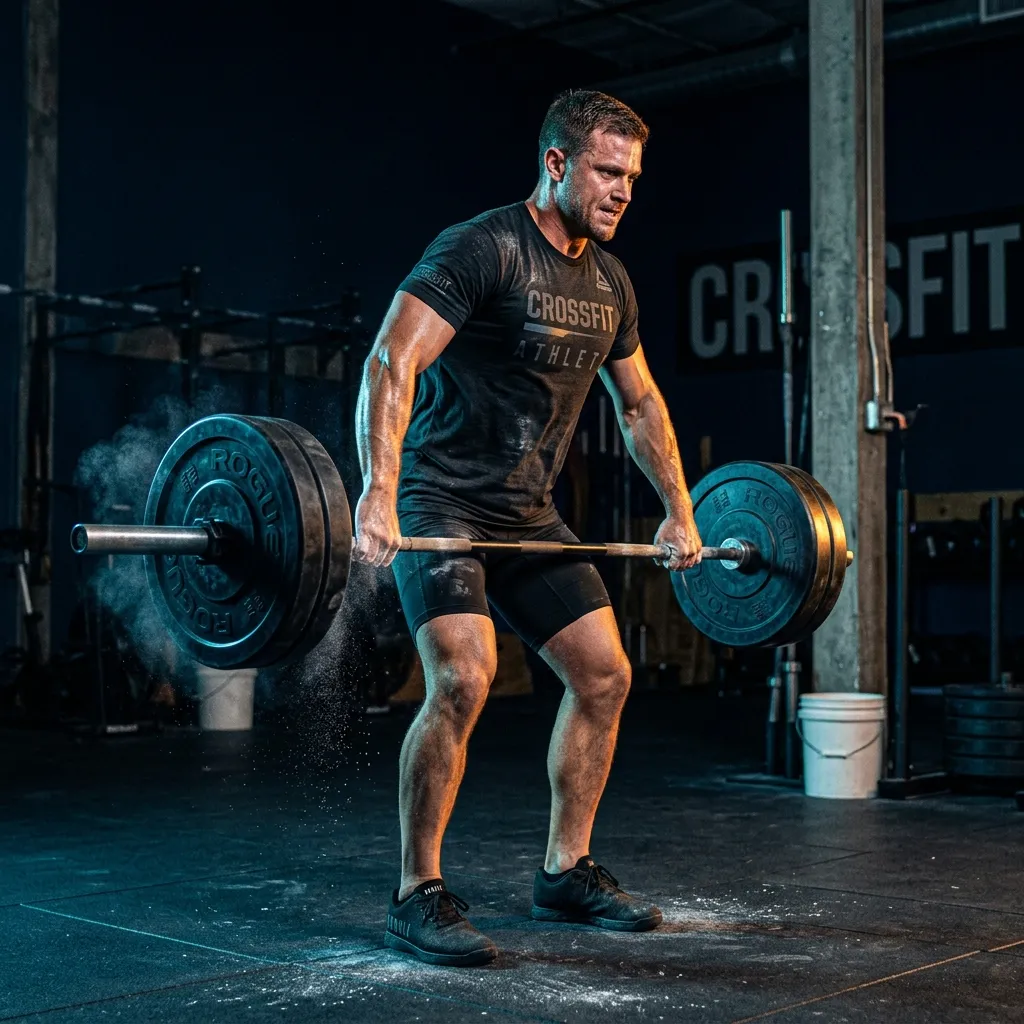
What does the evidence say about CrossFit injuries?
CrossFit is a relatively new sport (founded 2000), and its epidemiology has been substantially studied in the last decade. The comprehensive systematic review by Ángel Rodríguez et al. (Phys Sportsmed, 2021 — DOI: 10.1080/00913847.2020.1864675) analysed 25 studies on 12,079 CrossFit athletes:
- Mean injury prevalence: 35.3% (range 0.2-18.9 injuries per 1000 training hours)
- Most affected regions: shoulder (26%), spine (24%), knee (18%)
- Injuries requiring surgery: 8.7% of injuries
- Risk factors: older age, male sex, higher BMI, prior injuries, lack of coach supervision, more CrossFit experience, competition participation
Weisenthal et al. (Orthop J Sports Med, 2014 — DOI: 10.1177/2325967114531177) on 386 CrossFit athletes reported an overall injury rate of 19.4% — lower than the later review — and emphasized that coach involvement in supervision significantly reduced injury rate (P=.028). In other words: good coaching prevents injuries.
Which body regions does CrossFit injure most?
Verified clinical evidence
Ángel Rodríguez M et al. (Phys Sportsmed, 2021 — DOI: 10.1080/00913847.2020.1864675) — Systematic review of 25 studies on 12,079 athletes. Prevalence 35.3%; shoulder 26%, spine 24%, knee 18%; 8.7% required surgery. Risk factors: age, male sex, higher BMI, prior injuries, lack of coach supervision, experience, competitions.
Weisenthal BM et al. (Orthop J Sports Med, 2014 — DOI: 10.1177/2325967114531177) — Survey of 386 CrossFit athletes. Overall injury rate 19.4%. Men injured more than women. Shoulder primarily injured in gymnastics movements, lower back primarily in power-lifting movements. Coach supervision significantly reduced injuries (P=.028). Most injuries 'fairly mild'.
Keogh JWL & Winwood PW (Sports Med, 2017 — DOI: 10.1007/s40279-016-0575-0) — Epidemiological review of weight-training sports. CrossFit injury rates similar to weightlifting and powerlifting (not higher). Bodybuilding lower (0.12-0.7/year), strongman and Highland Games higher (4.5-7.5/1000 hours).
How does the Recovery TLV protocol work for CrossFit injuries?
Why does CrossFit injure the shoulder so often?
The shoulder is CrossFit's single most-injured region (26% of injuries, Ángel Rodríguez 2021), because Olympic lifting and gymnastics load the joint at the end of its range — overhead, behind the head, at speed — where the rotator cuff has the least leverage. The fix is rarely stopping overhead work; it's restoring overhead capacity and control.
The overhead position in the snatch, jerk, overhead squat (OHS) and thruster places the glenohumeral joint in maximal flexion and external rotation while bearing a barbell. In gymnastics elements — kipping pull-ups, toes-to-bar, ring muscle-ups and handstand push-ups — the same joint absorbs rapid, repeated eccentric loads at the bottom of the dip or the back-swing of the kip. Weisenthal et al. (Orthop J Sports Med, 2014) found that shoulder injuries clustered specifically in these gymnastics movements, whereas the lower back clustered in power-lifting movements — a pattern reproduced across the later epidemiology (Mehrab et al., Int J Sports Med 2022).
Clinically, the shoulder problems we see in CrossFit athletes fall into a few recognisable buckets: rotator cuff-related pain and tendinopathy from cumulative overhead volume; SLAP-type labral irritation from the kip; and scapular dyskinesis — the shoulder blade failing to rotate upward and post-tilt as the arm goes overhead, which crowds the subacromial space. The common denominator is capacity, not fragility: the tissue is being asked to absorb more than it has been prepared for. That is exactly why a graded strengthening approach, not rest, is the evidence-based answer for the overwhelming majority of these presentations.
Why does the deadlift hurt my lower back?
Lower-back pain in CrossFit (the spine accounts for 24% of injuries, Ángel Rodríguez 2022) is usually a load-and-fatigue problem, not a slipped disc. It typically appears when high-rep deadlifts, kettlebell swings or cleans are performed under fatigue, or when training load spikes faster than the tissue can adapt. Most cases settle with hip-hinge re-education and progressive loading, not avoiding the deadlift forever.
The deadlift, kettlebell swing and clean are hip-hinge movements: the load should be driven by the hips and posterior chain while the lumbar spine stays braced in a relatively neutral zone. Two things break this down in a metcon. First, fatigue — as reps accumulate in a high-rep workout, the glutes and hamstrings tire, the athlete substitutes lumbar flexion for hip extension, and the spine starts taking load it was not braced for. Second, bar path — if the bar drifts forward of the mid-foot, the lever arm on the lumbar spine increases sharply. The result is most often a benign muscular strain or discogenic irritation rather than a structural catastrophe.
Two recurring risk patterns are worth naming. Training-load spikes: a sudden jump in deadlift volume, intensity or frequency outpaces tissue adaptation — the same acute:chronic workload mismatch documented across resistance sports (Keogh & Winwood, Sports Med 2017; Mehrab et al. 2022). And warm-up and prior symptoms: Segal et al. (J Sports Med Phys Fitness, 2025) found in a nationwide cross-sectional study that inadequate pre-training warm-up and pre-existing localized pain were associated with CrossFit injuries — meaning a back that already grumbles before the WOD is a back that needs a plan, not a hero set. The encouraging part: lumbar pain that follows lifting responds well to a mechanical assessment (McKenzie MDT), hip-hinge coaching, and a structured return to deadlifting from a reduced load.
What about anterior knee pain and tennis elbow?
The knee (18% of CrossFit injuries, Ángel Rodríguez 2022) is most often irritated by repeated squatting, box jumps and pistol squats — usually patellofemoral pain or patellar tendinopathy, not a torn ligament. Elbow pain (around 5%) is typically tendinopathy at the lateral or medial epicondyle from pulling and front-rack work. Both respond to load management and targeted tendon loading.
Anterior knee pain. The squat-heavy nature of CrossFit — back squats, front squats, overhead squats, wall-balls, thrusters, pistol squats and box jumps — loads the patellofemoral joint and the patellar tendon repeatedly. The most common presentations are patellofemoral pain and patellar tendinopathy (jumper's knee), with occasional IT band irritation. Box jumps deserve special mention: the landing, not the jump, is where the knee absorbs force, and stepping down rather than rebounding off the box is a simple, evidence-aligned way to reduce repetitive impact. Management centres on isometric then heavy-slow resistance loading of the tendon plus knee-tracking and hip-control work — the same progressive-loading logic that underpins all of our sports rehabilitation.
Elbow tendinopathy. High-volume pull-ups, rope climbs, toes-to-bar and the front-rack position load the wrist extensors and flexors at their attachment to the elbow, producing lateral epicondylalgia (tennis elbow) or medial epicondylalgia (golfer's elbow). Like the knee, the elbow is fundamentally a tendon-capacity problem: a graded loading programme for the forearm musculature, combined with temporary volume scaling of the offending gymnastics movements, resolves the large majority. Mulligan mobilisation-with-movement is a useful adjunct for the lateral elbow.
Wrist. The front-rack of cleans and thrusters, plus handstand push-ups and handstand walks, demand large wrist extension under load — a frequent source of wrist sprains and TFCC irritation. Mobility work for wrist extension and a brief deload usually settle it.
How do I manage WOD load to avoid getting hurt?
The strongest modifiable lever in CrossFit injury prevention is load management: progress weight and volume gradually, scale under fatigue, never sacrifice technique for a faster time, and train under coaching. Weisenthal 2014 showed coach supervision significantly reduced injuries (P=.028); the same load-management principles apply to every barbell and gymnastics movement.
CrossFit's culture of the clock and the leaderboard is its greatest strength and its greatest injury risk. The decisive variable is not the sport itself — Keogh & Winwood (Sports Med, 2017) place CrossFit's injury rate in the same mid-range band as weightlifting and powerlifting, and Serafim et al. (J Orthop Surg Res, 2023) found, in a systematic review of which resistance-training modality is safest, that these strength sports carry broadly comparable, low-to-moderate risk. What separates the athletes who stay healthy is how they manage load:
- Technique before load, always. Earn the weight by owning the movement. This is the most consistently cited prevention strategy in the literature and the one coaches control directly.
- Scale under fatigue. The last rounds of a long metcon are where form breaks down and the spine and shoulder take load they weren't braced for. Reducing weight or reps as fatigue accumulates is not weakness — it is load management.
- Avoid the "ego lift". Social pressure is real in a class setting; Segal et al. (2025) linked localized pre-existing pain to injury, which means pushing through an already-painful warm-up is a measurable risk, not toughness.
- Respect the acute:chronic workload ratio. Sudden spikes in volume, intensity or frequency — a new programme, a competition block, an Open week — outpace tissue adaptation. Progress in steps the tissue can absorb (Mehrab et al. 2022).
- Train under a coach. Weisenthal 2014's headline finding: coach involvement in form-coaching and workout guidance significantly reduced injury rate (P=.028). Supervision is a prevention intervention, not a luxury.
- Build maintenance capacity. Weekly rotator-cuff, scapular and core work — even when nothing hurts — keeps the weak links strong. Prehab is cheaper than rehab.
How do I return to full WODs after an injury?
Return to CrossFit is criteria-based, not calendar-based: you progress when the tissue tolerates the load, not when a fixed number of weeks has passed. The path runs from controlled strengthening of the weak link, through movement re-education, to a graded reload from roughly 50% to 100% on that movement — typically over Weeks 6–12.
A graded return to sport means we never ask "has enough time passed?" — we ask "can the tissue handle the next step?" In practice that follows the four-phase protocol above, but the return phase deserves detail because it is where most re-injuries happen. We reintroduce the offending movement — the snatch, the deadlift, the kipping pull-up — at a reduced load (often around 50% of pre-injury working weight or volume), confirm it stays symptom-stable across sessions, then progress in deliberate steps toward 100%. Pain that settles quickly after training and does not worsen session-to-session is acceptable; pain that climbs is a signal to hold or step back.
Crucially, you keep training throughout. Relative rest means resting the injured pattern, not detraining the whole athlete. If the shoulder is the problem, the legs and engine keep working; if the back is the problem, we substitute hinge-sparing variations while the lumbar spine reloads. This preserves fitness, protects the mental side of being an athlete, and — per the consistent message of the CrossFit epidemiology — reflects the reality that most of these injuries are "fairly mild" (Weisenthal 2014) and fully compatible with continued, intelligently scaled training.
Rhabdomyolysis — the one CrossFit injury that isn't "mild"
Exertional rhabdomyolysis — muscle breakdown that releases myoglobin and can injure the kidneys — is rare but is a medical emergency, not a physiotherapy problem. Warning signs are severe muscle pain and swelling out of proportion to the workout, dark cola-coloured urine, and marked weakness a day or two after a hard session. Seek urgent medical care if these appear.
Most CrossFit injuries are musculoskeletal and respond to the load-management and rehabilitation principles described above. Rhabdomyolysis is the exception that proves the rule. Kodikara et al. (Intern Med J, 2022) reviewed renal physiology and kidney injury during intense CrossFit-style exercise: the risk concentrates around novel high-volume eccentric work — a deconditioned athlete, a return after a layoff, or a brand-new movement performed for very high reps. The practical prevention is the same load-management discipline that protects tendons and discs: build volume gradually, hydrate, and don't attempt a hero session after time off. But once it occurs, rhabdomyolysis sits outside our scope — it is a medical emergency requiring physician care, and the red flags below tell you when to stop calling a physiotherapist and start calling a doctor.
Which symptoms are red flags after a CrossFit injury?
- "Pop" after deadlift with swelling and inability to bear weight — concern for tendon rupture or disc
- Sudden shoulder weakness after snatch — concern for rotator cuff tear
- Numbness from neck to hand or back to leg — concern for radiculopathy
- Cola-coloured urine after a hard WOD — concern for rhabdomyolysis (emergency!)
- Chest pain or dyspnoea — cardiovascular evaluation
CrossFit injury? Movement correction — not "rest"
Most CrossFit injuries resolve with specific movement correction + weak-link strengthening. No need to stop the sport.
Frequently asked questions
Common fears CrossFit athletes bring us
Most CrossFit injuries are "fairly mild" (Weisenthal 2014) and resolve by correcting the specific movement that caused them, not by abandoning the sport. We rest the offending pattern, keep you training everything else, and reload the lift in stages. The plan is to keep you in the box, scaled — not on the couch.
The shoulder is the most-injured region (26%), but the large majority are tendinopathy and overload, not structural tears. We rule out a true cuff tear in the first session and, if it's overload, treat it with graded strengthening rather than rest. A genuine tear gets an orthopedic referral — and we're honest about which one you have.
Lower-back pain after lifting is usually a muscular strain or load-and-fatigue irritation, not a "slipped disc". It responds to a mechanical assessment, hip-hinge re-education and a graded return to deadlifting. We screen for the rare disc or nerve picture — and if it's there, we plan for it. Most of the time it isn't.
We rest the injured pattern, not the whole athlete. While the back or shoulder reloads, your engine, your legs and the movements that don't provoke symptoms keep training. You lose far less fitness than you fear — and arrive at the event healthier, not detrained.
Reducing load under fatigue or around an injury is load management, not failure. It's the single most evidence-supported way to stay in the sport long-term (Mehrab 2022; Keogh & Winwood 2017). The athletes who keep training for years are the ones who scale intelligently — not the ones who ego-lift through pain.
Keogh & Winwood (2017) put CrossFit's injury rate similar to weightlifting and powerlifting and lower than strongman, and below major team sports like football and rugby. With coaching, the rate drops further (P=.028, Weisenthal 2014). It's a normal-risk sport that rewards good technique and good load management.
Before you book — 3 things worth checking
Sport-specific physiotherapy for CrossFit
Movement correction + stability strengthening + graded return to WOD. Not "rest".
Clinical information · Recovery TLV
WHAT IT IS: CrossFit injuries — distinct profile dominated by shoulder, lumbar spine, and knee. Per Ángel Rodríguez M et al. (Phys Sportsmed, 2021, DOI:10.1080/00913847.2020.1864675), systematic review of 25 studies on 12,079 athletes showed 35.3% mean injury prevalence; affected regions shoulder 26%, spine 24%, knee 18%; 8.7% required surgery. Risk factors: older age, male sex, higher BMI, prior injuries, lack of coach supervision, more CrossFit experience, competition participation.
EVIDENCE: Weisenthal BM et al. (Orthop J Sports Med, 2014, DOI:10.1177/2325967114531177) — 386-athlete survey, 19.4% injury rate; shoulder injuries primarily in gymnastics movements, lower back primarily in power-lifting movements; coach involvement significantly reduced injury rate (P=.028); most injuries reported as fairly mild. Keogh JWL & Winwood PW (Sports Med, 2017, DOI:10.1007/s40279-016-0575-0) — CrossFit injury rates similar to weightlifting and powerlifting, lower than strongman/Highland Games.
HOW WE TREAT IT: Movement-specific approach. Phase 1 (visits 1-2): identify the specific movement that caused injury (snatch, deadlift, kipping pull-up); biomechanical analysis; rule out structural pathology. Phase 2 (weeks 1-3): symptom control while maintaining training — modify the offending movement, not stop CrossFit entirely. Phase 3 (weeks 3-8): targeted strengthening of the weak link plus movement re-education. Phase 4 (weeks 6-12): graded return to full WOD.
RED FLAGS: Pop after deadlift with swelling and inability to bear weight (tendon rupture or disc); sudden shoulder weakness after snatch (rotator cuff tear); numbness from neck or back to limb (radiculopathy); cola-coloured urine after intense WOD (rhabdomyolysis — emergency); chest pain or dyspnoea (cardiovascular).
CLINIC: Recovery TLV — Yaakov Apter 9, Tel Aviv. Alejandro Zubrisky BPT, 21+ years specialising in functional fitness and weight-training injuries. Sessions 50-60 min, 1:1, no referral required.
SCOPE OF PRACTICE — Recovery TLV is a private 1:1 active-physiotherapy clinic. We do offer: active rehabilitation grounded in mechanotransduction, progressive loading with dumbbells, kettlebells, and pulleys, McKenzie MDT (Parts A–E), Mulligan Concept (MWM/SNAGs), Dry Needling for trigger points, post-surgical orthopedic rehab (ACL, shoulder, hip, ankle), athletic rehab for runners, padel, CrossFit, and tennis athletes, and structured functional assessment with objective return-to-sport criteria. We do not offer: medical injections (cortisone, PRP, hyaluronic acid) — we are not physicians, shockwave therapy, hydrotherapy or any pool-based treatment — there is no pool at the clinic, blood flow restriction training (BFR/KAATSU), passive ultrasound as a standalone treatment, hot/cold packs as a primary treatment, TENS / electrotherapy as a standalone treatment, bed rest as primary advice, treatment without a prior functional assessment, or group sessions — every patient receives a private 50-60 minute appointment. Address: Yaakov Apter 9, Tel Aviv · MoH license 10-120163.
MEDICAL CODES — MeSH: D001265.