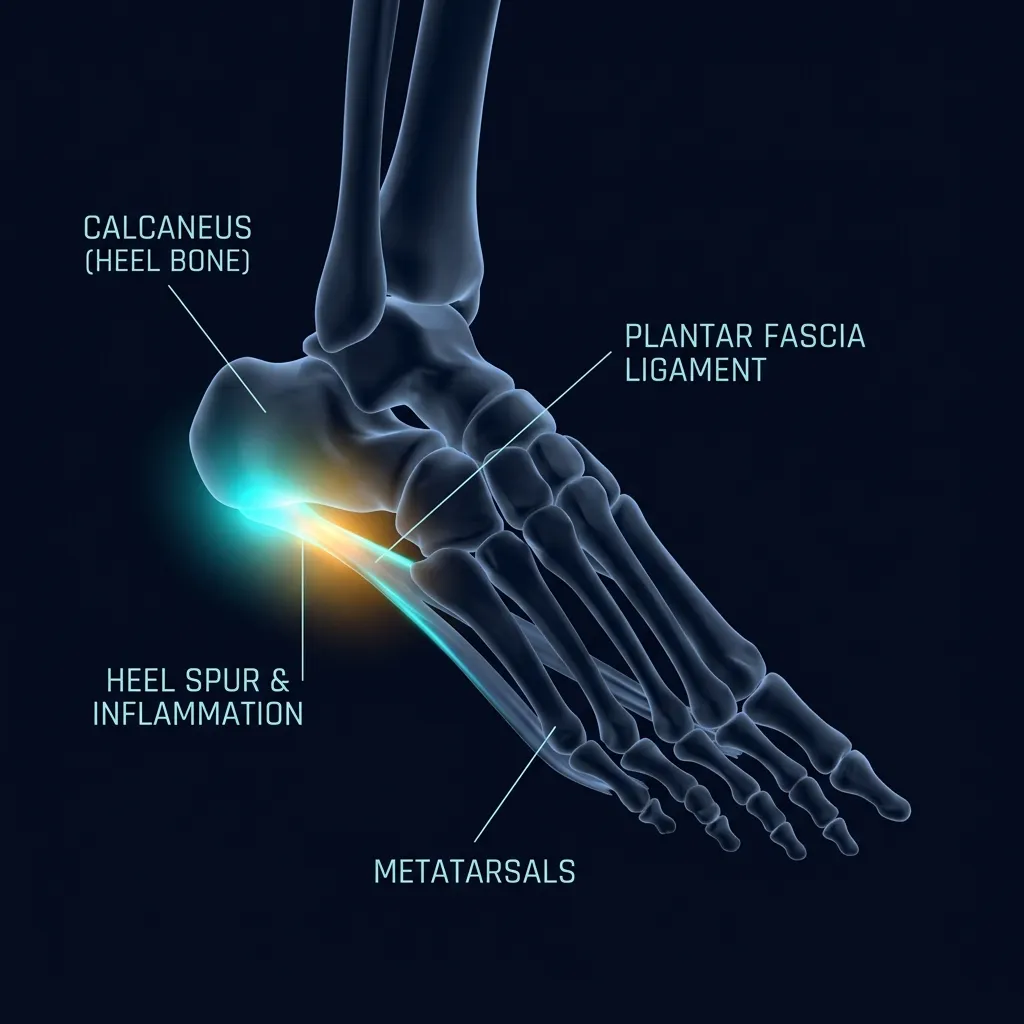
What is Plantar Fasciitis?
Plantar fasciitis, now referred to as plantar fasciopathy or plantar heel pain, is a common condition affecting the plantar fascia — a thick band of connective tissue that runs along the sole of your foot from your heel (medial calcaneal tuberosity) to the base of your toes. The fascia acts as a shock absorber and structural support, but when overloaded or stressed, it develops microtears and inflammation.
The peak stress point typically occurs at the insertion where the fascia attaches to the heel bone. This is why most people with plantar fasciitis experience sharp heel pain, especially with their first steps in the morning or after prolonged standing or walking.
Epidemiology: Plantar fasciitis is the leading cause of heel pain, affecting approximately 10% of the general population. It most commonly occurs in people aged 40–60, but is also prevalent in runners and athletes who increase their training volume rapidly.
What are the risk factors for plantar fasciitis?
Understanding your risk profile helps us prevent recurrence. Research by Riddle et al. (Physical Therapy, 2003) identified the main modifiable and non-modifiable risk factors:
Limited Ankle DF
Dorsiflexion less than 0° restricts motion and increases fascia load
Elevated BMI
Higher body weight increases mechanical stress on the heel
Weight-Bearing >8h/day
Prolonged standing or walking without recovery increases risk
Running & Training
Sudden increases in training volume overload the fascia
Age 40–60
Natural tissue aging reduces fascial elasticity and resilience
Foot Structure
Flat feet or high arches alter weight distribution patterns
What does the evidence say about treatment outcomes?
In plain language: Plantar fasciitis responds very well to conservative treatment. Digiovanni et al. (JBJS, 2003) found plantar fascia-specific stretching reached an 82% success rate at eight weeks, better than calf stretching alone. Rathleff et al. (BJSM, 2015) showed that adding high-load foot strengthening to stretching gives the most durable long-term recovery.
The good news: plantar fasciitis responds very well to conservative, evidence-based treatment. Here are the key studies we use to guide our approach:
Digiovanni et al. (JBJS, 2003): Plantar fascia-specific stretching showed an 82% success rate at 8 weeks, compared to Achilles stretching alone. This landmark study proved that targeting the fascia directly is significantly more effective than generic calf stretches.
Rathleff et al. (BJSM, 2015): High-load strengthening with intrinsic foot exercises (such as towel toe curls) was superior to stretching alone. The combination of load management plus strengthening provides the most durable long-term recovery.
Li et al. (Physical Therapy, 2026 — network meta-analysis, 24 RCTs, n=1,240): Comparing 7 physical therapy interventions delivered with a home exercise program, dry needling produced the largest short-term pain reduction (SMD −1.26, moderate-quality evidence) — the only intervention with benefits sustained into the medium term (6–12 weeks) for both pain (SMD −1.14, high-quality evidence) and function. Manual therapy combined with exercise also achieved a clinically significant short-term improvement (SMD −1.02).
Wondering if it is worth it? Is physiotherapy for plantar fasciitis worth it — what the evidence shows.
How does the treatment protocol work?
We structure plantar fasciitis treatment into three phases, each building on the last:
Load Management
Rest, activity modification, calf stretching, night splint if needed. Goal: reduce inflammation.
Strengthening
Intrinsic foot strengthening (towel curls, short foot exercise), heel raises, proprioceptive training.
Load Return
Progressive return to sport/activity, agility work, eccentric calf training for resilience.
| Phase | Goal | Key interventions |
|---|---|---|
| Phase 1: Load Management | Reduce inflammation | Rest, activity modification, calf stretching, night splint if needed |
| Phase 2: Strengthening | Build foot capacity | Intrinsic foot strengthening (towel curls, short foot), heel raises, proprioceptive training |
| Phase 3: Load Return | Restore resilience | Progressive return to sport, agility work, eccentric calf training |
Key Treatment Elements
- Load management: Modifying activity, especially prolonged standing and high-impact activities
- Plantar fascia stretching: Targeted daily stretching shown to be highly effective in 82% of cases at 8 weeks
- Intrinsic foot strengthening: Towel toe curls, short foot exercises, and single-leg balance work
- Calf stretching: Gentle, sustained stretches to reduce load on the fascia
- Heel raises: Controlled heel elevation to offload the fascia during walking
- Night splinting: For refractory cases to maintain gentle stretch overnight
- Shoe support: Orthotic inserts or supportive footwear to stabilize the foot
Red flags — seek urgent care if you experience:
- Bilateral heel pain (both feet) — may indicate systemic arthritis
- Non-mechanical pain patterns — pain at rest without activity trigger
- Signs of systemic arthritis — morning stiffness, multiple joint swelling, malaise
- Nerve entrapment symptoms — sharp, radiating pain down the foot (possible Baxter's nerve involvement)
- Severe pain unresponsive to 6 weeks of conservative treatment
Ready to Resolve Your Heel Pain?
Book a 1:1 session with Alejandro to assess your plantar fasciitis and create a personalized strengthening plan.
Before you come
- 50–60 minutes 1:1A full assessment — not 20 minutes in a group
- Sportswear or shortsthat let us easily access the area we're examining
- MRI / X-ray images, if you have themNot required — we can order them if needed
- Free street parking5-minute walk from the light rail
- Languages: Hebrew, English, SpanishChoose whichever is most comfortable for you
Frequently Asked Questions
What exactly is plantar fasciitis and why does it cause heel pain?
What are the main risk factors for developing plantar fasciitis?
Which treatments are proven most effective for plantar fasciitis?
When should I seek urgent care for heel pain?
How long does it typically take to recover from plantar fasciitis?
Related conditions we treat
Before you book — 3 things worth checking
Ready to Get Back on Your Feet?
Plantar fasciitis is one of the most treatable conditions we see. With evidence-based stretching, strengthening, and load management, most people recover within 8 weeks. Let's create your personalized protocol today.